Showing posts with label history of science. Show all posts

29 January, 2009

On Neologism, Part One

The Scottish physician Thomas Short, at the end of a parenthesis on diseases, in the middle of a long footnote, extending over several pages through a discussion of chalybeate waters, from his 1734 Natural, Experimental, and Medicinal History of the Mineral Waters of Derbyshire, Lincolnshire, and Yorkshire, writes with a twinkle:
The Causes we assign for these Diseases, we have borrowed from the ancient Egyptian Hieroglyphicks, as the incoercible Flatus, culinary Digestion, Evestrum vitae, Peroledi, Archeus, Gas, Blas, Deulock, &c. which we discourse of as distinct intelligent Beings in the human Body. These are things beyond the Ken of the present Age.—
It is a rare moment of linguistic fantasia in an otherwise unremarkable text: a series of lexical gobbets from the natural science of Paracelsus and Van Helmont, via his immediate source, William Simpson's Hydrologia Chymica (1669). Of all these charming arcanisms, only one has made it into popular currency, almost invisible in the cloud surrounding it here: gas. Of the others, only one, blas, has survived at all—revived a month ago, for instance, in the languagey sectors of the internet—thanks to a freak citation in the OED, handily cross-referenced in the etymology awarded its more famous twin: 'Van H. also invented the term BLAS'; although the OED's entry for blas rather bizarrely pairs it with an unrelated bit of Middle English dialect (sense 1), offering for sense 2 only, 'Van Helmont's term for a supposed ‘flatus’ or influence of the stars, producing changes of weather.' The OED clearly assumes no readers will come to blas except by way of gas: for while the latter entry clarifies which Van Helmont, the former does not. All the citations for blas, the phantom word, are Helmontian, except the last, a reference to Whitney's seminal Life and Growth of Language (1875). This is cited without quotation; but for you, reader:
Of the out-and-out invention of new words, language in the course of its recorded history. . . presents only rare examples. Sometimes, however, a case occurs like that of gas, already noticed as having been devised by an ancient chemist, as artificial appellation for a condition of existence of matter which had not before been so distinctly apprehended as to seem to require a name. Along with it, he proposed blas for that property of the heavenly bodies whereby they regulate the changes of time: this, however, was too purely fanciful to recommend itself to general use, and it dropped out of sight and was forgotten, while the other came to honor.
The full text of Life and Growth is online, although one word seems to have puzzled the OCR: that word, of course, being blas, which it renders Mas. So the OED defines blas as an influence of the stars on the weather, and Whitney, the old American windbag, defines it as an astral property that regulates time.
Stellae sunt nobis in signa, tempora, dies, & annos. Ergo patrant temporum mutationes, tempestates, atque vicissitudines. Quorsum opus habent duplici motu, locali scilicet, & alterativo. Utrumque autem, novo nomine Blas significo. . . Blas motivum stellarum, est virtus pulsiva, ratione itineris, per loca et secundum aspectus.

The stars for us are as signs, tempora, days and years. Therefore they effect the changes, tempestates and vicissitudes of the tempora. For this they require a double motion, that is locomotive and alterative. Both, however, I signify with the new name 'Blas'. . . Blas, the movement of the stars, is a propulsive power, by reason of their journey through places and according to their aspects.
The problem comes in the definitions of tempus and tempestas, which can mean time, season, occasion and weather. Either way, the Helmontian stars play a role in the astrological mechanism of the universe, which was wholly within the regular laws of natural science. Now the interesting question is: why has the OED preserved blas? Sure, it makes a nice rhyming twin with gas, and, as in Whitney, the two nicely illustrate the divergent possibilities of two initial bedfellows, a lexical version of Hawking radiation. That was the Liberman angle: 'it's too bad that 18th-century chemists couldn't find any real substance to which the reference of blas could be transferred, as the reference of gas was'.

But blas has no real substance as an English word: it exists in the penumbra of the lexicon, teasing us as a little jewel of potential meaning, but never so well-defined (time or weather? 'Both I signify. . .'), and never, more importantly, a true element in the inter-referential web of the vocabulary. It has no interaction with its fellows, except gas. It was only ever a parody of a word.

See, if not blas, why not peroledi or peroledes? For this is another Helmontism:
Habet ergo aer suos, non minus quam terra, fundos, quos Adepti vocant Peroledos. Invisibile itaque Gas, variis aeris stratis hospitatur, si aquae sua sint barathra, suae voragines, suae portae sunt in Peroledis, quas periti Cataractas Coeli, & valvas dixere.

Therefore the air, no less than the earth, has its own grounds, which the adepts call 'Peroledi'. Thus the invisible Gas is a guest in the various layers of the air, if the waters have their abysses, their chasms, so its own gates are in the Peroledi, which the experts call the sluices and folding-doors of heaven.
Oh, you want it in period English? It's only Margaret Cavendish, the second most famous English writeress of the seventeenth century, in a Philosophical Letter:
But rather then your Author [Van Helmont] will consent to the transchanging of Water into Air, he will feign several grounds, soils or pavements in the Air, which he calls Peroledes, and so many Flood-gates and Folding-dores, and make the Planets their Key-keepers; which are pretty Fancies, but not able to prove any thing in Natural Philosophy.
Is it purely in deference to the cute historical narrative of gas and blas that the OED likes blas and not peroledes? And why is it so much less generous to Van Helmont than to Paracelsus, who is awarded several neologisms in the dictionary? (In addition to the uncontroversial gnome and nostoc, Paracelsus gets archeus too, with a wholly unsatisfactory etymology section.) What are the criteria for formal recognition in the lexicon? What does it take to be a word?

[Part Two here.]

11 November, 2008

Wine and Water

When one cup in fell confusion
Wine with water blends, the fusion,
Call it by what name you will,
Is no blessing, nor deserveth
Any praise, but rather serveth
For the emblem of all ill.

Wine perceives the water present,
And with pain exclaims, "What peasant
Dared to mingle thee with me?
Rise, go forth, get out, and leave me!
In the same place, here to grieve me,
Thou hast no just claim to be.

— 'Denudata veritate', from the Carmina Burana, tr. Symonds.
The American next to me is in transcribing formulae for posset and gooseberry wine from a Middle English receiptboke. I go to the enquiries counter for some pointless request. As I wait, a young gentleman receives his book from Special Collections. It comes in a little packet, and when he pulls it out, I can see that it is smaller than his thumbnail. The look on his face, somewhere between surprise and annoyance, is priceless. He tries, momentarily, to read it, but is briskly defeated, and returns it to the counter. Curious, I order it myself. It turns out to be an 1896 Salmin edition of Galileo's Letter to Cristina (1615), 15 x 9 mm.

(The nice man on the desk says he has personally researched the book. Galileo wrote it so small, he informs me, to avoid the watchful eyes of the Inquisition; I hesitate to point out that this edition was printed almost three centuries after its words were penned, when the Inquisition had become a story with which to scare young Protestant boys into good behaviour.)

Galileo's letter is a plea for religious toleration of experimental science:
I think that in discussions of physical problems we ought to begin not from the authority of scriptural passages but from sense­ experiences and necessary demonstrations. . . It is necessary for the Bible, in order to be accommodated to the understanding of every man, to speak many things which appear to differ from the absolute truth so far as the bare meaning of the words is concerned. But Nature, on the other hand, is inexorable and immutable; she never transgresses the laws imposed upon her, or cares a whit whether her abstruse reasons and methods of operation are understandable to men.
If you stop and think about this, it is a little odd. The Bible, so as to make itself better understood, says things which are not literally true. But how can false things be well understood? Galileo's idea, which had in certain circles become a commonplace by 1700, was that the Bible fudged its physics (and metaphysics) so as not distract the foolish ancient rabble from their worship of God. But Nature acts without condescension, and so never lies.

*

Galileo, no doubt, would have pursed his lips at Cana—the classic miracle. Nature cannot transgress her laws: water cannot become wine. Perhaps, if he had been feeling scholastic, he might have suggested that the water merely took on the accidents of the wine, without changing its substance; a hundred years later he might have found some scientific approximation for the miracle, and trumpeted it up as a rational explanation. But here, for now, he would say that it mattered little about water and wine: the Bible simply wants us to know that Christ is the Lord our Saviour.

At any rate, Galileo could work apparent miracles with water and wine himself. In his 1638 Discorsi e Dimostrazioni Matematiche he describes an experiment, which runs, in Thomas Weston's elegant 1730 translation:
If I fill a round Crystal Bottle [palla di cristallo, ie. a crystal globe] with Water, whose Mouth is no bigger than that of a Straw, and after this turn its Mouth downwards, yet will not the Water, altho' very heavy and prone to descend in Air, nor the Air, as much disposed on the other Hand, as being very light, to ascend thro' the Water; yet will they not, I say, agree, that that should descend, issuing out of the Mouth, and this ascend, entering in at the same; but both keep their Places, and yield not to each other. But on the contrary, if I apply to the Mouth of this Bottle a little Vessel of Red Wine, which is insensibly less heavy than Water, we shall see it in an Instant gently to ascend by red Streams thro' the Water; and on the contrary, the Water, with the same Slowness, to descend thro' the Wine, without ever mixing with each other, till at length the Bottle will be full of Wine, and all the Water will sink to the Bottom of the Vessel that's underneath.
This is what Salviati, standing in for Galileo, claims to be happening in his thought-experiment:

The wine, instead of mixing with the water as we should expect, changes places with it, each liquid remaining pure. This passage has caused a certain stir in the scholarly literature. Alexander Koyré, the great historian of science, best known for his work on cosmology, considered the story as a reliance on untested thought-experiments gone too far: 'Galileo. . . had never made the experiment; but, having heard of it, reconstructed it in his imagination, accepting the complete and essential incompatibility of water with wine as an indubitable fact'. So much for casting off authority and beginning afresh from sense experience! Koyré, however, does not name a source.

As Koyré one-upped the empiricist Galileo, so James MacLachlan one-upped the rationalist Koyré in turn, and actually performed the experiment in time for a cheeky 1973 note in Isis.
In the late summer of 1971 I filled an after-shave bottle with water and inverted it over a goblet of red wine. A piece of drinking straw sealed in the mouth of the bottle dipped beneath the surface of the wine. For more than an hour I watched in fascination as a perfectly clear layer of water formed at the bottom of the goblet and became deeper and deeper! As Galileo had described, a thin red streamer wafted up through the water in the bottle and occupied a progressively redder and larger region at the top of the bottle. A light shining through the goblet made possible the detection of a streamer of water descending through the wine to form the layer at the bottom. After about two hours the bottle above had become a quite uniform red, and the layer of red left at the top of the goblet began to descend, ultimately making the liquid in the goblet a uniform pink.
So for MacLachlan, the wine and water do ultimately mix, but not before acting roughly as Galileo had said they would. Galileo, he is sure, actually witnessed the experiment, and so was able to describe its results with some precision. But, as it took Antonio Beltrán 25 years to point out, again in Isis (1998), the fact that the experiment can be done does not mean that Galileo actually performed it, and it is just as possible that, as Koyré had suggested, Galileo merely used a well-known example. Beltrán's evidence? The only similar experiment he can find is in Ambroise Paré's Des monstres et prodiges (1573):
The experience of two glass vessels called a wine-raiser, in which device, by placing the vessel filled with water on top of another filled with wine, it can be clearly seen how the wine rises through the water and the water descends through the wine, without their mixing, although they move through the same narrow pipe.
And just so Beltrán didn't go thinking he'd one-upped MacLachlan in turn, the editors of Isis allowed MacLachlan to blow Beltrán an amused raspberry in a note following the latter's article. MacLachlan thinks it pretty unlikely that 'a medical student in Pisa (being indoctrinated from Galenic treatises) would have read a French surgical work', although he does not at all deny the probability that Galileo's experiment was unoriginal. Both Beltrán and MacLachlan, in fact, miss a much more likely source for Galileo: Francis Bacon's 1627 compendium of experiments, Sylva Sylvarum, which contains, very near the start, an even stranger proposition:
Take a Glasse with a Belly and a long Nebb [spout]; fill the Belly (in part) with Water: Take also another Glasse, whereinto put Claret Wine and Water mingled; Reverse the first Glasse, with the Belly upwards, Stopping the Nebb with your fingar; Then dipp the Mouth of it within the Second Glasse, and remove your Fingar: Continue it in that posture for a time; And it will unmingle the Wine from the Water: The Wine ascending and setling in the topp of the upper Glasse; And the Water descending and setling in the bottome of the lower Glasse. The passage is apparent to the Eye; For you shall see the Wine, as it were, in a small veine, rising through the Water.
Here the wine not only slides up past the water without mixing, but actually further unmixes itself! Bacon states clearly that the experiment doesn't work the other way around, or with coloured water, and concludes from this that 'this Separation of Water and Wine appeareth to be made by Weight; for it must be of Bodies of unequall Weight, or ells it worketh not; And the Heavier Body must ever be in the upper Glasse.' And then he moves swiftly on.

*

Bacon, the better mage, really could turn water into wine, his own sort of miracle. Both he and Galileo described a Nature that seemed so marvelous, even as they insisted it was not. And so as to accommodate the occult secrets of hydromechanics to the understanding of every man, both wrote in the common tongue, and spoke in vivid parables, which they called 'experiments'.

12 September, 2008

An Inconvenient Tooth

He peered sideways up and gave a long slow whistle of call, then paused awhile in rapt attention, his even white teeth glistening here and there with gold points. Chrysostomos.
Sometimes the world has an appalling air of doneness. I work best with unsolved, incomplete and unwoven materials—and the Germans have been doing their utmost to foil me of late. I spend a week researching the story of the Golden Tooth, with the plan to write an article on the subject, only to find that it has already been written, and as a whole book, with a comprehensive bibliography, only four years ago, and in German. The swinehound!

Teeth seem to be everywhere at the moment. My cuñada likes to tell the story of the Ndembu tooth-extraction ritual. The Ndembu culture, according to Victor Turner, attributes great spiritual significance to the front incisors, and when a tribesman is thought to be mixing awkwardly with the rest of his tribe, the witchdoctor pretends to extract one of the man's teeth, as a scapegoat object, symbolic of his social problems. The accompanying ritual includes the airing of grievances on both sides, so that the community can return to normal. Thus, cultural homoeostasis at work.

At the moment, Mrs. Roth's second lower right molar is more than a symbol of difficulty: it is a literal source of agony, having broken apart and set her gums and jaw at war with each other—the dentists can only throw up their arms in helpless confusion. Perhaps extracting the tooth would put her soul to rest, and cure her heart of its intrinsic evil: we are yet to discover. It is not the first time we've had a contretemps with her mandibles. Only last year she had to be fitted with a toothguard for her nocturnal bruxism. They took a cast of her dentures, a picture of which I saved for my own macabre enjoyment—


Fifteen pages of typical elegance are devoted to teeth in D'Arcy Wentworth Thompson's On Growth and Form (rev. ed. 1945). This is one of the most beautiful books ever written, on a visual, literary, even on an intellectual level. It is one of those books written for dreaming, and I'm sure I could produce a post on every single page. The images are works of art. A photograph of an elephant's jaw, for instance, could double as a recumbent Surrealist nude:


Meanwhile, a series of diagrams demonstrating the shapes of a horse's molars anticipate the biomorphisms produced by Hans Arp in the 1920s. Here we have the beauty of pure form if we want it, and the beauty of scientific analysis if we want that. Figure A represents an eroded molar in cross-section, and B and C are each less eroded. (Funny that Thompson should have chosen to arrange the diagrams in reverse order.)

What do the key-letters stand for? Logophiles rejoice! a (and a', a'') are ectolophs; b is a protoloph; b' a mesoloph; b'' a metaloph. -loph, here, from the Greek for 'crest'. c and c' are lakes, valleys, or fossettes, x is a col, and o cusps or conules. The vocabulary is ported from topography, which unexpectedly becomes the dominant metaphor in Thompson's prose:

"To recognise this lake or pit in the simple contours of the young incisor is an easy matter; but in the abraded molar the enamel-layer which once covered all its ups and downs forms a contour-line, or "curve of level," of great complexity. This contour-line alters as the levels change, and varies from one tooth to the next and from one year to another, so long as wear and tear continue. The geographer reads the lie of the land, with all its ups and downs, from a many-contoured map, but the worn tooth shews us only one level and one contour at a time; we must eke out its scanty evidence by older and younger teeth in other phases or degrees of wear. The "pattern" of a horse's molar tooth is indeed so closely akin to a map-maker's contours that some of the terms he uses may be useful to us. He speaks, for instance, of ridge-lines and course-lines, lignes de faite and lignes de thalweg; of a gap, or lowland way between two hills, in contrast to a col or saddle at the summit of a mountain-pass; or of a gorge, which is a narrow steep-sided valley; or a scarp, which is a long steep-faced hillside."

All this is consistent with Thompson's overall project to bring the living kingdoms closer to the mineral. In his mechanical-mathematical world, life diminishes in significance, and the processes of life, namely the evolutionary processes, begin to jostle with more fundamental physical forces for impact on living creatures. In perhaps the most dazzling chapter, sort of a twentieth-century Garden of Cyrus, Thompson expounds on hexagonal patterns in nature as the simplest product of symmetrical forces:
If the law of minimal areas holds good in a "cellular" structure, as in a froth of soap-bubbles or in a vegetable parenchyma, then not merely on the average, but actually at every node, three partition-walls (in plane projection) meet together. Under perfect symmetry they do so at co-equal angles of 120°, and the assemblage consists (in plane projection) of co-equal hexagons.
What interests us is that soap and vegetable matter are treated side-by-side, as equals—along with tortoise shells, sunflower whorls, the basalt columns of Giant's Causeway, cracks in drying mud or varnish, honeycomb, and so on and so on. The sheer scope of the argument is greater than any division between living and non-living objects: 'In dealing with forms which are so concomitant with life that they are seemingly controlled by life, it is in no spirit of arrogant assertiveness if the physicist begins his argument, after the fashion of a most illustrious exemplar, with the old formula of scholastic challenge: An Vita sit? Dico quod non.'

On Growth and Form is a great book because it is a transformative book: it transforms, or transmutes, the world we know into a world of fantasy, of secret forces vying for power. It transmutes geology into geometry, biology into pure mechanics. And as Thompson's thought tends towards a procedural (hypothetical) inanimism, it coincides with its opposite, animism. It was an animism, or something like it, that suggested to Jakob Horst, a physician at Helmstedt University (and a contemporary there of Giordano Bruno), the idea that gold could grow naturally, for instance on a boy's tooth. In 1594 he was presented to a young Silesian lad named Christoph Mueller, among whose new adult teeth was—supposedly—one made of solid gold. In his account of the phenomenon, De aureo dente (1596), he asserts:
The strange and distant material of the golden tooth comes about from blood flowing through veins in the cavity and substance of the golden tooth. The golden appendage is born from the tooth's osseous roots. The gold on the tooth feeds, lives and feels.
Horst goes on to argue that on Mueller's date of birth, 22 December 1585, the sun was in conjunction with Saturn in the sign of Aries, producing an excess of heat, which in turn fanned the nutritive force in the tooth, producing gold—an effect both natural and miraculous. Years later, Duncan Liddel, a Scottish physician also working in Germany, pointed out that the sun only entered the sign of Aries in March—even Horst's hokum astrology was bad. In 1599, the Ramist and alchemist Andreas Libavius summarised the philosophical grounds of Horst's thesis, to which he himself was opposed, and invoked an old methodological principle later adopted by Charles Darwin:
That gold can assume a vital principle, and perhaps become vegetable [i.e. growing], will not seem absurd to those who believe in the living gold born in the Danube, on which were branches and leaves of pure vegetable gold. Thence the chemists claim that the golden stone is also vegetable: then it seems that the beginning and foundation of vegetation belongs to 'mineral spirits' (succis mineralibus), since these occupy the middle position between vegetable and elemental things, just as zoophytes are between plants and animals—for Nature does not make a leap (natura non faciente saltum).
Thompson would have agreed: Nature does not make a leap, She makes transformations. Hence the perfect continuity between the organic and the inorganic. Of course, Horst's thesis was soon exposed. The tooth was a fraud: its gold had been merely painted on. One account claims that 'a certain nobleman got an inkling [of the imposture], came to the place pretty drunk, and demanded that the tooth be shown him; when the young fellow, at his master's word, kept silent, the nobleman struck his dagger into the boy's mouth, wounding him so badly that the aid of a surgeon had to be called, and so the deception was fully exposed'. When it comes to the generation of gold, the organic appears demarcated from the inorganic after all, despite such modern marvels as this.

In the West, these sorts of stories attract the positivist mind, comfortable in its assurance that such shenanigans don't get taken seriously by intellectuals any more. Thus Vincenzo Guerini, in his History of Dentistry (1909), scoffs: 'In our days news of such a kind would be immediately qualified, and universally held to be an imposture. But three centuries ago the most marvellous and unlikely things were easily believed in, often even by the learned'. Anthropological respect is accorded only to the superstitions of darkest Africa, as to those of the Ndembu in Zambia—superstitions that are not discomfortably close to home, and which, for this very reason, present no threat of fantastical transmutation, of bouleversement.


Plato has not been of much help to my suffering Lily. (Although she did enjoy having her nails done at Aristotle's little salon, next door.) Too busy with all this deuced chatter about Ideal Teeth and intradentine hierarchies. He has no drills in his office: only an assortment of books and lenses. And his understanding of the human anatomy and physiology, at least such as he presents in his Timaeus, is simply idiotic. His fees are astronomical. When I mentioned to him the possibility of gold teeth, he shook his head. But at least if she managed to grow a bit of gold on the end of her crowns it would help pay for an operation. I think it is worth giving it a shot, "science" be damned.

19 August, 2007

For the Birds

Today, a fun spin through the history of listening to birds.

Fulcanelli concludes this opening section of Le Mystère des Cathédrales:
Finally I would add that argot is one of the forms derived from the Language of the Birds, parent and doyen of all other languages—the one spoken by philosophers and diplomats.
In Les Demeures des Philosophes, Fulcanelli elaborates:
The language of the birds is a phonetic idiom solely based on assonance. Therefore, spelling, whose very rigour serves as a check for curious minds and which renders unacceptable any speculation realized outside the rules of grammar, is not taken into account.
(The latter statement closely resembles what I described as Walter Whiter's 'ghoti' reasoning.) Now, what is this 'language of the birds' all about? There is, of course, a Wiki article on it, though the page is rather haphazard and unreliable. Similarly, the internet is full of newage mama-djambo on the subject, much of it in French. We can do better.

The trope is found throughout classical literature, associated often but not always with the great Roman institution of augury, divination by birds. Thus the hopelessly unsceptical Aelian, On Animals I.48:
The Raven, they say, is a sacred bird and attends upon Apollo: that is why men agree that it is also of use in divination, and those who understand the positions of the birds, their cries [klaggas], and their flight whether on the left or on the right hand, are able to divine by its croaking.
Herodotus on the priestesses at Dodona:
I expect that these women were called 'doves' [peleiades] by the people of Dodona because they spoke a strange language, and the people thought it like the cries of birds.
The oaks at Dodona, and Apollo's laurels at Delphi, have symbolic links to augury. Before the development of sibyls, priests interpreted oracles from the rustling of leaves—a rarefied aerial music, like birdsong. Mediaeval scholia on the twin doves at Aeneid 6.190 make reference to the Dodonean peleiades, and Fulcanelli also raises the oaks in the context of his 'diplomatic language', which has 'a double meaning corresponding to a double science'. Meanwhile, Apollonius of Rhodes, from the Argonautica:
And above the golden head of Aeson's son there hovered a halcyon prophesying with shrill voice the ceasing of the stormy winds; and Mopsus [the sage] heard and understood the cry of the bird of the shore, fraught with good omen.
The Roman poet Pacuvius (whom we last met here), quoted in Cicero's sceptical dialogue On Divination, and again by Montaigne in his essay on prognostications (Essais I.9), here Englished wittily by Charles Cotton:
Who the Birds Language understand, and who
More from Brutes Livers than their own do know,
Are rather to be heard than hearkned to.
In Plutarch's dialogue De Sollertia Animalium, Aristotemus argues:
But as for starlings, magpies, and parrots, that learn to talk, and afford their teachers such a spirit of voice, so well tempered and so adapted for imitation, they seem to me to be patrons and advocates in behalf of other creatures, by their talent of learning what they are taught; and in some measure to teach us that those creatures also, as well as we, partake of vocal expression and articulate sound.
And then there are the sages, to whom the faculty for understanding the birds (and often the beasts) is ascribed. Apollodorus, The Library, 3.6.7, on Tiresias:
And when Chariclo asked her to restore his sight, she could not do so, but by cleansing his ears she caused him to understand every note of birds.
Philostratus, Life of Apollonius of Tyana, 1.20:
I must perforce dwell upon. . . the cleverness with which after the manner of the Arabs he managed to understand the language of the animals. For he learnt this on his way through these Arab tribes, who best understand and practice it. For it is quite common for the Arabs to listen to the birds prophesying like any oracles, but they acquire this faculty of understanding them by feeding themselves, so they say, either on the heart or liver of serpents.
An instance of Apollonius using this power is related in Life 4.3. Meanwhile this on Melampus, from Pliny's Natural History, 10.137, and quoted again in Aulus Gellius, Noctes Atticae 10.12:
The person, however, who may think fit to believe in these tales, may probably not refuse to believe also that dragons licked the ears of Melampus, and bestowed upon him the power of understanding the language of birds [avium sermonis]; as also what Democritus says, when he gives the names of certain birds, by the mixture of whose blood a serpent is produced, the person who eats of which will be able to understand the language of birds.
Porphyry, in his pro-vegetarian treatise De Abstinentia 3.3, also mentions both Apollonius and Melampus in the course of his assertion that animals have reason and speech:
If, however, it is requisite to believe in the ancients, and also in those who have lived in our times, and the times of our fathers, there are some among these who are said to have heard and to have understood the speech of animals. Thus, for instance, this is narrated of Melampus and Tiresias, and others of the like kind; and the same thing, not much prior to our time, is related of Apollonius Tyanaeus.
Porphyry claims further that: 'an associate of mine informed me that he once had a boy for a servant, who understood the meaning of all the sounds of birds, and who said that all of them were prophetic, and declarative of what would shortly happen', and adds that 'perhaps, all men would understand the language of all animals, if a dragon were to lick their ears'.

In the utopian past or afterlife, the language of the birds need not be decoded by sage or augur, but can be understood by all. Thus this tale, related by a woman returning from the underworld, in Pherecrates, The Miners, quoted by Athenaeus (Deipnosophistae, 6.269) in the context of cockaignish paradises—
Roast thrushes, dressed for a rechauffé, flew round our mouths entreating us to swallow them as we lay stretched among the myrtles and anemones.
To comprehend the language of birds is to transcend the realm of culture for that of nature. The language of culture uses clumsy, confusible words; the language of nature moves with the rhythms of the world—it is beyond words, and more like music—birdsong. It is also, like everything natural, an expression of divine will; thus augury and prophecy. This yearning for the pre-cultural and the pre-verbal represents a sort of Rousseauvian streak in the classical world. It is related, I think, to this passage in Plutarch's De Signo Socratis:
Our recognition of one another's thoughts through the medium of the spoken word is like groping in the dark; whereas the thoughts of daemons are luminous and shed their light on the daemonic man. Their thoughts have no need of verbs or nouns, which men use as symbols in their intercourse, and thereby behold mere counterfeits and likenesses of what is present in thought, but are unaware of the originals except for those persons who are illuminated by some special and daemonic radiance.
In the Middle Ages came the 'parliament of fowls' genre, owing everything to Platonic mysticism and nothing to Aristophanes, and surfacing simultaneously in the Persian Mantiq at-Tayr (1177) and the Latin Speculum Stultorum of Nigellus Wireker (c. 1180). Biblical manuscripts, meanwhile, commonly portrayed doves twittering the Word of God into the ears of the evangelists. The loci classici on the sages quoted above were collected by the great arcanist Agrippa of Nettesheim in his 1531 De Occulta Philosophia, I.55—I quote from the 1651 translation, by one 'J. F.':
Most wonderful is that kind of Auguring of theirs, who hear, & understand the speeches of Animals, in which as amongst the Ancients, Melampus, and Tiresias, and Thales, and Apollonius the Tyanean, who as we read, excelled, and whom they report had excellent skill in the language of birds.

But Democritus himself declared this art, as saith Pliny, by naming the birds, of whose blood mixed together was produced a Serpent, of which whosoever did eat, should understand the voices of birds.
I do not know where 'Thales' comes from—not Diogenes Laertius, at any rate. Agrippa and his sources were well-known among European intellectuals of the later Renaissance, and Samuel Butler could count on his literate readers getting the joke when in Hudibras (1663) he describes the hero's squire Ralpho as:
A deep OCCULT PHILOSOPHER,
As learn’d as the wild Irish are,
Or Sir AGRIPPA; for profound
And solid lying much renown’d. . .

He understood the speech of birds
As well as they themselves do words;
Cou’d tell what subtlest parrots mean,
That speak, and think contrary clean.
Fulcanelli evidently knew Agrippa, or at least one of his French plagiarists, for the list of sages in Mystère precisely parallels that found in the Occult Philosophy:
Mythology would have it that the famous soothsayer Tiresias had perfect knowledge of the Language of the Birds, which Minerva, goddess of Wisdom, revealed to him. He shared it, they say, with Thales of Miletus, Melampus and Appolonius [sic] of Tyana. . .
Grasset d'Orcet, according to Raminagrobis, had already used the expression in his esoteric analysis of Rabelais; I don't know if he was the first to talk in these terms. But his conceit, followed by Fulcanelli, is clear: by unlocking the mystical potential of the words with which they play, they are tapping into a deeper current than that of human language and grammar—they are, in other words, listening to the music of the birds, of the gods—listening to nature.

*

But wait—there's more! What about those who really did take bird-language seriously, not just as a myth or metaphor, but as something susceptible to rational analysis? Athanasius Kircher discusses birdsong in Book I of his 1650 Musurgia Universalis (some pictures here), transcribing a few melodies with notes and staves. He recounts various anecdotes, for instance about
Damian of Fonseca, Portugal, a man of great learning and authority, who has in his Museum a little caged bird, of the species Alauda, which they call 'Gallandra', trained by the said friar on his right hand, not only to pronounce the Holy Liturgy as if in a human voice, but also to chatter many other things, which can hardly be witnessed without admiration.
In his 'Appendix de Phonognomia', Canon 3, Kircher goes on to discuss the causes of animal language, concluding that 'from this a refined knowledge can be formed, by which we can understand the voice and language of the animals, as is written of Apollonius Thyaneus', before referring the reader to his own forthcoming Turris Babel (1679), in which 'we explain at greater length the language of these animals'. That work is online here, but sadly I cannot find the relevant passage, if indeed it exists.

Following on from the arguments of Plutarch and Porphyry about animal reason, the French Jesuit Guillaume-Hyacinthe Bougeant claimed (contra Descartes) that animals had a (limited) rationality; this is the subtext of his delightful book, A Philosophical Amusement upon the Language of Beasts and Birds (1739), which was translated anonymously the following year. The text is online (of course), thanks to Animal Rights History—hurrah for political correctness!
Birds do not Sing but speak. What we take for Singing is no more than their natural Language. Do the Magpy, the Jay, the Raven, the Owl, and the Duck Sing? What makes us believe that they Sing is their tuneful Voice. Thus the Hottentots in Africa seem to cluck like Turkey-cocks tho’ it be the natural Accent of their Language, and thus several Nations seem to us to sing, when they indeed speak. . .But in short, what do these Birds say? The Question should be proposed to Apollonius Tyanaeus, who boasted of understanding their Language. As for me, who am no Diviner, I can give you no more than probable Conjectures.
Bougeant makes an interesting admission at the end of his treatise:
I shall here make you a Confession, that will reduce the whole Language to almost nothing. I mean that you must absolutely retrench from it whatever is called Phrase or grammatical Construction, not excepting the most Contracted.
Although Bougeant wants us to appreciate the linguistic abilities of the birds and other beasts, he denies that animals are as intelligent as humans: they can only utter 'sentences' corresponding to very basic immediate sensations and needs. But compare this to Fulcanelli's stipulation that esoteric analysis of the 'language of the birds' should disregard human grammar and spelling.

We come to Michel Bréal, the founder of semantics, whose little essay 'On Bird Language' is included in George Wolf's collection of Bréal's shorter works. Bréal quotes a transcription of crow-calls made in an 1806 paper by Dupont de Nemours (a friend of Turgot and progenitor of the Duponts):
cra, cré, cro, crou, crouou.
grass, gress, gross, grouss, grououss.
craé, créé, croa, croua, grouass.
crao, créé, croé, croue, grouess.
craou, créo, croo, crouo, grouoss.
Bréal makes the point previously made by both Bougeant and Porphyry that 'the difference between animal and human organs makes hearing the details of animal language even more difficult'. He then goes on to discuss repetitions in bird-sounds (the nightingale: 'zquo, zquo'; the sparrow: 'tell, tell', etc.), insisting that they come about because 'the speech organ once in movement, less effort is required to let them continue than to bring them to rest'. Bréal compares bird-repetition to primitive human reduplication, including Kaffir njo njo, 'to break', as well as Latin me-min-i, 'I remember'. Bréal agrees with Dupont that there are dialects in bird-languages, although he concludes that 'Tiresias, who understood the language of all birds, knew more about it'.

This was in 1900; since then there has been plenty of scientific interest in bird communication. According to Jean Aitchison, birdsong is the closest thing to human speech, containing both innate cries and learnt patterns—a combination of meaningless notes carrying a given message. She also discusses dialects of birdsong. Last year an article on recursive 'grammar' in starlingsong caused a splash in certain sectors of the blogging community. I learnt of it mainly via Languagehat, who claims to have 'an admitted prejudice against the whole talking-animal thing'. I guess Steve won't have much interest in this post, then.

Update: material on Kircher's Musurgia has been added. Thanks to Michael for the pointer (see comments).

15 August, 2007

Astronomy domine

Funny how differently two historians can metaphorize the same discovery. Here's Christopher Hill, from The Intellectual Origins of the English Revolution:
Copernicus's theory had 'democratized the universe' by shattering the hierarchical structure of the heavens, Harvey 'democratized' the human body by dethroning the heart.
While here, at greater length, is Jonathan Sawday, from The Body Emblazoned, discussing this image from the De Humani Corporis Fabrica of Vesalius:
The Fabrica appeared in 1543, the same year that Copernicus' De Revolutionibus Orbium Coelestium appeared: a remarkable coincidence in the history of discovery of both the macrocosm and the microcosm. But the Vesalian image is suggestive of something more than a coincidence. For in its concentric design Vesalius’ title-page seems to throw down a gauntlet to Copernicus. As Robert S. Westman has demonstrated, Copernican theory—the heliocentric construction of a mathematical universe—rested not only on observation and calculation, but on an aesthetic derived in part from Horatian ideas of decorum, and in part on Neoplatonic ideas of symmetry and order. . . It is not the sun, the title-page of the Fabrica insists, which lies at the centre of the known universe. The world is neither geocentric, nor heliocentric, but uterocentric: the womb is our point of origin, hence its central placement in the image.
Copernicus, representing (for Hill the Marxist) the fight against the Catholic orthodoxy embodied in the Ptolemaic universe, 'democratizes' the universe. Science is one of the heroes of Hill's book, and Harvey and Gilbert stand for the great age of English science, before the rise of the Royal Society. Throughout Hill's works we find an exaltation of everything and everyone associated with democracy—even symbolically. In truth, though, Copernicus cannot be said to have democratized anything—after all, he still propounded a concentric universe with the perfect and imperishable heavens at the periphery. He was still, after all, a decided Platonist.

What could be more different than Sawday's account? The latter compares Copernicus not to the 'democratizing' Harvey—a Royalist, incidentally—but to Vesalius, a committed hierarchist, whose title-page recreates the concentric ordering of the Ptolemaic and Copernican cosmologies. Sawday loves patterns, fragmentations, anatomies, maps, lists, blazons, and so he loves, too, the intricate formal orders that he sees both in the Vesalian page and in the 'Horatian' / 'Neoplatonic' aesthetics of the De Revolutionibus.

29 May, 2007

Art and the Festering Foot Fungus

Gawain writes, in a spot of 'collegial pugilisation' directed at me:
Alas, this sort of “art history of ideas” is usually no more than the writer’s flight of fancy, a kind of free association of ideas. All it does is link some work of art, or some fragment of style to something else—some kind of signifier in the author’s brain—like Plato’s forms, or socio-economic theories, or moral concepts, or psychoanalysis. Unfortunately, proceeding by this excellent method it is possible to relate everything to everything else—“Paintings and The Proletarian Struggle”, certainly, but how about—“Paintings and The Festering Foot Fungus”?
(Why 'unfortunately', I wonder?) My obvious response was Festering foot fungus? Now there's an idea, my dear alliterative Pole. It must have been the Stephen Potter in me. Thus, for my pugilisatory friend, and of course for the rest of you as well—

*

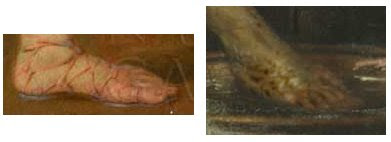
My readers may think the title quite a challenge. Not me. I knew immediately where first to turn: Venus, Cupid, Folly and Time, painted around 1547 by one of Gawain's favourites, Bronzino. Most of us here have seen the image, a grand hieroglyph of the mannerist age, but how many know the latest soundings of its mysteries? It turns out that Bronzino's Folly (also called Pleasure) provides an exquisite example of Cinquecento piede d'atleta, athlete's foot, or to give the affliction its proper scientific name, tinea pedis. Here is Folly's right foot, after a recent restoration of the panel by the good people at the National Gallery:


We can clearly see the effects of unchecked trichophyta between and along the toes; compare, for reference, a modern photograph of the condition:


Bronzino was no doubt working from a model—probably a friend or associate with the condition. Representations of tinea pedis are rare in the Renaissance, and other sorts of foot-disease were painted more often. For instance, in Poussin's Bacchanalian Revel of 1632 (left) we find a sort of scabrous welting of the whole foot, while Peter's foot in Tintoretto's Christ Washing the Feet of his Disciples (1565, right) seems to be experiencing the early stages of necrosis:


It would be appropriate, I wager, to conduct a full-length survey and analysis of the social history of foot disease in Renaissance painting; but this, of course, is beyond our present ambit, and so I offer merely a few remarks on the narrower subject of Bronzino's tinea in oils. Now, as I said, painted tineae are rare; the only other examples from this period that spring to mind—a Barocci Magdalene, and, if memory serves me aright, an allegorical leper by Scarsellino—are not to be found online; both of these, moreover, are at least a generation later than Bronzino's panel. So I know of no precedents in painting for this image, although I'm sure Gombrich could have pointed me in the right direction.

Contemporary medicine, on the other hand, provides a few clues. In 1546 a treatise was published in Venice by Girolamo Fracastoro entitled De Contagione et Contagiosis Morbis. This was the first book to work out fully a theory of the contagion and transmission of disease: Fracastoro denied the Hippocratic-Galenic doctrine that all illness results from an imbalance of humours. Thus, while the mediaeval Galenists had taught that skin diseases (including the mycosis or morbus militis—our tinea) were caused by a drying-out of the body's bile or phlegm, Fracastoro instead posited that they were transferred from one body to another by offensive particles called seminaria. (The latter word is related to the atomic semina of Lucretius, although Fracastoro's theory has more in common with the Neoplatonic concept of species or immaterial emanation: for more details, see this pdf.)

Fracastoro further linked skin-diseases in general, and mycosis in particular, to syphilis. This should not surprise us. Fracastoro was the master of syphilis; he dined and slept with it, and was its confidant, its Boswell, even its Milton. In 1530 he'd written an epic poem on the subject, in three books, entitled Syphilis sive morbus gallicus, which in fact is the origin of our word. (A French epitome of the book is online here.) The poem was a hit, and went through 50 editions in Latin alone. It would not be too much to say that syphilis was responsible for Fracastoro's career, and by golly, he was determined to capitalise on it. The precise relation between the 'master disease' and mere mycosis is never spelled out in the De Contagione, but perhaps he perceived the latter as a milder, even inchoate form of the loathsome cankers assigned to syphilis in the previous epic:
Protinus informes totum per corpus achores
Rumpebant, faciem horrendam, et pectora foede
Turpabant.

Shapeless scabs burst at once through the body
and the dread face, and foully disfigured the breast.
What is important for our present purposes is that, according to J. F. Conway's pathbreaking 1986 analysis, syphilis itself appears allegorically in Bronzino's famous painting:


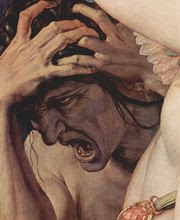
Here syphilis, generating madness as it did for Nietzsche, is the gruesome result of the triumph of lust, symbolised by the principal action. Conway makes use of Fracastoro in his discussion of Bronzino; if we allow that the painter knew the Syphilis, we may go further and suggest that he also knew De Contagione, and thus date the Venus after 1546, possibly the following year. The cute cherub with the cutaneous mycosis joins the triumph of lust, scattering his poisonous petals upon the amorous couple—an incarnation of the seminaria that carry disease from one body to another. Bronzino was adding his small vote of support to Fracastoro's new theory, a bold move; but he hardly wanted to mar the fine, glossy surface of his ducal commission with something so ugly as a fungal infection, so he confined the disease to the boy's foot, a tiny detail, which indeed had been lost to dirt and varnish until the recent cleaning.

As so often, it is the smallest elements—for Morelli an ear or a hand, for me a tineatic foot—that yield the greatest interpretive riches. Gawain would not agree, but perhaps the rest of my readership will give the idea some credence.

29 April, 2007

Rilib and Kaelib

In July 1896, a German naval captain called Winkler—first name unknown—was stationed on the Jaluit atoll, a district of the Marshall Islands in the western Pacific. Jaluit was the administrative centre and main trading-station of the Islands, which had come under German control in 1885. Winkler was unusually interested in the local customs, and especially in a variety of 'sea-chart' presented to him by the land-inspector, Dr. Irmer. These charts consisted, in his words, of 'a number of sticks lashed together in a rude latticework, and on this at various points were tied small shells'. Irmer could not make head or tail of them. It turns out that Westerners had been puzzled by these devices for some time; the first certain reference to them can be found in a report by the Hawaiian missionary Luther Halsey Gulick in 1862.


While stationed there, Winkler made a systematic study of these charts, and in 1898 he published a report in the Marine-Rundschau, which in 1901 was translated into English for the Smithsonian Institute Report (51, 487-508, online as a scanned PDF here). Since then there has been a huge flurry of interest in the charts, especially after the US took control of the islands in 1947; a 1992 bibliography lists 44 relevant items. I've looked at a few of these items, and none of them adds much to Winkler's account. The clearest exposition can be found in a 1960 article by William Davenport, online here. But there is also a Wikipedia article, and various other internet sites that say much the same. All of these accounts abstract the data from Winkler's article—but when we return to his piece, we discover something different—of human, not just cartographic interest. It would be ripe for some post-colonial deconstruction, but as for myself, I'd rather use my own eyes.

*

Winkler, not being an academic, knew how to tell a good story. He presents his research of the charts as a quest for hidden treasure, and as a narrative it is better than fiction. The note of adventure is sounded in his opening paragraph:
Dr. Irmer confessed that he was unable to explain the meaning and function of the charts, for great secrecy was preserved among the islanders on this score, and only a few of the old chiefs, indeed, were in possession of the secret.
Thus Winkler is given the mission to decode the charts by Irmer. The first person to whom they turn is the local chief and master-pilot, Lojak, whose interpretation is to be translated by Irmer's servant Ladjur:
One forenoon an impressive scene was enacted in Dr. Irmer's quarters, when Lojak, with the greatest secrecy, first closed all the windows, in spite of the 34° C. heat, having threatened Ladjur with death if he divulged the tabooed mystery; but the result of the long sweat bath was a complete negative.
It is a game of looking—Winkler is offered a window into the secret, and he in turn offers us a window—but the shades are drawn, for we have no idea what happened. (One of my correspondents has eloquently written, 'If I admire the plunderers it is only for their sensational prose. As when Howard Carter notes the distractions of Valley work, translating graffitos scrawled by Greek historians. When John Lloyd Stephens reads at night, in the ruins of a Maya castle, by the light of bird-size fireflies. Articles of conquest I like for what they preserve of subjugated cultures.' Surely this is what he means.)

Winkler then discovers something substantive: that the shells represent islands, and the sticks represent wave-currents. Marshallese navigators, he is told, use the charts by looking over their canoes at the wave-currents and plotting accordingly; he is sceptical that this is possible. Winkler spends the next year enquiring about the charts in Australia, New Zealand, and the South Sea, but learns nothing further. The explorer Benedict Friedlander personally implores Winkler to find out more, and so on his return visit to Jaluit in 1897, he renews his efforts. He befriends his fellow captain Kessler, who is 'in fraternal relations' with a local chief named Nelu:
Then began a strenuous, monotonous, and patient research. Chief Nelu, who did not wish to conceal aught from his brother Kessler, was first pumped. He told us all that he knew, and gave us pleasure with his willingness, but when, in the evening I collected all that had been heard and noted down and tried to put it into form I found so many contradictions that pretty much all that had been written had to be crossed out.
Winkler decides that Nelu, 'through incessant drinking of beer, which furnished his sole nourishment, had become too stupid to be able to render a clear explanation'. The melancholy is overwhelming: even the chief, supposedly a man of power and knowledge, but in fact a drunkard, has no idea what the charts mean. These venerable objects, the stick-charts, have become opaque and illegible, despite preserving their mysterious aura, like the Delphic E.

They return to Lojak, who is less reluctant to divulge now that Nelu has spilt the beans. Winkler calls what results 'hour-long sessions and squeezings'. Still, he comes up against the contempt of the old chief: 'Once Lojak told me with seeming frankness that I was the dumbest churl he had ever seen.' Lojak, like Nelu, likes a good tipple; but his preferred drink is sack, which makes him friendly again. Thus the locals are corrupted into divulging their secrets by booze—but also by thirst for status, represented by a beautiful jacket: 'As an extreme measure, I had hanging in my cabin a showy uniform coat which I promised Lojak if he would answer all my questions'. What could be a better symbol of colonialism, as a twin process of military and economic conquest? This is how the White Man, lean and cunning, overcomes the greedy Savage.

But even Lojak turns out to be incompetent, and Winkler draughts in a 'half-breed' Portuguese named Jochem de Brun, and the native assistant navigator Laumanuan, who together are able to correct Lojak's errors: 'At last, in this way, we succeeded in clearing up the greater part of the doubtful points'. Further investigations among the natives—interviews with Muridjil, Burido, Litokwa and Launa—prove useless. Nobody, it seems, really has a grasp of what these charts mean. Winkler turns to some notes by a merchant named Capelle: 'Misfortune had overtaken him in business'. As the old world passes away, with barely a drunken whimper, the gloom, passing, deepens; and yet something—something—is salvaged from the wreckage.

*
The so-called charts do not deserve the name in our sense, but they merely serve to bring to view the water condition, as well for the instruction of the chief's sons, who have to be initiated into the secrets of navigation, as for the settling of differences between chiefs piloting a boat when the water indications are not plain and varying interpretations have been made.
This is Winkler's summary of the charts; later he adds, 'they are made by chiefs for their individual use as reminders of the various things which they have to attend to in sailing, as well as for rendering clear the noteworthy signs in the tuition of the uninitiated'. David Lewis puts the matter in similar terms in his classic study, We Are the Navigators:
The stick charts are not charts in the Western sense, but are instructional and mnemonic devices concerned with swell patterns. Nor are they essential navigational tools, de Brun, for instance, never having used one.
Davenport had argued in 1960 that the charts 'are used to teach navigators and possibly to store knowledge against memory loss. They are most assuredly not used to lay out courses, plot positions and bearings, or as aids in recognizing land forms as the European navigator uses his chart. Nor are they mnemonic devices to be taken along on a voyage for consultation.' Davenport also remarks that visual observation of the water is coupled with tactile observation:
[The navigator] learns to lie on his back in the bottom of the canoe and to interpret the wave pattern by noting the rise and fall, yawing, and slapping of sea against the hull.
Kjell Akerblom, in his 1968 Astronomy and Navigation in Polynesia and Micronesia, repeats Davenport's conclusions almost verbatim, also noting that the distribution of the charts (of which many have now been collected, for instance by Schück in 1902) is not even within the archipelago: 'If they had been of real value in navigation one might have expected the opposite'.

All later sources parrot the explanations of the charts given by Winkler: that the sticks (identified by Davenport as 'palm ribs bound by coconut fiber') represent nothing geographical, but rather the patterns of wave-swells between islands in the archipelago. Here is the secret—the navigators of the Marshall Islands locate island-masses by calculating the refraction and reflection of wave-fronts around and against the island shores. This is a technique specific to the geography of an island nation, and cannot be found anywhere else in the world. Every article on the subject, including the Wiki piece, explains the method to some degree, showing how a wave-swell reacts when it hits an island—curving around at an angle, and interfering with itself and with swells coming from other directions. The patterns of interference coalesce into long lines of 'nodes', stretching out to sea—the navigator can follows these nodes to the island. Winkler even provides the local terminology, which has been duly repeated for a century. The wave-swells are called dunung; the species that comes from the east is a rilib, and that from the west a kaelib. The node produced by swell-interference is a bot (or boot), while the line of bots is an okar. A photograph of a chart can be seen here, while a particularly elaborate diagram (taken from the Winkler article) looks like this:


Here the rilibs are the curved lines to the right, the kaelibs are the curved lines to the left, the dots (shells) represent islands, and the transverse lines indicate lines of sight—ie. boundaries at which the islands at the top and bottom can be seen with varying levels of clarity. Many more drawings, some resembling the geometric art of 1920s Russia, can be found in Winkler's article. Here, however, sloppy copying has made his very words wavelike:


*

As I said, all the sources will tell you this same basic information, and more that I have here omitted. But few convey to the reader the process of obtaining the information; few articulate the beauty and significance of this precious data. Winkler remarks,
The interpretation of the charts is. . . always difficult, if one has not the maker of the chart himself as explainer; another, even an entirely competent navigator, can not under any circumstance read the deliverances of a chart which he himself has not made. Hence the repeated false and apparently wild information from the sticks.
Akerblom picks this up: 'the charts are an expression of the personal knowledge and experience of the different navigators, which are kept strictly secret and not circulated outside the immediate family'. Doug Aberley, introducing a book on 'bio-regional mapping', writes wistfully:
In all of us is some remnant of an ability to understand relationships of physical space to survival and the evolution of stable community life. In admiring the mapping of aboriginal cultures, the goal is not to copy others, but to rediscover in ourselves a genetic memory of ancient skills.
Aberley thinks that we have lost something in our progress. But more different than our methods of seafaring—and navigation by wave-refractions is certainly novel to a Western mind!—are our attitudes towards knowledge. For the Marshallese, there is still something religious about these maps; the secrets are guarded with more than a political fervour. They have that opaque, mysterious aura, that 'taboo', that I compared to the Delphic E. But it is the open society, as Popper recognised, that advances in its knowledge. We see in Winkler's article a closed society starting to fall apart. Davenport, 6o years later, notes that 'for over fifty years now writers have reported that wave navigation and chart making were rapidly falling into disuse, and that compasses, hydrographic charts, and even sextants and chronometers were about to replace them'—but cheerfully adds that the Marshallese navigators have also continued to use their own system, now publicly disseminated, alongside the modern techniques. He attributes this to 'the fact that the coveted skills of the navigtor are no longer politically valuable to the contending chiefs'. But perhaps, also, it is a sign that with the increased presence of the West, a little magic has gone out of the world of the Marshallese navigators.

Update: More information collected by the Nonist.

15 February, 2007

1938-6939

What would you say to the men of 6939?

In 1938, a capsule was lowered into the ground at the New York World's Fair, designed to last 5,000 years. It was made of Cupaloy—an alloy of 99.4% copper, 0.5% chromium, and 0.1% silver—seven feet, six inches long, and sealed with asphalt. Inside, within a glass 'envelope' from which the air had been 'exhausted' and replaced with nitrogen, were placed items and artefacts of the world as it was on the eve of the Second World War: pictures, microfilms—religious texts, the Constitution, a history of the world—and other objects. A small pamphlet was included, with a key to the English language, and other notes; this pamphlet was also distributed to the world's libraries to commemorate the event.

Recently Rick Prelinger at the popular blog Boing Boing scanned one of these pamphlets and wrote a little notice about it. My brother-in-law forwarded this article to me last week. As usual with this sort of thing, the piece consisted mainly of "here's something neat" without any substantive discussion of the pamphlet's contents. Well, I'm glad there was something for me to do.


History, c. 1938.

The tone of the pamphlet is fascinating—it has a sort of wistful, almost elegiac quality in parts, combined with the gung-ho eulogy of technological progress that you'd expect.

For there is no way to read the future of the world: peoples, nations, and cultures move onward into inscrutable time. In our day it is difficult to conceive of a future less happy, less civilised than our own. Yet history teaches us that every culture passes through definite cycles of development, climax, and decay. And so, we must recognize, ultimately may ours.
Was history teaching them that in 1938? Will Durant seems to have been telling that story, for one. And Spengler had been propounding a gloomy version of the thesis for 20 years. In any case, the capsule team commissioned statements on 'the strengths and weaknesses of our age' and 'the discernible trends of human history' from three eminent men of the time. Who would you pick, dear reader? They chose Nobel physicist Robert Millikan, Thomas Mann, and Albert Einstein. It will be instructive to compare their responses. Millikan writes:

AT this moment, August 22, 1938, the principles of representative ballot government, such as are represented by the governments of the Anglo-Saxon, French, and Scandinavian countries, are in deadly conflict with the principles of despotism, which up to two centuries ago had controlled the destiny of man throughout practically the whole of recorded history. If the rational, scientific, progressive principles win out in this struggle there is a possibility of a warless, golden age ahead for mankind. If the reactionary principles of despotism triumph now and in the future, the future history of mankind will repeat the sad story of war and oppression as in the past.
It is obvious that Millikan is not much of a stylist. In the first sentence 'representative' badly clashes with 'represented', and 'Anglo-Saxon' is precious; 'practically the whole' is childish; 'triumph now and in the future' is redundant, and 'in the future' knocks painfully against 'future history of mankind'; finally, one does not repeat a story 'as in the past'. His dream is the old dream of the humanist Enlightenment—that of the triumph of the rational and scientific against the forces of despotism, and establishment of a 'golden age'. It is almost simperingly naïve. Compare the novelist:

WE know now that the idea of the future as a "better world" was a fallacy of the doctrine of progress. The hopes we center on you, citizens of the future, are in no way exaggerated. In broad outline, you will actually resemble us very much as we resemble those who lived a thousand, or five thousand, years ago. Among you too the spirit will fare badly—it should never fare too well on this earth, otherwise men would need it no longer. That optimistic conception of the future is a projection into time of an endeavor which does not belong to the temporal world, the endeavor on the part of man to approximate to his idea of himself, the humanization of man. . .
Millikan was an American. Mann was not. Mann has no illusions of a golden age: he speaks almost like Hegel of the spirit among men—but in his eyes there is nothing transcendent, for the spirit is only a man's personal quest to absolve himself of temporality, and attain his own Ideal Form. This is in the tradition of Eckhart and the German mystics, and wants nothing to do with the humanist cartoon still trumpeted by Millikan. Read side by side, the men of 6939 will be scratching their heads and laughing at one of them. My money's on Millikan. I suspect that for as long as the human race survives, 'the intelligence & character of the masses [will be] incomparably lower than the intelligence and character of the few who produce something valuable for the community'. Those are Einstein's words, describing the present—he prays that the future will 'read these statements with a feeling of proud and justified superiority', but I doubt it.


The English Language, c. 1938.

Included in the pamphlet is a 'Key to the English Language' written by one John Peabody Harrington, an ethnographer of Native Americans based at the Smithsonian Institute. His job is to explain how English works to those living when 'all the spoken languages of the present time will have become extinct'. Grammars have been written since time immarmoreal, of course—but they have been addressed to contemporaries, and many concepts are taken for granted. Harrington's task is more comparable to that of the Arecibo message, or other communiqués destined for the stars.

Still, his approach is in many ways conventional. He starts with phonetics—vowels, diphthongs, then consonants—moves on to syllables, then the grammar of inflexions and pronouns, deictics, adjectives, comparative and superlatives, and finally verbs. Classical grammars, likewise, began with the smallest elements (stoicheia) and moved up the scale of complexity, generally ending in syntax and poetic metre. A simple early grammar of English, that written by Ben Jonson around 1620, divides the study into two parts—'etymology' (OED sense 3, 'That part of grammar which treats of individual words, the parts of speech separately, their formation and inflexions') and 'syntax'. The first begins with an enumeration of English sounds—vowels, then consonants, then diphthongs. Vowels are classically defined as those sounds which can be made alone, whereas consonants, as the name indicates, require another sound (ie. a vowel) so as to be heard. Harrington's conception of phonology is much more sophisticated—we should expect this, as he was writing during the heyday of descriptive linguistics, and Bloomfield's standard Language had been published five years earlier. The Key defines the vowel as a sound 'whose hemming amounts to mere cavity-shape resonance', while the consonant is a sound 'whose hemming amounts to closure, violent restriction, or closure followed by restriction'. The IPA had reached pretty much its present form in 1933, the same year as Language. But for some reason, Harrington eschews its notation, using instead a [j] to denote the schwa (IPA [ə]), and a [c] to denote a lengthened vowel (IPA [:]). Harrington also offers a 'mouth map' of the sounds of English:


This is already better than previous guides could do. The Key next discusses grammar, using pictures to indicate grammatical distinctions. The difference between singular and plural is indicated by a picture of one bird and a picture of three. The difference between 'here' and 'there' (or 'this' and 'that') is indicated by a picture of two men pointing to each other. The 'good-better-best' distinction is shown by three arrows in a target. And best of all, 'past-present-future' is represented by a ship between two cities. The idea is admirable, but the problem, as Wittgenstein realised (Philosophical Investigations I.6), is that it is impossible to use a picture to indicate an idea unless the person looking at the picture already has some context for the idea to be taught. The 6939 man looking at the ship between towns might equally conclude, without further knowledge, that "paest" was the name of the first town, "prezjnt" that of the ship, and "fyuctur" that of the second town.

This becomes especially evident when Harrington deals with 'subordination', which is really the only sophisticated bit of grammar he treats. To illustrate "Running he aimed", where 'running' is subordinate to 'aimed', Harrington shows a man running with a bow and arrow:

One wonders how helpful this will be. The Key concludes with the Fable of the North Wind and the Sun rendered in his phonetic spelling, and a list of the thousand most used words in the English language, keyed on a series of diagrams. The words include 'ridgepole', 'rafter', and 'haystack'.

That's 1938 for you.

10 February, 2007

The Royal Road

Do the good people who mean so well by science imagine that sculptors will in the future chisel microscopes in marble, that painters will depict the circulation of the blood, and that poets will display in rich rhymes the principles of Euclid?

— Max Nordau, Degeneration (1892).
The proofs and diagrams of Euclid, organised with their near-perfect artistry, have provided countless philosophers, mystics and poets with visual inspiration. In this post I discuss the response of three writers to Euclid's very first problem—the construction of an equilateral triangle on a straight line. Here's the problem, adapted for clarity from this website:

1. Let AB be a given finite straight line.

2. Describe a circle [BCD] with centre A and radius AB. Again describe a circle [ACE] with centre B and radius BA. From the point C, at which the circles cut one another, to the points A and B, join the straight lines CA and CB. [You can see this construction in the above diagram; CA and CB are indicated by dotted lines.]

3. Now, since the point A is the centre of the circle BCD, therefore AC equals AB [ie. because both lines are radii of BCD]. Again, since the point B is the center of the circle ACE, therefore BC equals BA.

4. Therefore AB = AC = BC.

5. Therefore the triangle ABC is equilateral, and it has been constructed on the given finite straight line AB.
There are several problems with this proof, known since antiquity; most of these concern necessary axioms not enumerated beforehand. But these are specialist quibbles, and need not concern us. The proof is essentially sound.

*

In the late 5th century, Proclus Diadochus, the last of the great Neoplatonists, wrote a commentary on Euclid's Elements. It is from this work that we have the famous story about Euclid and Ptolemy, from which the title of my post derives. Like his predecessors, Proclus had a mystical conception of number as the essence and foundation of the universe. It is no surprise, then, that we find him allegorising Euclid's first problem in terms of Neoplatonic metaphysics:
That an equilateral triangle is the best among triangles, and is particularly allied to a circle, having all its lines from the centre to the circumference equal, and one simple line for its external bound, is manifest to every one; but the partial comprehension of two circles in this problem, seems to exhibit in images how things which depart from principles, receive from them perfection, identity, and equality. For after this manner, things moving in a right line, roll round in a circle, on account of continual generation; and souls themselves, since they are indued with transitive intellections, resemble by restitutions and circumvolutions, the stable energy of intellect. The zoogonic or vivific fountain of souls too, is said to be contained by two intellects. If, therefore, a circle is an image of the essence of intellect, but a triangle of the first soul, on account of the equality and similitude of angles and sides; this is very properly exhibited by circles, since an equilateral triangle is included in their comprehension. But if also every soul proceeds from intellect, and to this finally returns and participates intellect in a two-fold respect; on this account also it will be proper that a triangle, since it is the symbol of the triple essence of souls, should receive its origin comprehended by two circles. But speculations of this kind, as from bright images in the mirror of phantasy, recall into our memory the nature of things.
I quote the first English translation of Proclus' commentary, done by Thomas Taylor in 1789. Taylor was extremely prolific, also being the first to translate the works of Plato, Aristotle, Plotinus and Iamblichus—and you can imagine how influential these translations were on the burgeoning Romanticism of the late eighteenth century.

The passage quoted here deals with a lot of technical Neoplatonic mumbo-jumbo. I had just written a paragraph explaining this mumbo-jumbo in some depth, but then I concluded that my readers would be more interested if I instead picked out the salient points. The key is this: the human soul (psuche) proceeds at birth from the divine intellect (nous), and through philosophical contemplation seeks to return to an understanding of (and identification with) that divine intellect. This basic theme is at the core of virtually all Western speculative mysticism. Here the triangle represents the soul (which, as in Plato's Republic, has a 'triple essence'), and the two circles represent the twofold path of the soul away from, and back towards, the divine nous.

What is interesting is that Euclid's diagram is taken as a hieroglyphic to focus the contemplative mind: the general schema of Euclidean geometry is presupposed as a perfect picture of the real world, and consequently of the ideal spiritual world as well. This conception of Euclid extends all the way through the Middle Ages and Renaissance, and continues among the mystical thinkers of the eighteenth century, including Taylor himself.

*

Two years after the publication of Thomas Taylor's translation, S. T. Coleridge wrote a comic poem about Euclid's first problem, dated March 31, 1791. He was 18, and still at school; in October he would enrol at Jesus College, Cambrige. However, Coleridge was already devouring the Neoplatonists. In the 1817 Biographia Literaria, he refers to his 'early study of Plato and Plotinus, with the commentaries and the THEOLOGIA PLATONICA of the illustrious Florentine; of Proclus, and Gemistius Pletho'. In his 1818 Treatise on Method, Coleridge would propound a very Platonic conception of mathematics, which he classifies as a 'formal pure science', along with logic and universal grammar. He contrasts this category to the 'real pure sciences' of metaphysics, morals and theology. Mathematics, he insists, deals purely with the ideal—with essentia, not with existentia:
Now these laws are purely Ideal. It is not externally to us that the general notion of a square, or a triangle, of the number three, or the number five, exists; nor do we seek external proof of the relations of those notions; but on the contrary, by contemplating them as Ideas in the Mind, we discover truths which are applicable to external existence.
By the time he attended university, Coleridge was, in his own words, an excellent Greek scholar, so it is debatable whether he would have needed to refer to Taylor in order to read the Neoplatonists. Nonetheless, it is clear that he was already fascinated with mathematics. In 1791, upon completing his poem, he wrote to his brother George,
I have often been surprized, that Mathematics, the quintessence of Truth, should have found admirers so few and so languid. —Frequent consideration and minute scrutiny have at length unravelled the cause—viz.—that though Reason is feasted, Imagination is starved; whilst Reason is luxuriating in it's [sic] proper Paradise, Imagination is wearily travelling on a dreary desart. To assist Reason by the stimulus of Imagination is the design of the following production. In the execution of it much may be objectionable.
Much of the work is, indeed, objectionable. In fact, 'A Mathematical Problem' is one of the silliest poems ever penned. But then, poetry could do with a little silliness now and then. Play it, Sam:
I.

This is now — this was erst,
Proposition the first — and Problem the first.
On a given finite line
Which must no way incline;
To describe an equi —
— lateral Tri —
— A, N, G, L, E.
Now let A. B.
Be the given line
Which must no way incline;
The great Mathematician
Makes this Requisition,
That we describe an Equi —
— lateral Tri —
— angle on it:
Aid us, Reason — aid us, Wit!

II.

From the centre A. at the distance A. B.
Describe the circle B. C. D.
At the distance B. A. from B. the centre
The round A. C. E. to describe boldly venture.
(Third postulate see.)
And from the point C.
In which the circles make a pother
Cutting and slashing one another,
Bid the straight lines a journeying go.
C. A. C. B. those lines will show.
To the points, which by A. B. are reckon’d,
And postulate the second
For Authority ye know.
A. B. C.
Triumphant shall be
An Equilateral Triangle,
Not Peter Pindar carp, nor Zoilus can wrangle.

III.

Because the point A. is the centre
Of the circular B. C. D.
And because the point B. is the centre
Of the circular A. C. E.
A. C. to A. B. and B. C. to B. A.
Harmoniously equal for ever must stay;
Then C. A. and B. C.
Both extend the kind hand
To the basis, A. B.
Unambitiously join’d in Equality’s Band.
But to the same powers, when two powers are equal,
My mind forbodes the sequel;
My mind does some celestial impulse teach,
And equalises each to each.
Thus C. A. with B. C. strikes the same sure alliance,
That C. A. and B. C. had with A. B. before;
And in mutual affiance
None attempting to soar
Above another,
The unanimous three
C. A. and B. C. and A. B.
All are equal, each to his brother,
Preserving the balance of power so true:
Ah! the like would the proud Autocratrix do!
At taxes impending not Britain would tremble,
Nor Prussia struggle her fear to dissemble;
Nor the Mah’met-sprung Wight
The great Mussulman
Would stain his Divan
With Urine the soft-flowing daughter of Fright.

IV.

But rein your stallion in, too daring Nine!
Should Empires bloat the scientific line?
Or with dishevell’d hair all madly do ye run
For transport that your task is done?
For done it is — the cause is tried!
And Proposition, gentle Maid,
Who soothly ask’d stern Demonstration’s aid,
Has proved her right, and A. B. C.
Of Angles three
Is shown to be of equal side;
And now our weary steed to rest in fine,
’Tis rais’d upon A. B. the straight, the given line.
Well, I did warn you. Now it is evident that the first two parts (and the beginning of the third part) of this poem merely describe, in hilariously poor verse, Euclid's problem. The remaining lines articulate Coleridge's metaphorical reading of the construction. It is clear that Coleridge has no need of seeing, with Proclus, a mystical hieroglyph. Instead he finds in the construction an image of interpersonal 'balance' and harmony, of 'Equality's Band'. His exposition seems to reiterate itself, with an odd pointlessness, between 'Harmoniously equal for ever must stay' and 'Preserving the balance of power so true'. After that, syntax and sense become gnomic and confusing. The Autocratrix—ie. Catherine the Great—the Briton, the Prussian and the Muslim—what have their fright and fear to do with Euclid? Lucyle Werkmeister (in MLN 1959, online here), reads it as a comic response to Edmund Burke's theories about the relation of the sublime to the human imagination. She concludes, 'as a joke on Burke, it is not without some interest. Even so, one is not sorry that it turned to be unique'.

The reference to the stallion makes one think of the proem to Parmenides' hexametric On Being, though I cannot be sure that this is what Coleridge had in mind. More generally, it is tempting, albeit wholly without foundation, to see in this ridiculous poem an anticipation of the radical, anti-imperialist politics that the young poet would concern himself with during the 1790s—the image of the harmonious triangle a precursor to his utopian Pantisocracy.

*

James Joyce's response to the Euclidean problem is, naturally, far more difficult to decipher. I have already mentioned this response on a number of occasions, but I have not yet offered any discussion thereof. It occurs in Finnegans Wake 2.293, in the middle of a renownedly difficult passage often referred to as the 'Night Lessons'. Here is Joyce's version of the diagram—

Here π takes the place of C, α and λ the place of A and B, and P occurs opposite π. Joyceophiles will immediately recognise here the recurring initials of ALP (Anna Livia Plurabelle)—'A is for Anna like L is for liv. Aha hahah, Ante Ann you're apt to ape aunty annalive!'. The construction itself is described in the subsequent pages, albeit heavily garbled in the usual Wake manner. For instance, when Joyce writes 'With Olaf as centrum and Olaf's lambtail for his spokesman circumscript a cyclone', we understand 'With α (aleph) as the centre, and αλ (aleph-lambda) as the radius (spoke-sman), describe a circle (Gk. kuklos)'. Similarly, 'join alfa pea and pull loose' means 'join [by straight lines] απ and πλ'. 'Loose' suggests luis (pron. loosh), the Irish L, as well as Lucia, Joyce's daughter. 'Alfa' suggests alfalfa—also called luc-erne—and along with 'pea' connotes fertility. The climax of the exposition arrives on p. 297:
Outer serpumstances being ekewilled, we carefully, if she pleats, lift by her seam hem and jabote at the spidsiest of her trickkikant (like thousands done before since fillies calpered. Ocone! Ocone!) the maidsapron of our A.L.P., fearfully! till its nether nadir is vortically where (allow me to aright to two cute winkles) its naval's napex will have to beandbe.
Finally: 'Paa lickam laa lickam, apl lpa! This it is an her. You see her it'. The significance of this passage and diagram is hotly debated among Joyce scholars. It is clearly, like everything else in the book, polysemic—some have seen in it a schematic map of Dublin, others a sexual joke (the central shape seen as a vagina between two arse-cheeks), or a theological diagram, with 'Pee for Pride' (hell) at the base, and 'Pie out of Humbles' (heaven) at the top. It is all of those things, because it can be. The climax is clearly erotic—'You see her it'—recapitulating the theme of voyeurism that pervades the book.

But when it comes to Joyce—on Euclid or not—your guess is as good as mine, or anyone else's. Thomas Rice's book, Joyce, Chaos and Complexity, discusses our hero's interest in non-Euclidean geometry, an obvious sort of analogy to his own oblique methods. But Rice has nothing on the Euclid diagram. Others do, but their expositions are the usual ingenious exegeses, taking bits here and there to find a pattern. Joyce's total demolition of order and harmony, of the geometric method, is the farthest point possible from Proclus' mystical vision. Far from being an ideal figure inspiring recollection of the Neoplatonic hypostases, Euclid's diagram becomes for Joyce just another part of the dirty, playful, sexy natural world. What was once orderly and bounded, the epitome of clarity and simplicity, is now an icon of the the infinite and indefinite, something to catch the eye in a sea of words.