Showing posts with label Judaism. Show all posts

29 April, 2008

Armchair history

London pelting but at least bright late. Library at last less choked with facebook-addled undergraduates. I remind myself of Lavengro, one of those Victorian paid-per-word novels that pays no attention to dramatic interest, thank God. George Borrow sojourning in London, 1825 or so. An evening at the house of an Armenian. Rabbi enters, a Sephardi, settles some business; Armenian asks him to stay for a drink. Rabbi says
"He—he—he! señor, you know I do not love wine. I love Noah when he is himself; but, as Janus, I love him not. But you are merry; bueno, you have a right to be so."

"Excuse me," said I; "but does Noah ever appear as Janus?"

"He—he—he!" said the Rabbi, "he only appeared as Janus once—una vez quando estuvo borracho; which means——"

"I understand," said I, "when he was—" and I drew the side of my right hand sharply across my left wrist.

"Are you one of our people?" said the Rabbi.

"No," said I, "I am one of the Goyim; but I am only half enlightened. Why should Noah be Janus, when he was in that state?"

"He—he—he! you must know that in Lasan akhades [Ladino, 'Hebrew language', from Hebrew leshon ha-kodesh (לשון הקודש), literally 'holy language'; compare Yiddish loshn-koydesh] wine is janin."

"In Armenian, kini," said I; "in Welsh, gwin; Latin, vinum. But do you think that Janus and Janin are one?"

"Do I think? Don't the commentators say so? Does not Master Leo Abarbenel say so, in his Dialogues of Divine Love?"

"But," said I, "I always thought that Janus was a god of the ancient Romans, who stood in a temple open in time of war, and shut in time of peace; he was represented with two faces, which—which—"

"He—he—he!" said the Rabbi, rising from his seat; "he had two faces, had he? And what did those two faces typify? You do not know; no, nor did the Romans who carved him with two faces know why they did so; for they were only half enlightened, like you and the rest of the Goyim. Yet they were right in carving him with two faces looking from each other—they were right, though they knew not why; there was a tradition among them that the Janinoso had two faces, but they knew not that one was for the world which was gone and the other for the world before him—for the drowned world and for the present, as Master Leo Abarbenel says in his Dialogues of Divine Love. He—he—he!"
If you look for Master Leo Abarbenel, you won't find your man. Your man, in fact, being Yehuda ben Yitzhak Abravanel, also known as Judah Leon Abrabanel, Isaacus Abravanel, or even simply as Leone Ebreo—Leon the Hebrew. Damn those polyonymous Jews. Leon's Dialoghi d'Amore was first published in Italian in 1535, although he probably composed it around 1501, its original language still disputed. I flicked through it in the Library today. Lots of pronouncements on Truth and Beauty in good Ficinian style. Obligatory quotations from the Symposium. Allegorical exposition of the pagan gods. And so on. No index; had to wade through every bloody page to find the one I wanted. Began with the first half, then tried a different tack and worked back from the last page. Finally found the page right in the very middle. Book 3:
Many declare that they have it on divine authority, not only from Moses, the divine lawgiver, but originally from Adam, from whom the unwritten oral tradition, called in the Hebrew tongue Cabbala, signifying reception, passed to the sage Enoch, and from Enoch to famous Noah; who, after the Flood, on account of his discovery of wine, was called Jajin, because in Hebrew this signifies wine; and he is depicted with two faces reversed, because he witnessed the age before and after the Flood.
Three years before Leon was putatively writing—ie. in 1498—appeared a most strange book that got the whole of Europe talking for a hundred years. This was Annius of Viterbo's Commentaria super opera diversorum auctorum de antiquitatibus loquentium. It is, incidentally, online here. Now Annius' big idea was to get lots of fragments from ancient historians—Berosus of Chaldaea, Myrsilos of Methymna, Fabius Pictor, and so on—draw them all up, and weave them into a holistic history of the ancient world. Here, for instance, is a nice bit of Myrsilos, in Gothic type, with Annius' commentary in Roman:


The same basic idea had been done before by writers like Josephus and Eusebius; the only problem with Annius was that all of his fragments had been entirely fabricated, and by him. One of Annius' core theses was that Noah and Janus were the same person, and also the same as Vertumnus, Ogyges and others. Annius gets his Janus lore from the first book of Ovid's Fasti, where the god is presented as a founder of agriculture in Rome. In an early comment to Berosus, Annius claims: 'Noa primus pontifex cum filiis et uxoribus sacrificia et holocausta obtulerit; Sive igitur idem sit Ianus et Noa: ut tempus et Epitheta utriusque convincunt'—Noah, the first pontifex, with his sons and wives, offered a sacrifice and a holocaust; but this means that Janus and Noah are the same: as the period and their epithets both convince us. On the spurious passage of Myrsilos shown above, or rather on the word Enotria, he remarks:
Et tempore Ianii non erat vinum in Etruria et Latio: negat hoc Cato dicens Ianum dictum Enotrium: quia primus invenit vinum et far. . . Unde Fabius pictor ait principio Ianum invenisse vinum et far ad religionem et sacrificia magisque usum et ob id sibi farrata et vinum in omni sacrificio prolibari; Addit autem Berosus quod ipse dictus est a Scythis / linguae eorum Ianus: quia primus in Armenia invenit vinum. Aramea enim et Hebrea lingua Iain vinum dicit, a quo Ianus vinifer derivat.

And in the time of Janus there was no wine in Etruria or Latium: Cato denies it, calling Janus 'Enotrius': because he first discovered wine and grain. . . From which Fabius Pictor has said that in the beginning, Janus discovered wine and grain for religion and sacrifices and greater use, and on account of this, wheaten cakes and wine are offered to him in every sacrifice; however, Berosus adds that he is called 'Janus' by the Scythians in their tongue: because he first found wine in Armenia. For wine is called 'Iain' in the Aramaic and Hebrew language, from which derives 'Janus', the wine-bearer.
Elsewhere: 'Ex his probatur irrevincibiliter a tempore demonstrato a Solino et propriis Epithetis Iani / eundem fuisse Ogygem / Ianum et Noam.' From these things is indisputably proved, from the time noted by Solinus, and by the characteristic epithets of Janus, that Ogyges, Janus and Noah were one and the same. Annius does not demonstrate his thesis quite as much as we would like, and this leads me to suspect that he is not the first to make such a connection. An origin, perhaps, in the Jewish commentaries? I do not know them at all. What I can find, however, is that the Rabbis commonly associated Janus with a more obscure character, Zepho. Noah Rosenbloom traces this to the mediaeval history of the Jews, the Josippon, which states "that Esau's grandson, Zepho, fled from Edom to Italy where he was crowned as king Zepho-Janus". In 1505, Abraham Zacuto writes 'Janus was the first king of Italy. He killed a beast named janus and thus got his name. They say he was Zepho, son of Eliphaz, grandson of Esau.' Zepho himself seems to come from a midrashic Book of Jasher, though I cannot ascertain how far this work predates its 1625 editio princeps.

According to the Jewish Encyclopedia, 'Ibn Yahya [Shalshelet ha-Kabbalah, 1587] says that Noah has been identified by some with Janus, deriving the latter name from the Hebrew "yayin" (wine); Noah, it is said, was so called because he was the first to drink wine.' So the Jews were happily recycling this stuff from Annius and Leon. Meanwhile, Annius's work is abridged into English by Richard Lynche, as An Historical Treatise of the Travels of Noah into Europe (1601):
He [Noah] further taught those people [the Scythians] the use of agriculture and tillage of the ground, and also the finding out of the use of the grape, and the manner to plant vines and other necessaries for their more easie living, wherupon hee was entearmed also Ianus, which in the Scythian tongue, signifies the giver of wine.

The ancients likewise have shaped him forth with two keyes in his hand, to shew thereby that he was the inventor of gates and dores, and also of the locking of them and making them fast, to the end, that the holy temples and sacred places should not bee polluted with the impious abuse of theeves and uncivile persons, and to avoid adulteries and other such like sinnes then raigning: and of his name since have all dores and gates been called Ianuae. In many other sorts and formes have the auncients defigured the image of this Noe Ianus.
Scythian, Hebrew, same difference. (Scythians were pretty exciting to your average scholar of the period. Boxhornius was just about to identify their language as the very first—the so-called 'Scythian hypothesis', ancestor of our Kurgan hypothesis.) Lynche's translation was put out just in time for Sir Walter Ralegh to include, in the first volume of his History of the World (1614), an excoriating riposte to Annius:
And if we may believe Eusebius better than Annius, then all the kings of the Latins (before Æneas) consumed but 150 years; whereas no man hath doubted, but that from Noah to Æneas's arrival into Italy, there passed 1126 (after the least rate of the Hebrew account) and (after Codoman) 1291. For Janus (who was the first of their kings) lived at once with Ruth, who married Booz, in the world's year (as some reckon) 2717, after the flood 1064, and Noah died 350 years after the flood; and so there passed between Janus of Italy, and Noah surnamed Janus, 704 years.
Some were not to be put off their mythophilological flights. One such was Theophilus Gale, whose masterpiece, The Court of the Gentiles, retales, in its first volume, published in 1669, Book 2, chapter 6:
As for the Theogonie of Janus and his Parallel: if we consider him historically, and according to the Mythologie of the Poets, To he [sic] refers to the storie of Noah, or Javan. That which inclines some to make him Parallel with Noah is 1. The cognation of his Name, with the Hebrew יין jain, wine; whereof Noah was the first Inventor, according to Vossius. Again, 2. Janus was pictured with a double forehead; because he saw a double world, that before, and after, the Floud; as Noah. 3. As the beginning, and propagation of mankind, after the Floud, was from Noah; so also they ascribe the beginnings of al things unto Janus: Whence the entrance to an house is called by the Romans, Janua; and the entrance to the year Januaris. Whence some make the name Xisythrus, given by the Assyrians to Noah (as in the storie of the Floud, Book 3, Chap. 6, § 4.) to signifie an entrance or door, from ןין, a post or threshold of a dore, as Vossius. 4. Latium, where Janus's seat was, (whence part of old Rome was called Janicule) was called Oenotria. Now οινωτρια comes from οινος Wine. Thus much for Janus's parallel with Noah.
I was hoping that these references to 'Vossius' denoted one of the chronological treatises of Isaac Vossius. I was hoping for this because I own a 1661 copy of these various works bound together—the very kind gift of a family friend. But I could not find the relevant passage. What I did find was this: 'Quod si omnes istos errasse dixeris, et Noachum et Ogygum eundem fuisse putes, jam absurdior erit error, et necesse erit ut credas Noachum in Graecia regnasse, et regnum illud fuisse antiquius diluvio.' For if you say that all these things are wrong, and you think that Noah and Ogyges were the same, the error will now be more absurd, and you will be forced to believe that Noah reigned in Greece, and that his reign predates the Deluge. Still, fantasists like Godfrey Higgins and Morgan Kavanagh were peddling the same syllabub in the nineteenth century. Kavanagh takes it further, in fact:
Another very plain proof that Jonas, or Jonah, means water, is this, that it cannot differ from Janus, of which the root Jan is allowed to mean wine. . . And as the name Janus cannot mean wine without meaning water also, it follows that he might have had such events told of him as belong to Noah and Jonas; and that his history might have once borne a close resemblance to that of Noah, we can conceive from this fact, that "on his coins are often seen a boat and a dove, with a chaplet of olive leaves, or an olive branch." [The quote is from Gale.]
Thus men dream and dream. . . But our patience is drawn out, and it has finally grown dark. It is midnight. The rain is beating on the windows. A glass of port?

05 October, 2006

Cohn's New House

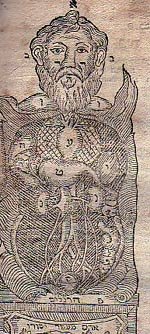
The image below has been all round the internet and back—no surprise there, it's a sockdolager. But nobody, it seems, has bothered to find out anything much about it. Well, except me. Following, then, is a contextual discussion, and after that a translation, courtesy of Simon Holloway.


The image is an engraving from the Ma'aseh Tovviyah, a 1707 encyclopaedia first printed in Venice. The book was compiled by one Tobias Cohn—whose name, due to the vagaries of Hebrew translation and transliteration, is variously rendered Tobias Moses Kohen, Toby ha-Cohen, Tovviyah Katz, Tuvviyah or Tuviyah Kats, or any combination thereof. There's a Wikipedia article about him. According to David Ruderman, the world authority on Early Modern Jewish science, there have been many editions of the Ma'aseh since 1707: in fact, the work was allegedly reprinted in Cracow (1908), in Jerusalem (1967, 1978) and even in Brooklyn (1974). However, I have not been able to find any reference on the internet to these modern editions. Even the Library of Congress has only a first edition. Readers will be interested to discover that they can purchase a copy on Abebooks, should they wish, for a mere $7,000—or $12,500 for a first edition.

The Ma'aseh, written 'in a rich Hebrew style rather than in Yiddish', contains material on all the sciences of Cohn's day—theology, astronomy, hygiene, botany, cosmography, and medicine. It is notable for containing a staunch 'refutation' of Copernicus, damning him as the 'first born of Satan' for contradicting the Tanakh. Despite this, much of it is forward-thinking: its chapter on medicine, which is by far the most significant part, is quite modern in two of its endorsements: the circulation of the blood propounded by William Harvey (see N. Allan's article here), and the secular iatrochemistry which had grown out of Paracelsus. This latter science, practiced in Cohn's day by Sylvius de la Boe and Thomas Willis, was strongly empirical, eschewing the mysticism of other Paracelsians like Robert Fludd. (The Ma'aseh, apparently, does not mention by name the outspokenly anti-semitic Paracelsus.) Cohn also advocates treatment based on similarity between illness and remedy—think vaccine, or homeopathy—rather than on contraries of Galenic humours, as previous writers had done. Ruderman concludes his chapter on Cohn from Jewish Thought and Scientific Discovery in Early Modern Europe:
By aspiring to train Jewish minds to identify knowledge with the layout of words on the printed page, rather than the divine hieroglyphics of the mysterious natural world, Cohen fully identified himself with an emerging field of study, a chemistry to be studied, methodized, and employed for purely utilitarian purposes rather than one to be experienced or religiously celebrated.
But while he advances towards empiricism, Cohn retains traces of the symbolical. For instance, like all good early modern physicians, he accepts physiognomy, basing his treatment on Giambattista Della Porta, as would many bright sparks well into the 19th century. And the illustration above demonstrates a rather poetical turn of thought, comparing the different parts of a man's body to the chambers of a house. The engraving is, in fact, titled 'Dr. Cohn's New House'. According to Allan, the conceit was taken from period sources—Harvey makes some limited reference to it, and Donne mutters, 'When I looke into the larders and cellars and vaults into the vessels of our body for drink, for blood, for urine, they are pottles and gallons'. The Donne connection is that of a modern literary scholar, and should not be taken seriously, as Cohn had no English. The association of man and architecture, at least on a very general scale, was ancient; Vitruvius invokes the architecture of temples—
Hence no building can be said to be well-designed which wants symmetry and proportion. In truth they are as necessary to the beauty of a building as to that of a well formed human figure.
I am not familiar with the post-Biblical Jewish sources, although we might compare Qohelet (Ecclesiastes) on a man's old age and death (12.3 ff.), which is at least as close as Donne:
In the day when the keepers of the house shall tremble, and the strong men shall bow themselves, and the grinders cease because they are few, and those that look out of the windows be darkened. . . Or ever the silver cord be loosed, or the golden bowl be broken, or the pitcher be broken at the fountain, or the wheel broken at the cistern.
Adam Clarke provides the classic exegesis of these lines, reading the keepers as hands, the strong men as legs, the grinders as teeth, the windows as eyes, the silver cord as the medulla oblongata or spinal marrow, the golden bowl as the skull, the pitcher as the vena cava, and the wheel as the great aorta. Clarke notes, fantastically: 'It has been often remarked that the circulation of the blood, which has been deemed a modern discovery by our countryman Dr. Harvey, in 1616, was known to Solomon, or whoever was the author of this book: the fountains, cisterns, pitcher, and wheel, giving sufficient countenance to the conclusion'. Simon Holloway, who should know about such things, warns me however that this passage is not necessarily microcosmic, despite the apparent obviousness of that interpretation.

Cohn's image soon achieved popular currency, and would be copied again and again; here is a version from the 1721 edition—


And below is a later Ottoman version, taken from an old Wellcome Library catalogue of new acquisitions. According to a personal email from Dr. Nikolaj Serikoff at the Wellcome Library, who offers his first opinion of the still-uncatalogued manuscript, this is a modern imitation of the 'Cerrahiye-i Ilhaniye written by Serefeddin Sabuncuoglu'. I have not been able to find any pictures from that work.

Recyclings and copies of pedagogical medical images were common in the 17th century: the famous prints of Vesalius would be pirated all over Europe, in medical texts by Helkiah Crooke, Juan de Valverde and others, even cropping up as late as the Encyclopédie (1751-65) of Diderot and D'Alembert. William Cowper was embroiled in a public spat with Govard Bidloo after he copied the latter's fine plates without acknowledgement. Often this practice was accepted, and even admired—Valverde openly admitted his use of Vesalius:
Although it seemed to some of my friends that I should make new illustrations without using those of Vesalius, I did not do so, in order to avoid the confusion that could follow. . . and because his illustrations are so well done that it would like envy or malignity not to take advantage of them.
Diderot, likewise, explains that his use of Vesalius is purely pragmatic: 'M. Tarin, chargé de l'Anatomie, s'éstoit appliqué à chercher dans chaque auteur les figures reconnues pour les meilleures'. It's not a bad defence.

*

I leave the reader with this, a translation that I commissioned from the Hebrew scholar Simon Holloway. He produced this piece very efficiently, and if it is anything to go by then the linguistic work he's doing on the Tanakh for his masters thesis will no doubt be greatly enlightening. Simon offered many fascinating notes, which I have edited for readability, at the risk of over-simplification; those interested can see his own post for a full commentary.

A New House

1a א The roof of the house and the citadel of
1b wisdom, is the head.

This line and line 10a are the only ones to employ a single letter at the start rather than two. I assumed at first that he was only putting in two letters for paired items, but this turns out not to be the case. On an off chance, I considered that this may be for religious reasons. א is often used in kabbalistic literature to refer to the singularity of the divine, and י is often employed as an abbreviation of God's name (יהוה). According to Wikipedia, Tobias Cohn was a fierce antagonist of the kabbalistic tradition. If that is true, that would rule out any possibility of the letters א and י being singular for any spiritual reason.

2a בב The horns [or, protrusions] of the house
2b and the ears.
3a גג The windows of the house
3b and the eyes.
4a דד Sealed windows
4b and the nostrils.
5a הה The upper opening
5b and the mouth and lips.
6a וו The roof of the house
6b and the shoulders.
7a זז The lattice windows of the house
7b and the lungs.

The etymological root of the word for "lungs" is רוה which means to be moist, reflecting the Talmudic belief that the lungs were designed to absorb liquid.

8a חח An oven and stoves.
8b And that is the liver, and the container of
8c the bile.
9a טט The cookery
9b and the stomach.
10 י The storage room and the spleen.
11 לל Transporters of the waste-product.
12 ממ -?- of the urine.

I have thus far been unable to work out what the verb might be.

13 ננ The storage room of the water.
14a סס The pool and the tank
14b or the container of the urine.
15a עע The root of agony
15b or the stronghouse,
15c and the heart and all of its openings.
16a פפ The foundations of the house
16b and the legs.

Under the two images, the following is written:

17 פפ The foundations of the house—under the image of the house
Man is from dust, his foundation is פפ—under the image of the man.

28 August, 2006

The Divided Self: Part I

This is the first of a trilogy of posts about the divided self in history and literature, using Freud as he should be used, as a diviner or shamanic guide. I would like the reader to understand these posts as a continuous journey or poem of ideas, and not as an argument—there is, I daresay, little truth here, but also, I hope, not a little of the sublime.

*

Freud, the great kabbalist of the last century, defined masochism as the two-step redirection of a primary sadistic instinct. Between sadism and masochism is an intermediary stage: 'The desire to torture has turned into self-torture and self-punishment, not into masochism. The active is changed, not into the passive, but into the reflexive, middle voice' ('Instincts and Their Vicissitudes', 1915). In anticipation I note on this page of Strachey's translation an instance of parapraxia or Freudian slip—'is what' has been typographically disordered as 'ihs wat', revealing a playful-violent swat between the two words.

The reader will here notice Freud's grammatical metaphor: he refers to the instinct turned upon itself in terms of the 'middle voice'. Hebrew, like the Greek with which Freud was more familiar, also has a middle voice; this account of Hebrew grammar describes its usage:
The Hebrew middle is often employed for reflexives (doing something to yourself) and reciprocals (doing something to each other). This is why, e.g., Hebrew fight is always in the middle voice.
We see here an uneasy conflation of two types of action: things done to oneself, and things done by two parties to one another. As a result, the word 'fight' sits ambiguously here. It is an interesting choice of example. Even in English, the word causes rudimentary confusion with regard to its agents; contrast 'Odysseus fought with Ajax' to 'Odysseus fought with Ajax against the Trojans'. If we allow ourselves to think like Freud for a moment, or like the kabbalist, we may consider this choice of grammatical example, fight, as a suggestion of similarity—or even identity—between fighting with one another, and fighting with oneself. Physical war, and particularly civil war, has always been a trope of psychological conflict: even as early as the Bhagavad Gita, the war between Pandavas and Kauravas is explicitly revealed as a strife of the soul.

Israel's great war at present is, of course, with Palestine. It's an odd phenomenon: a conflict between two ethnic and religious global diasporas localised within a small geographical space. As such, it has partisans all over the world—two Jewish friends of mine, for instance, have trained with the Israeli cadet force, although neither has actually taken part in the war, thank goodness. But the present conflict also carries echoes of its earlier incarnation, ie. the Biblical struggle for hegemony in Canaan. (I notice linguistic delights, for instance the transformation of the merkabah from Ezekiel's celestial chariot into an Israeli tank.) The Bible presents this struggle as racial—I use the word loosely, to mean 'between groups of unrelated peoples'. The Israelites come from far off (Egypt) to claim the land from various tribes of Canaanites, Philistines and Phoenicians, and later they are at war with Assyrians, Babylonians and so on. There is the suggestion, however, that the Israelites are returning to this land: after all, Jacob had settled here (Gen. 37.1) before repatriating to Egypt at the end of his life. In The Tenth Generation, George Mendenhall offers evidence that the hegemonic struggle for Canaan was in fact not racial but political/religious: a civil war between local despots and a revolutionary proletariat, who massed against their oppressors under the standard of a new god, Yahweh. Norman Gottwald refers to this as the 'retribalization hypothesis'. If Mendenhall is right, ancient Canaan can be seen as divided against itself in a Marxist class-struggle: at a national level, what was portrayed in the Bible as 'fighting with one another' was really 'fighting with oneself', a masochistic instinct.

The schism at Canaan would be played out again and again in Jewish history: with the strife of David against Saul and Absalom against David, with the secession of Jeroboam from the despotism bequeathed by Solomon, with the proletarian revolt of the Maccabees against the corrupt priesthood of Antiochus Epiphanes, and again with the division of scribal and priestly élites in the Temple, finally with the myriad popular movements which fermented during the Roman occupation—culminating in the greatest schism of all, in the Joshua who led his people over the Jordan, and brought the walls of Jericho tumbling down. Israel was no longer a self divided, but would suffer instead the aggressions of a third party.

30 March, 2006

Sartor ne ultra bracas

A good while ago, back when I really had no readers, I wrote a long post on Intelligent Design; at the end of this piece was quoted my favourite joke, about the tailor's trousers, from Beckett's Endgame. Well, it turns out that Beckett didn't come up with this joke. I just stumbled on an article by Richard Raskin ('God Versus Man in a Classic Jewish Joke'), which quotes the same joke, although told without Beckett's brilliantly subtle command of irony, translated from a 1925 French collection by Raymond Geiger:
Yossel stops in at Rabinovitch's shop and orders a pair of pants from him.

— "But it's on one condition: that you deliver the pants to me tomorrow evening. I need them; I'm about to set out on a trip. Otherwise I'll go to Hirschberg."

— "Count on me. I give you my word of honor that you will have them tomorrow evening."

But Rabinovitch is lazy and forgets his customer's order. Two years later, he remembers, hurriedly makes the pants and rushes off to deliver them. Yossel looks very displeased:

— "Rabinovitch, you're some tailor! It takes you two years to make a pair of pants, while God needed only six days to create the world!"

— "Yossel, please, don't compare me to God: take a look at the world and just look at these pants!"
As my readers can probably tell, this is obviously a Jewish joke. It all makes sense now! Raskin discusses the mechanism of Jewish humour, as exemplified here. He detects two comic currents in the narrative, both focusing on the punchline; firstly, the 'crafty salesman' reading, according to which the tailor is duping his customer—this produces a joke akin to those found in the mediaeval fabliau or jestbook traditions. The other reading is one which identifies with the tailor's sincere lament—this produces a genuinely tragic vision of the world, with man's dominion narrowed in scope to mere 'tailoring', man the creator succeeding at least where God the creator has failed so miserably.

Raskin doesn't mention Beckett's version in his survey article; when I asked him about this, he admitted ignorance. I wonder, though, to what extent Beckett's comedy derives from Jewish models, either in general tone or by direct borrowing. Perhaps there has already been a book on the subject. . . or one waiting to be written?

29 March, 2006

Official alcoholism

Said Rabha: A man is obliged to intoxicate himself on Purim, till he cannot distinguish between "cursed be Haman" and "blessed be Mordecai."

— Babylonian Talmud, Book Four, Megillah, ch. 1.
A curious injunction. As Daniel Alder notes ('Drinking on Purim: When to Say When?'), you'd have to be really massively drunk not to be able to distinguish those two phrases; this fact leads him to consider less literal interpretations. One mediaeval commentator suggests that what is required is the repetition of a tongue-twister, something like "Cursed be Haman. Blessed be Mordecai. Cursed be Zeresh. Blessed be Esther", which would be a little more taxing. The famous talmudist Rashi, meanwhile, claims that the festive wine will send the reveller slumberward, thus unable in sleep to distinguish any two phrases. Yet another mediaeval, predictably, follows the gematria route, demonstrating the numeric equality of the two phrases in question. Compare another oenophilic Hebrew trick:
A simple example of gematric power might be the Hebrew proverb [nik' nas 'jajin jå' så sōd], lit. 'entered wine went out secret', i.e. 'wine brings out the truth', in vino veritas. The gematric value of יין 'wine' is 70, and this is also the gematric value of סוד 'secret'. Thus, this sentence, according to many Jews at the time, had to be true.

— Ghil'ad Zuckermann, 'Language Conflict and Globalisation' (2003).
Why would any organised religion promote pleonastic inebriation? Alder's solution is merely a celebration of communal triumph over hardship, alcoholism providing a means of overcoming rationality, in the manner of soma and Sufic whirling. Which isn't really any explanation at all. But for a different take on drunkenness, so typically Greek in its rational irony, see Plato's Laws (his last work), end of Book One. In this dialogue, the Athenian Stranger, who takes Socrates' place, argues that institutional drunkenness would test the moral resolve of young soldiers, just as gymnastics tests for physical fearlessness in peacetime:
The legislator would induce fear in order to implant fearlessness; and would give rewards or punishments to those who behaved well or the reverse, under the influence of the drug?

Certainly.

And this mode of training, whether practised in the case of one or many, whether in solitude or in the presence of a large company—if a man have sufficient confidence in himself to drink the potion amid his boon companions, leaving off in time and not taking too much,—would be an equally good test of temperance?

Very true.

Let us return to the lawgiver and say to him, 'Well, lawgiver, no such fear-producing potion has been given by God or invented by man, but there is a potion which will make men fearless.

You mean wine.

Yes; has not wine an effect the contrary of that which I was just now describing,—first mellowing and humanizing a man, and then filling him with confidence, making him ready to say or do anything?