Showing posts with label art. Show all posts

31 May, 2009

Squaquarinellus

In Book 21 of Teofilo Folengo's Baldus (1517), a spoof epic in macaronic hexameters—that is, half Latin, half Italian, the latter frequently provincial—the eponymous hero and his friends find themselves in battle with a dragon or serpent (anguis, serpens, draco, drago, dragus, according to taste); finally, after one warrior rides its back and punches it to the ground, on the verge of death, it transforms into a formosa putina. . . cui nomen Smiralda fuit, de gente luparum, a beautiful girl by name of Smiralda, of the race of she-wolves. Falchetto, the dog-man leading the attack on the dragon, is about to duff Smiralda up too, but she entreats him:
Talibus ingannans, Falchettum porca carezzat
barbozzoque eius digitis putanella duobus
fat squaquarinellum, velut est ars vera piandi,
sive carezzandi menchiones atque dapocos. (ll. 446-449)
The putanella, little whore, fat squaquarinellum eius barbozzo duobus digitis: she does something to his chin [barbozzo in dialect, see here] with two fingers. The poem's recent translator, Ann Mullaney, renders the passage:
Tricking him with such words, the pig caresses Falchetto; the little whore takes his chin between two fingers and gives it a small tug, in accordance with the true art of getting and stroking dolts and low-lifes.
In Emilio Faccioli's 1989 translation into modern Italian, this squaquarinellus is given as 'con due dita gli va titillando il barbozzo'. Folengo's own phrase derives from the Mantuan idiom far squaquarin, which Cherubini paraphrases as far vezzi, that is, 'to fondle, caress, flatter'. The word seems to come in turn from the verb squaquarare, which appears three times in the poem: 1.144, 7.437, and 24.39, translated variously 'to sport', 'to live it up', and 'to soak up', where Cherubini offers ciarlare (to chat) and gozzovigliare (to carouse). The more usual meaning is 'to soften, quicken, loosen', also 'to shit, blurt out, reveal a secret', with connotations of both diarrhoea and soft cheese, two Dalinian motifs that occur throughout the poem.

At any rate, it strikes me that Smiralda's chin-pulling alludes to the well-known gesture made by Thetis when entreating Zeus at Iliad 1.501: she dexiterēi d' ar' hup' anthereōnos helousa, takes hold of his chin from below with her right hand, while at 8.371 Athena reports that Thetis ellabe cheiri geneiou, grasped [Zeus'] chin with her hand. (Compare 10.454, where the Trojan spy Dolon is about to do the same to Diomedes.) This gesture is illustrated in Ingres' rather garish and ungainly early painting:


Samuel Butler, in a notorious 1892 lecture arguing for the poem's female authorship, remarks, à propos of this passage, that 'it is still a common Italian form of salutation to catch people by the chin. Twice during the last summer I have been so seized in token of affectionate greeting, once by a lady and once by a gentleman.' Butler's holiday reminiscences aside, Thetis is not making the gesture as an 'affectionate greeting'—she is indicating her suppliancy. For Walter Leaf, who, like Butler, translated the Iliad, with a little help from his friends, the action suggests a beaten warrior who 'can only clasp his enemy's legs to hamper him, and turn aside his face so that he cannot see to aim the final blow, until he has at least heard the prayer for mercy'. R. B. Onians, in his fantastical Origins of European Thought (1951), disputes Leaf's interpretation, arguing that the chin (geneios), like the knee (gonu), is related to genus and generation: 'this would also explain why the chin, as if holy in the same way as the knee, was clasped by the Greek suppliant'.

Folengo's Smiralda, whose name has already been misheard as Smerdola two hundred lines earlier, is not humbly entreating Falchetto. Her gesture is instead ironic, a two-fingered teasing or chucking of the chin, softening Falchetto's heart and brain: a solicitative trollop, Thetis in burlesque.

05 October, 2008

Wer band dich in Schlummer so bang?

Today I went along to a little film-screening, courtesy of Owen Hatherley and his cinematophile chums, as part of an ongoing art exhibition called the Wharf Road Project. The walk from Angel took me through the back streets of Islington, under a precipitate artillery—the ideal landscape of a miserabilist London. I almost walked right past the front door. Inside I was greeted first by a uniformed security guard, then, beamingly, by one of the artists, who invited me to explore the four floors of art. And the four floors were full of the usual rubbish that passes for art today—abstract paintings, video-screens, the distended head of a cat with black gunk oozing from its eyes—the sort one sees shortlisted for the Turner Prize every year. It made no impression on me.

On the second floor two pretty girls were wiping walls and rails. They seemed to be cleaning, but the motions of their hands were so spectral and disembodied, or mechanical, they might have been droids, or apparitions. They evinced no desire to exercise any control upon their surroundings. This did make an impression on me. Perhaps it was a performance piece.

Hand-dryers were located in the corridors outside the toilet cubicles.

In one of the rooms on the third floor I found the films being set up. Another young woman in an attractive brown dress handed me a little pamphlet, bearing essays on the event's theme of apocalypse, clamouring with references to T. S. Eliot and Heidegger, Dasein and diegesis. One of them quotes an article by the Marxist economist Harry Cleaver:
Crises are not to be feared or "solved"; they should rather be embraced and their opportunities explored. We should always be ready to take advantage of any crack or rupture in the structures of power which confine us. Only those who benefit from these structures should fear such cracks.
Naomi Klein, clearly, disagrees. (Affidavit: this is the first and last reference to Klein that will ever appear on this site.) We sat in the dark silence, some of us, not me, slurping Red Stripe, others munching on chocolate bites. Owen sat in the middle, communicating little to the assembled crowd. We watched a Herzog documentary on a volcano that never erupted, ending rather inappropriately to Siegfried's Trauermusik, and then an odd made-for-TV drama about nuclear apocalypse in Sheffield. The beards and scarves slurped and munched in passive silence; the DVD broke, and they couldn't find a remote; the rain spat a bit outside; the conspirators were quiet but really very pleasant.

*

There is now so much emphasis on the revolutionary. I suppose the contribution of modernism, on which Hatherley has written a book, was to make revolution—aesthetic, and then political—the aim of art. The problem is that revolution runs itself into the ground very quickly. Revolutions in taste happened every year until Duchamp put urinals on display, and then there could be no more. Revolutions in literary technique happened every year until Finnegans Wake, and then writers could only go backwards. The same happened with atonalism, photorealism, brutalism. We are still in the abyss of modernism. Its finest results are all in the past: we cannot best them, and we refuse to be conventional—or rather, to accept the conventional, for there is really nothing more conventional than today's art. By refusing to accept convention we have become hollow, straining for empty revolution, which in artistic terms no longer has any meaning. This was brutally and hilariously clear in the Hirst pre-auction show I attended last month out of pure idle curiosity, a fadged-up array of sheikhly gewgaws entirely lacking in talent, ideas, beauty, originality, even shock for Christ's sake—but whose contents went on to fetch £111m.

Up the road from the gallery, on the south side of Noel Road, the interwar Hanover Primary School is heavy and powerful in the drizzle. An architecture that lumbers and speaks, grey and dark. The sky, too, is grey and dark, and the canal. I walk the mile to the Barbican. London can be so flat, so unremitting, lacking in love and romance, so unrevolutionary—and it is magnificent.

27 July, 2008

How to judge a book

A little show and tell.

As I said in a comment to my last post, reading the content is 'only a small part of what I want to do with a book'. I have no truck with the Platonic injunction never to judge a book by its cover, because it relies on a too easy separation of form and content, body and soul, to the discredit of the former. Just as one shudders to drink wine from a paper cup, or eat a fine steak with plastic cutlery, so one is ashamed to have one's Joyce or Shandy in an ugly classics edition, let alone on the screen. None of us here has a problem with the taste for fine volumes. But what constitutes a fine volume? If you are going to have a fine Aristotle or Cicero, a lavish eighteenth-century edition in gilt calf is undoubtedly the way forward, for those who can afford it. But what of those modern (or even pre-modern) authors who refuse to be manifest in gilt calf?

Myself, I favour the browned dustjackets, attractively limned in black and red, that flourished in the middle of the last century, especially in the 1940s. Here, for instance, is my 1948 copy of Nashe's The Unfortunate Traveller, which had previously appeared only in period pamphlet form, or else in buckram-bound Workses of 1833 and 1904:


The layout of the cover loosely imitates a standard Elizabethan title-page (though not Nashe's), gently modernized. Ayrton's image illustrates Nashe's account of the 'sweating sickness' that broke out in London in 1517: 'This sweating sicknes, was a disease that a man then might catch and never goe to a hot-house. Manie Masters desire to have such servants as would worke till they sweate againe, but in those dayes hee that sweate never wrought againe.' An apt reference, given the sudorific humidity currently plaguing London. Here, again, is a 1945 Phaidon edition of Burckhardt:


The materials are the same—cheap paper, red and black ink—but the effect is quite different, largely due to the crabbed inscription-capitals of the title, and to the Quattrocento woodcut. (Can anyone identify it?) Best of all in the genre, though, is undoubtedly this, sadly a reprint, but an authentic one, which I once picked up in the rare books department of the famous Strand bookstore, NYC:


I find it virtually impossible to dislike the Menippean contents of this volume, no matter how light the Surrealists' literary talents might have been. The design is a modernist masterpiece. How much variety can be obtained from these jackets, so simple and elegant. I wonder if their progenitor is the marvelous cover of the Kelmscott Chaucer. Certainly, there is not enough design any more: so many modern books, even when they've been well budgeted to look handsome, resort to photography or, worse, a famous painting in the adornment of their covers. Such recycling, at its best, can be clever, but like Eco's novels, it demonstrates the sad triumph of erudition over imagination.

*

Buying attractive editions of cherished books poses no problem. I feel less comfortable when I come across a work with beautiful covers but no interest between them. I have vacillated, in my collecting days, in my opinion on owning a book purely for its pretty face. I try to stand firm, the rationalist and Platonic collector. But now and then I have bowed to the lure and allure of physical beauty. For instance with books of poems, purchased despite my intense hostility, or at best indifference, to most poetry.


An undated (ca. 1900) George & Harrap edition of Browning's Pippa Passes, in limp plum suede with Nouveauish gilt and stamping—only three pounds last summer. The poem is infamous for its hilarious misuse of the word twat—amply covered by Language Log.


A 1958 New Directions paperback of Ferlinghetti which I 'borrowed' from my parents: the cover photograph is simply astounding, and the typography inside is a treat. Shame about the words ('Kafka's Castle stands above the world / like a last bastille / of the Mystery of Existence'). This was already the end of the line for modern poetry.

You notice the contradiction. At the beginning of this post I denied Plato and the strict separation of form from content, and yet now I happily disengage brilliant jackets from their puerile wearers. Wie gliet ich auß! Is it possible that the face could change my opinion of the mind?


I fear that if Crow, above in its 1970 first edition, were packaged differently, I might find it equally as tepid as the rest of Hughes' works. (And I pray that I never stumble upon a well-designed volume of Plath.) At times the adolescent sophisms sink to Ferlinghettiesque levels:
So finally there was nothing.
It was put inside nothing.
Nothing was added to it
And to prove it didn't exist
Squashed flat as nothing with nothing.
But then there are moments of amusement, or better sophisms, at least:
And what loved the shot-pellets
That dribbled from those strung-up mummifying crows?
What spoke the silence of lead?

Crow realised there were two Gods—

One of them much bigger than the other
Loving his enemies
And having all the weapons.
It ain't poetry, but moments like this chime with that grotesque, Dubuffetian cover drawing by Hughes' buddy Leonard Baskin, so pathologically hostile to the prettiness of poetry-lovers: the antitype of Pippa Passes and A Coney Island. It is therefore fitting that the cover evokes the raw elegance of the old mid-century covers shown above, black and red on matte paper. We don't need subfusc suede or glamorous photography, it says; only a simple graphic. And that cover gives wings to the words, epea pteroenta, that struggle to sing inside.

I leave you with two other favourites in my collection, bad books with terrific jackets. And which two books could possibly be more different?


A bizarre tragedy by Queen Victoria's novelist of choice, in a 1937 Methuen edition, which I acquired from a Charing Cross vitrine solely on the strength of its cover. The spine features what seems to be an exploding atom rendered as the Japanese naval ensign: oddly prescient, in its symbolic way, of coming atrocities. The cover photograph—date uncertain—shows Clovelly High Street, which remains little changed to this day. The dedication is 'To those self-styled 'progressivists', who by precept and example assist the infamous cause of education without religion and who, by promoting the idea, borrowed from French atheists, of denying to the children in schools and elsewhere, the knowledge and love of God as the true foundation of noble living, are guilty of a worse crime than murder'. And so the novel itself is a work of sickly piety, a sermon that the new science is not, after all, incompatible with the old religion: that the Atom is God.

It is important to read these sorts of books now and then, mixed in with your modern classics. One needs to acquaint oneself with the clumsy and hard to understand—with the Sylvie and Brunos as well as with the Snarks and Alices. In this case I found the wormwood of the message sweetened the over-writing, and by the magical primitivism of the jacket design. And then, from the rear to the advance-guard, a French atheist and 'progressivist':


A 1958 Gaberbocchus first edition, in cute saffron cloth, of the well-known Exercices des Style in Barbara Wright's translation. You can pay 200 dollars for one of these on abebooks, but I picked up mine for 50p in a library sale at the University of York. The title-page is of some interest: it reads, for some reason in French, Exercices de Style par Raymond Queneau. Someone has crossed out the 'c' in Exercices and written 's' in red pen, likewise replacing 'de' with 'in' and 'par' by 'by'. The work itself is juvenile: a smirky gimmick that could have been, and probably was, tossed off in a couple of hours—but it has some charm as a period document, conjuring that noman's land after Surrealism but before the OuLiPo, when the French avant-garde were trying desparately to find their feet again. Again, the cover design, with its jazzy doodles and parodic portrait, is the perfect essence of Queneau's literary spirit.

Now, what are your favourite covers?

24 June, 2008

Lutus Lutetiae

Squit, squit, squit, all weekend. Ten times a day, or more. It was horrible. Must have been something I ate—bad salmon or prawns, maybe. At least I could read as I squote, a small consolation. Other consolations were denied me. Normally in this condition, one's cul is easily torché, so wet and dilute is the dung. But this time—oh! I had a rich macerate umber paint with every swab. This morning the smell of a regular session was enough to put me off my imminent pain au chocolat. My arse, in fact, was itself like a huge pain au chocolat, after a minute in the microwave. (Georges Perec taught Harry Mathews the expression, avoir le pain d'épice au bord des lèvres.) I clench; I suffer.

Dali, in his Passions, which I purchased last week at a bouquiniste opposite the Île de la Cité—a worthy addition to my burgeoning collection of Daliana—tells the story of the Caca Dauphin. 'In the presence of dignitaries and the best artists of the realm, the divine child freed his bowels. There were collected coppers, ochres, greens, browns, and the Court was clothed in the colours of the Dauphin-poop. I know nothing at once more traditional and more subversive, nothing more legitimate and more scandalous, nothing more nobly alive.' Dali, of course, loves shit, scybales, sir-reverence, ordure. And he adores the thick palette of Moreau (detail, right): 'Gustave Moreau, the most glorious of erotic and scatalogical painters, pursued only one aim, but that fanatically: to make gold appear at the end of his brush. It is with excremental colours, ochres, burnt umbers, that a good artist succeeds in suggesting the matter of gold. Gold, as with Moreau, is born of the shadows, of the abysses of dark matter, and this is why our civilization, lacking grandeur, is that of fresh, gay colours—that is to say, inhuman and indivine. See America.' Moreau's hues are, as Dali puts it, antibonbons.

I did not visit the Musée Moreau. I meant to. But I wound up beat from all the skiting. I barely got to the Louvre without passing out from the sun and the din of tourists not even trying to parlay frongsay. But I did get to the Louvre. It was a necessity. Unfortunately I was really only there to see the Italian Renaissance, and that meant wading through all the run-off from the Gioconda. It was all creaking floorboards and Ah, Botticelli! Oh, Giotto! More interested in the name-plates than the paintings. March swiftly through the Tuscan Trecento—'don't like this stuff'—Raphael, check; Titian, check. Snap snap snap at the Veronese Cana. Peer appreciatively at the speck of the Leonardo. 'It's a self-portrait, you know.' For some reason they didn't want to flow out the back of the room to see the Ingres Roger and the rest of the famous French rubbish. So I was stuck with them.

Clearly, the Trecento was the room for the Moreauiste. The Trecento is the excremental century par excellence, with its defecund gold and ochre, the superb and unromantic brutality of its figuration. Who can fail to enjoy the Master of the Rebel Angels with his tumbling nasties—


What image could be more stercorine? Let us allegorize the fall of Lucifer and his infernal host as an expulsion of congurgitated matter from the white celestial vaults of the buttocks. Likewise, we discover Christ recast as a dung-beetle, with a stylised carapace for a chest, wrapped in a torchecul, and mounted on iconic gold, a classic Catholic gilt complex:


Dali says of Catalonia: 'The passion of God, of gold, and an erotics of non-consummation go together in the mystical soul of my country.' But it is not only Catalonia, as this Tuscan crucifix testifies. No wonder all the American tourists, accustomed to their deodorised, puritanical pastels and primaries, fresh and gay, walk right past this stuff, their glazed bored eyes hiding an unconscious dread. The Trecento room also contains Quattrocento primitives, including a very fine little Sano di Pietro predella with a St. Jerome comic-strip.


We are in the same world as the St. Anthony I wrote about here: a St. Anthony tempted by gold, mysteriously vanished, or metamorphosed into the brown landscape. Here Jerome has cast off his cardinal's hat, to reveal the aureate radiance of a halo, among trees studded with gold; his excrement has been transformed into vipers and scorpions. The vermilion towns sketched in each top corner are gorgeously charming, aren't they?

*

Oh, enough of shit. I've had enough, believe me. My wife, as always so pharmaceutically astute, has just given me a couple of Imodium tablets, chewable, mint-flavoured, and literally nauseating. I don't think they have taken effect yet. I continue to suffer.

Strangely, there are some marvelous paintings in the Louvre of a wholly inexcremental nature. In the long corridor of Italian Quattro- and Cinquecento proper, it is Mantegna who really holds my interest, as he generally does. For instance, look at his astonishing treatment of marble as a decorative element in the magnificent Virgin of Victory (1496):


And contrast this, in terms of technical skill, to the treatment of marble by an earlier generation, for instance Castagno's very fine Last Supper of 1447:


In 1497-1505, Isabella d'Este commissioned a number of matching works for her first studiolo in the Castello di San Giorgio; Mantegna painted the first two, Perugino the third, and Lorenzo Costa the last two. Mantegna, again, creams the competition. In my post on Quattrocento painting, I showed a mysterious cipher-text from a 1453 manuscript attributed to Mantegna; and here, fifty years later, the old bastard is at it again. A long scroll is entwined around a dryad-like figure to the far left: the topmost involution has some Latin, but below it are two visible faces containing nonsense-scripts of a Voynich variety, the second rather resembling (but not, in fact, being, at least not entirely) square Hebrew forms.


This thrill of obscurity recurs on the Paris streets, in a very rare moment of mystery. Just south of the Seine, at the entrance to the Jussieu campus, currently under re-construction, one finds high thin twin walls of graffiti, or possibly art of a strange urban sort, utterly illegible and incomprehensible:


Greg Afinogenov, a jolly nice chap and fellow blogger whom I met over beer near the Bastille last week, thinks Paris a dead city, replete with bobos and lacking all remnants of authenticity. I am inclined to agree. The city fills me with a slight horror, and yet I can't put my finger on quite why. Perhaps it is the visual monotony, or else the surfeit of grand architectural statements begging to be photographed, just like the Gioconda. Paris hardly allows you to find out for yourself. Everywhere is known, or not worth knowing. In London, the most known is also ripe with opportunities for new knowledge. Walk down Tottenham Court Road, looking not at the electronics stores but at the rooftops. At Buckingham Palace, walk around the corner to Lugsmoor Lane and the back streets of Pall Mall. Head north off Oxford Street and stroll down pre-Regency ways still intact. But Paris is without respite: it retains the totalitarian aesthetic of Haussmann. Consequently, its only successes are in the monumental, and for me, only in the modern monumental, or in other words, the monumental not betrayed by endless ornamentation. Thus the crystal city of Les Halles:


Or the oppressive and hieratic interior of the Bibliothèque Nationale (the reason for my visit), which a friend of mine rightly compared to Karnak:


But very little of the quiet succeeds in this city. We read about, and so desire to retrouver for ourselves, the quiet and cloistral streets of Maldoror, of Eugène Sue, of the Surrealists. This is why I took, to read on the train, the Williams translation of Soupault's Last Nights of Paris. But it is no good; and even Soupault is dull in the light of day. Dali writes: 'My entire mental life is made up of the recording of visions, with a view to total orgasmic superposition. There is a stretch of the Rue de Rivoli that I find sublime, from the Hôtel Meurice to the Place Vendôme. And, well, I always make it 'come out' at the last moment.' But I ask you: is this, said stretch now, sublime?—


When I at last return home to my wife, only the second woman to whom I have ever remotely mattered, cut off from telephone or internet contact for six painful days, and two of raw squitting, the relief on both sides is palpable.

20 May, 2008

Oumin and Berzeboul

In Hyde Park, Sunday before last, when the sun was busy making a mockery of the anti-social, a dear friend of mine asked me, quite out of the blue I think, who had more names—God or the Devil? Well, the answer is obvious. But the question was brought back to me today as I leafed through the first volume of Armand Delatte's Anecdota Atheniensia (1927), in which are transcribed a number of Greek manuscripts relating to the history of magic and divination. The first item in this collection is a Traité de Magie found in two codices—A, Athens National Library 1265, from around 1600; and B, MS 115 of the "Société Historique et Ethnographique d'Athènes", from around 1800.

Sometimes one stumbles into the realm of the obscure—actually this happens fairly often in my case—and sometimes one goes beyond that realm, or rather to its darpest, deekest corner, and comes across words, pages, so gossamer as to be moored to our reality only with the frailest of threads. I cannot even imagine somebody else looking at this book. If I should breathe too hard, the letters will evaporate into nonsense. And so, to reassure myself that this Traité, so shrouded and forgotten, really exists, I fix it here, so that it may see a little light.

The Traité consists largely of theurgical (white) and goetical (black) invocations. To be able to control a daemon, you must first know its name. Thus beginning on p. 25 (Codex B, f. 21), is a long passage on the names of benign and malign spirits. The list of angelic names really gets underway on the next page:
δεομαι του cαγιου ονοματος σου, δος μοι χαριν τω δουλω σου cοπως δυνηθω cυποταξαι και σπαραξαι και εις τους ποδας μου πεσειν τα πνευματα των δαιμονιων, εις ονομα—

I need your holy name; give grace to me, your slave, so that I can subject and tear apart the spirits of the daemones, and make them fall at my feet, in the name of—
And then the catalogue itself, with several repetitions:
Ελελογη Ελογη Αδοναγη Μελεχ Σαδαγι Βαβι, Τετραγραμματον, α και ω, αρχη και τελος, Ηοσεφ Μπεσελ Ασχας Ραβ Μπαλατην Αλητος Σελ Αρεπα Αγιοθ Λεμουθ Νησουρ Αδαμσορ Λαγις Μηλα Φιλους Φηλας Ανα Αβουνα Ραμ Πηραμ Μπι Λαμζου Ηαλεμ Ληθ Αταγι Ενκθα Ελζεφηρες Φαριν Φακα Φανη Σιγιλα Ηαρουγη Καρα Μπαρουχ Οντα Ιλημ Εματορ Αβρασας Αθητιελ Κεομ Πιαλ Αμον Αμουναμεθ Ουδαδ Διαμοτ Δαχη Δαμα Πηναθ Ηαραθ Σημχα Ποραθ Οκυενλ Τηταγι Οιρον Ορ Τισα Αμους Τα Ατδαθ Δηδη Μαηκη Βινιρα Ελαλ Ια Κα Ουγεμαχ Μπαρουλ Βιελες Παρχηελ Σιμεολ Μαλχαδεελ Αδονελ Χαη Ατα Ελοημ Ορα Αμιτα Ραβιχανουν Εληον, Τετραγραμματον, Γραφοντον Ελεαν Ελαθ Ον Ναβαρ Μαπηρ Ανα Αβουνα Ηνουν Καηαμ Λεοδαμ Χαη Βακον Ζηβλατον Αγι Ια Ζαγδον Δαμανε Ελοα Δελοημ Ελοημ, α και ω, αρχη και τελος
Once you start looking at the list, you start to recognise the names. Some of the titles are plain: Tetragrammaton, alpha kai omega, arkhē kai telos, 'beginning and end'. Other identifications are almost indisputable: Adonagē must be a variant of Adonai, 'Lord'; Melekh must be the Hebrew מלאך, 'angel'; Elelogē, Elogē and especially Eloém are surely Elohim, just as Ia is Jah. Abrasas or Abrasax is a common Gnostic daemon. Then we reach obscurer and more doubtful cases. Amon is a daemon named among the standard 72 of mediaeval lore. Μπαρουχ or Baroukh looks like 'Baruc', one of the 'Names of God, most holy and unknown', from the Key of Solomon, a mediaeval grimoire; the name also seems to appear in the Greek magical papyri, III.110, as 'Barouch'—is the name related to that of Jeremiah's scribe, Baruch? And is Ram related to Raum, another standard daemon? Is Balatēn equivalent to Beleth, Nabar to Naberus, Ora to Oray? Could Elzephēres be a Semitic form of [El] Zephyr? Could Diamot conjure Tiamat? And might Tētagi recall Titache, also mentioned in the Key? The identifications become less and less certain, until finally we are all but lost in an apopheniac haze of letters.

On the following page (B, f. 23), is a corresponding invocation of evil spirits:
cινα, cοπου και ευρισκεσθε, ελθετε εμπροσθεν μου και καμετε το θελημα μου ανευ βλαβης και κακωσεως του σωματος και της ψυχης μου εν ειδει ανθρωπινω και σχηματι και μορφη. cορκιζω cυμας—

In that place, wherever you are to be found, come unto me and labour at my desire, without harm or damage to my body and soul, in a human form, shape and figure. I command you—
But here the demons are much fewer in name than the angels:
Δενας Κονταστορ Τζιτζανηελ Χαληκεελ Οραπαελ Λουμπηελ Λουτζιφερ Βερζεβεουλ Ασμεδαη Ορνιλ Παγαριθ Γαρπα Εζιμμιστραος
Again, most of the names are obscure—many are evidently Hebrew, with their endings in -el—but three at least are clearly recognisable. These are Loutzipher, Berzebeoul, and Asmedaē, or as we know them, Lucifer, Beelzebub and Asmodai. Indeed, we can fill up the canonical list elsewhere, with Ασθοροτ or Astaroth (p. 17) and Μπεθιηλ or Beliel (p. 25), along with many others—though not Satan. On p. 28 we read 'I command you, Lotropheres, I command you, Astathor, I command you, Berzeboul, I command you, Admodai, you who are the foremost among the daemones'. On p. 34 we have another group under the heading 'prayers for the south wind (notos)':
Βερζεβουλ, Ακαηλ, Αχογισθ, Ρηξ, Θεου, Ηφαλ, Μηανηθ, Εφηπτα, Μητοαρ, Καριτερ, Ηπολταγι, Λεστρηθο, Καθηθουλ, Βηοδον, Μαλησκαρ, Παλησκαξ, Βιλιουλ, Πηγιαβ, Γααβηουλ, Ησγινελ, Ρεδε, Ποον, Λαμηουλ, Δαμασιν, Ηπερηηπαρ, Ουκας, Λατζηταν, Ποτε, Θαρμι, Λαβηκος, Ουτηκαι, Ηθαψον
The south wind is harmful, and so we see Berzeboul and Bilioul (Beliel) included among the number of spirits associated with it. Good old Berzeboul appears in the flesh, too, on p. 81, along with one 'Oumin':


The 1818 Dictionnaire Infernal of Collin de Plancy, the last of the grimoires, tells us that almost all demonologists regarded Belzébuth as the 'sovereign of the dark empire; and each depicts him according to his own imagination'—'One sees, in the veritable Claviculae Salomonis, that Belzébuth appeared sometimes under monstrous forms, like those of an enormous calf or of a goat with a long tail; often, meanwhile, he shows himself under the figure of a fly of extreme fatness.' But our Berzeboul could hardly be jollier. And how marvelous, how out of the ordinary to see lines as lively as this in an old book that makes you sneeze, full of Greek type on mystical subjects. I mean, this is what you expect to see—


Our two spry daemones, on the other hand, look like the sort of thing Picasso might have doodled in the New Yorker. [A note on this. The problem with comparing anything to Picasso is that Picasso is generally taken as a catch-all name for modern art. Often as not, saying something looks like a Picasso means the eyes are in the wrong place. One feels like the fool who mentions Shakespeare whenever he sees a 'thee'. Still, it really does look like the sort of thing Picasso might have doodled in the New Yorker.] Oumin's face recalls the treatment of faces in La Baignade (1937); Berzeboul, meanwhile, reminds me of the figuration in work like La Joie de Vivre (1946), or the pigeon of a 1941 Nature Morte. When I showed the image to Mrs. Roth, she said, Oh, it looks like a Picasso. Only she, of course, pronounces it Pic-ah-sso. I like to think he would have relished the association. After all, his 1941 burlesque, Desire Caught by the Tail, ends with this, a modernistical version of demonic magic:
(ALL THE CHARACTERS come to a stop on either side of the stage. By the window at the end of the room bursting it open suddenly, enters a golden ball the size of a man which lights up the whole room and blings the characters, who take handkerchiefs from their pockets and blindfold themselves and, stretching up their right arms, point at each other, shouting all together and many times)

ALL. You! You! You!

(On the golden ball appear the letters of the word: 'Nobody'.)
Picasso's continuing goal is a search for authentic figuration. He wants to strip away the superficies of the human shape, to discover its essence, its primitive essence. As a modernist, he is a primitivist. In many respects modernism was an attempt to recapture the visceral thrill of the Romantic experience: the thrill of speed, of dreams, of childhood adventure. The modernist, like the Romantic, wants to experience the world immediately—without mediation. This accounts for two of Picasso's most famous sayings. Je ne cherche pas, he says, je trouve. I do not spend time looking for something: I find it, immediately. Certain peintres, he says, transforment le soleil en un point jaune; d'autres transforment un point jaune en soleil. Some painters turn the sun into a yellow dot; others [ie. Picasso] turn a yellow dot into the sun. To experience a yellow dot as the sun, a single line as a bird, without mediation, is the Picassian experience par excellence.

It was the same with words: the modernist word, ideally, is a fleshy and direct thing, not a pallid and passive bearer of meaning. A rose is a rose is a rose. Cropse. Drip drop drip drop drop drop drop. Cornegidouille. Loplop. Sordello. And so on. The modernist tries to recover the 'essential identity between the word and what it represents'. I take the expression from Cassirer, who is writing not about modernism but about primitive religion.
As the Word is first in origin, it is also supreme in power. Often it is the name of the deity, rather than the god himself, that seems to be the real source of efficacy. Knowledge of the name gives him who knows it mastery even over the being and will of the god.
This was written in 1925, right at the heart of modernism. Three years earlier, Ogden and Richards had published their Meaning of Meaning, which features an entire chapter trying to explain primitive name-magic to civilised Oxbridge rationalists. In 1927 Delatte publishes his Anecdota. In 1928 Preisendanz publishes the first volume of his edition of the Greek magical papyri. The synchronicity of art and scholarship is no coincidence. Compare a modernist nonsense 'poem' like Hugo Ball's 'Karawane' (jolifanto bambla ô falli bambla, grossiga m'pfa habla horem) to the above Ελελογη Ελογη, or to a typical invocation from the papyri
Your name is LOU LOULOU BATHARTHAR THARĒSIBATH ATHERNEKLĒSICH ATHERNEBOUNI ĒICHOMW CHOMWTHI Isis Sothis, SOUĒRI, Boubastis, EURELIBAT CHAMARI NEBOUTOS OUĒRI AIĒ EWA ŌAI.
In the one case, the nonsensical or halfsensical babble is religious; in the other, it is secular, or a secular sort of religious. Men of all ages have sought oblivion and transcendence in pure sound and the free line.

24 November, 2007

Millais vs. Roth

Today I learnt that my old English teacher Jim Cogan—who nursed me through the adolescence of my writing career, each week insisting I stick only to prose or poetry from now on, and teeming with suggestions, privately dismissive of my classmates as 'little shits', and father to a legendary beauty whom none of us had ever seen—died a couple of months ago. He got a Times obituary and all. Without him Conrad would have looked very different on the page, I can assure you. The distant hoarding is empty tonight, shorn of its commerce and capital, image and word; just black, in a square of light, like the page for Yorick in Tristram Shandy, or a black flag flown at half-mast, for the dead.

*

My friends and I went to the Millais exhibition at the Tate. Mrs. Roth, who actually likes Millais, did not come, due to a butterfooted accident, earlier in the day. It is just as well. It might have riled her to hear me go on about Millais so. I walked round passively for a while before really venting my opinions. It has been a hard week, dour and pluvious, with crows craking on the rooflight, mordant winds, and a chill springing up in the common room.


I have been sombre, pent-up, pensive, apprehensive, paranoid, frustrate and cantankerous. The usual, yes, but a little more so. I needed something vituperable, and so I found it. Jim would have been proud, possibly.

One's first sight upon entering the show's first room—painted a charming prussian green, by some margin the prettiest shade in the whole show—is a certain 'hideous, blubbering, wry-necked, red-headed boy in a bed gown', and beside him a 'kneeling woman, so horrible in her ugliness, that (supposing that it were possible for any human creature to exist for a moment with that dislocated throat) she would stand out from the rest of the company as a monster from the vilest cabaret in France or the lowest gin shop in England'. That would be, of course, Christ in the House of his Parents. Thankfully, the massed ranks of gapers swiftly obscure the painting, but in doing so, they sadly reveal other canvases of equivalent ugliness—Millais's 'first exhibited work', for instance, daubed in 1846, when the lad was just 16; in technical terms impressive for a man of any age. It is there for contrast, we are told:
In 1848 Millais's art underwent a dramatic transformation when he established the Pre-Raphaelite Brotherhood with a group of six other rebellious young artists including Dante Gabriel Rossetti and William Holman Hunt. This movement was formed in a spirit of opposition to the operatic illusionism that underpinned British academic painting and which characterises Millais's own Pizarro of 1846.
So runs the blurb affixed to the wall of the first room, in large letters for the sand-blind, who must be making up a sizable majority of the crowd, and getting their full money's worth. A while ago, Gawain interrogated guidespeak on the matter of Titian. I did not hear guidespeak, nor was I about to shell out 3 quid (and that's on top of an exorbitant nine for the show, with student discount) for an audiobox to tell me what to think; so I will have to rest content to interrogate wallspeak instead. Do you like that word, 'underpinned'?

In the third room, Millais shifts 'dramatically' from pre-Raphaelitism to a 'new manner', here labelled Aestheticism: 'Retrospectively, such works appear to have heralded the inception of British Aestheticism's ideal of Art for Art's sake, anticipating the subsequent work of Rossetti, Whistler, and Albert Moore.' This is, of course, meaningless. How can any painting appear to herald the inception of an ideal, retrospectively or not? Is there really such a difference between the pre-Raph Millais and the 'Aestheticist' Millais? Is it just that his brushstrokes are a bit looser? The first offering in this room, apparently painted with his forehead, is the Eve of St. Agnes, which looks like a Degas that has just died:


With aestheticism goes decadence, I suppose, and third-room Millais is certainly into decay, or I should say, 'transience'. Here is a great Gawainian word—transience. It recurs again and again. Here's what Tate says of Autumn Leaves, an 1856 canvas featuring the facial talent of Millais's new cuñada, Sophie Gray:
The figural composition resembles a Renaissance altarpiece, and the picture has been seen as a rumination on the transience of life. But Millais presents the girls on the verge, not of death but of maturity, to awaken a sense of nostalgia in the viewer.
The commatic structure of that last sentence is wrong, I think. It should say, 'on the verge not of death, but of maturity, [so as] to awaken'. It is also unclear just how a scene of girls on the verge of maturity might awaken nostalgia in a viewer—'a sense of' is mere padding—and how the hack can be so damn sure of this 'viewer' in the first place. Wikipedia, incidentally, agrees with 'transience', and uses the same passive weasel-words to assert it:
The painting has typically been interpreted as a representation of the transience of youth and beauty, a common theme in Millais's art.
But Wikipedia at least has the grace to use the word 'representation'. Tate has described the painting as a 'rumination', yet another offensively meaningless article of artspeak. Now, Gawain has a 'nothing ugly' policy for pictures on his site. I don't. So let's have a look at the bloody thing:


Does the figural composition resemble a Renaissance altarpiece? Malcolm Warner thinks something similar: 'These gestures on Millais's part towards religious symbolism, along with the hieratic detachment of the girls from one another, and the way the two sisters to the left look out to us as if offering some kind of intercession, gently recall a company of saints in an altarpiece.' The problem with this sort of comparison is that it is impossible to refute.


Transience and mortality are everywhere. Take another third-room picture, Spring (above), painted in the three years following Autumn Leaves, and possibly the least unattractive work on display. If 'Autumn' is about transience—or maturity, or nostalgia, or something like that—then surely 'Spring' should be about fertility and fecundity?
Spring equates Millais's new ideas of female beauty with natural and human mortality. . . Alice Gray posed for the girl on the far right. Above her a scythe acts as a symbol of mortality, and makes plain the meaning of the picture—that human and natural beauty will fade.
Aargh—death again! Yet more transience! And the internet agrees:
The girls, relaxing in an orchard of spring blossom, are tasting curds and cream. The underlying theme, however, is the transience of youth and beauty. This is expressed in the fragile bloom of adolescence, the wild flowers and the changing seasons. The scythe on the right indicates the inevitability of death.
I want you to consider these statements. For Tate, the scythe reveals the 'meaning of the picture'. Implied is that the picture has a meaning—that it makes sense for pictures to have a meaning, to be 'about something'—and that that meaning is central to the picture's value. In this example, the 'meaning' of the picture is that 'human and natural beauty will fade'. The meaning is a proposition, to which the picture can be reduced. For the online text, from the Lady Lever Gallery in Liverpool, transience is not the 'meaning', but rather the 'underlying theme', which is both 'expressed in' and 'indicated by' the surface details. If this sounds either confusing or wrong to you—it is. Both.

All of these sentences are easy to glide over. Tate and Lever want you to read them like this: 'Spring, Millais, female beauty, natural and human, mortality, scythe, symbol, mortality, meaning, human and natural, beauty.' The gawker, one of the middles taking a cultured day off from her nine-to-five, and probably nodding along to the voice piped in from the audio-tour—a voice, no doubt, using words like 'beauty' and 'meaning'—smiles contentedly that she has decoded the symbolism and enriched her spiritual life with beauty and meaning. She is fed her pabulum, and moves on. Every time we go to a gallery, we are fed this pap, over and over again, and hardly notice it. We start talking pabulum. We talk of beauty and meaning, and of themes; we say that paintings are about things, or rather some paintings, good paintings—we like the paintings of which we can say that they are about things—we flatter ourselves—we perpetuate pap.

But if we actually read the bloody sentences, and think about how the words relate to ideas, and the ideas to each other, we should begin to realise how little these sentences mean as propositions. 'Spring equates Millais's new ideas of female beauty with natural and human mortality.' I defy you to get any sense—let alone any good sense, and let alone something true—out of that.

At times the cant reaches grotesque levels. Room Five is the most ghastly of all rooms, not only in this exhibition, but in any exhibition, in any museum. The Chamber of Horrors at Madame Tussaud's has nothing on it. They have banned smoking in enclosed public spaces; I move to ban Millais's 'Fancy Pictures' in all public spaces, enclosed or not. Avert your eyes, for here is one:


And here—oh, you've been waiting for this, you damned cynic—is the blurb:
In taking on a genre widely perceived to have degenerated into something rather trite and whimsical, Millais sought to elevate it by imbuing his child subjects with a sense of mortality. Emblems suggesting the fragility of existence such as flowers, birds and bubbles were common in these works, and models were often posed as philosophers lost in thought or contemplating the beauty and transience of the natural world.
If only Millais himself had been imbued with mortality at an early age. I ask you, if a flower is now shorthand for the italicised phrases, then there a god's lot of philosophical gardeners out there. I could only think of the poor children pressed into service as Christ, Ralegh, leaf-bearers or, god forbid, philosophers.

*

My companions in torture, who in fact loved every minute of it, and tolerated my contempt with good cheer, thought that perhaps I might be saying that Millais is 'sentimental'. The word is initially appealing, but does not get us very far. If I am, as I claim, a formalist, why should I object to sentiment? If a formalist, it must be pure form—rosy cheeks, luminous outlines, soft focus, pastels—that offends me. But then: is my objection to this form arbitrary? Or is it, rather, a response conditioned by long association of that form with the sentimental? Genuinely, I am not sure. Occasionally I see things I almost like: the cavalcade of receding profiles in Isabella, the Ernstian foliage in Ophelia, or the Rorschach tree-silhouettes poking up above the horizon in Autumn Leaves. But these details are always, always, ruined by context: the incessant brightness and over-modelling of Isabella, the structural flaccidity of Ophelia, and the clashing purples and reds, cold and wan, of Autumn Leaves.

And curiously, I love the actual Pre-Raphaelites; why should I like one and not the other? Are they very similar at all? I suggested that one of the advantages of Renaissance altarpieces (for example) is that one doesn't need to worry about meaning or themes, let alone transience. A picture of Christ taken down off the Cross is just that—it is not about anything. This frees us to concentrate on form. Towards Raphael start appearing problem paintings whose meaning is very much under discussion—the Grand Boojum being the Primavera. But the vast majority of the religious and secular painting of the Quattrocento wears its 'meaning' on its sleeve. And that 'meaning' is never transience—not until the Seicento. It is a tremendous relief.
Pre-Raphaelite works revived medieval and early-Renaissance art and featured a deliberate naivety in composition and a psychological intensity which insisted on the quirks and specifics of human physiognomy.
We're back to the first room now. The presentism is obvious: Quattrocento composition must be 'naïve', just as its artists are 'primitives'. But whence cometh 'psychological intensity'? Is the century before Raphael noted for that? I think of it as an era of flat arrangements and elongated figuration, miniaturist style, perspectival experiment, the sweet and tasteful soft, classical erudition, sinuous lines, colours glowing subtly on an understated ground—all this I saw in the Siena show at the National, and none of it do I associate with the PRB, with its chunky figures, plain light, garish jewel-tones and cloy. Millais was an artist of undoubted technical ability, but no warmth, and no confidence. In the 1870s he started painting the sort of academic pompiage his 1848 self hated, but Tate is on hand to save his reputation:
As well as expressing the persona of the artist, gestural brushwork also communicated his identification with an Old Master tradition in painting epitomised by Titian, Velázquez and Rembrandt.
Everywhere we turn, his reputation is saved. It is to be saved. He can do no wrong: even the bucketworthy tableaux of Room Five are 'elevated' by 'a sense of mortality'. Here he is richly allegorical: there he paints for 'non-specialists eager for drama, characterisation and narrative'. He winds up painting landscapes, full of 'celebrations of autumnal scenery and light, and unresolved narratives'. I wonder if there is transience somewhere in that autumnal light. Millais clearly wanted it all—and the Tate has given it to him. We should be refusing this, we few, no less strongly than we refuse the junk shored up against Britain each year by the Turner Prize. Let us have some pride in our cynicism.

29 May, 2007

Art and the Festering Foot Fungus

Gawain writes, in a spot of 'collegial pugilisation' directed at me:
Alas, this sort of “art history of ideas” is usually no more than the writer’s flight of fancy, a kind of free association of ideas. All it does is link some work of art, or some fragment of style to something else—some kind of signifier in the author’s brain—like Plato’s forms, or socio-economic theories, or moral concepts, or psychoanalysis. Unfortunately, proceeding by this excellent method it is possible to relate everything to everything else—“Paintings and The Proletarian Struggle”, certainly, but how about—“Paintings and The Festering Foot Fungus”?
(Why 'unfortunately', I wonder?) My obvious response was Festering foot fungus? Now there's an idea, my dear alliterative Pole. It must have been the Stephen Potter in me. Thus, for my pugilisatory friend, and of course for the rest of you as well—

*

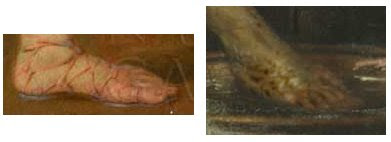
My readers may think the title quite a challenge. Not me. I knew immediately where first to turn: Venus, Cupid, Folly and Time, painted around 1547 by one of Gawain's favourites, Bronzino. Most of us here have seen the image, a grand hieroglyph of the mannerist age, but how many know the latest soundings of its mysteries? It turns out that Bronzino's Folly (also called Pleasure) provides an exquisite example of Cinquecento piede d'atleta, athlete's foot, or to give the affliction its proper scientific name, tinea pedis. Here is Folly's right foot, after a recent restoration of the panel by the good people at the National Gallery:


We can clearly see the effects of unchecked trichophyta between and along the toes; compare, for reference, a modern photograph of the condition:


Bronzino was no doubt working from a model—probably a friend or associate with the condition. Representations of tinea pedis are rare in the Renaissance, and other sorts of foot-disease were painted more often. For instance, in Poussin's Bacchanalian Revel of 1632 (left) we find a sort of scabrous welting of the whole foot, while Peter's foot in Tintoretto's Christ Washing the Feet of his Disciples (1565, right) seems to be experiencing the early stages of necrosis:


It would be appropriate, I wager, to conduct a full-length survey and analysis of the social history of foot disease in Renaissance painting; but this, of course, is beyond our present ambit, and so I offer merely a few remarks on the narrower subject of Bronzino's tinea in oils. Now, as I said, painted tineae are rare; the only other examples from this period that spring to mind—a Barocci Magdalene, and, if memory serves me aright, an allegorical leper by Scarsellino—are not to be found online; both of these, moreover, are at least a generation later than Bronzino's panel. So I know of no precedents in painting for this image, although I'm sure Gombrich could have pointed me in the right direction.

Contemporary medicine, on the other hand, provides a few clues. In 1546 a treatise was published in Venice by Girolamo Fracastoro entitled De Contagione et Contagiosis Morbis. This was the first book to work out fully a theory of the contagion and transmission of disease: Fracastoro denied the Hippocratic-Galenic doctrine that all illness results from an imbalance of humours. Thus, while the mediaeval Galenists had taught that skin diseases (including the mycosis or morbus militis—our tinea) were caused by a drying-out of the body's bile or phlegm, Fracastoro instead posited that they were transferred from one body to another by offensive particles called seminaria. (The latter word is related to the atomic semina of Lucretius, although Fracastoro's theory has more in common with the Neoplatonic concept of species or immaterial emanation: for more details, see this pdf.)

Fracastoro further linked skin-diseases in general, and mycosis in particular, to syphilis. This should not surprise us. Fracastoro was the master of syphilis; he dined and slept with it, and was its confidant, its Boswell, even its Milton. In 1530 he'd written an epic poem on the subject, in three books, entitled Syphilis sive morbus gallicus, which in fact is the origin of our word. (A French epitome of the book is online here.) The poem was a hit, and went through 50 editions in Latin alone. It would not be too much to say that syphilis was responsible for Fracastoro's career, and by golly, he was determined to capitalise on it. The precise relation between the 'master disease' and mere mycosis is never spelled out in the De Contagione, but perhaps he perceived the latter as a milder, even inchoate form of the loathsome cankers assigned to syphilis in the previous epic:
Protinus informes totum per corpus achores
Rumpebant, faciem horrendam, et pectora foede
Turpabant.

Shapeless scabs burst at once through the body
and the dread face, and foully disfigured the breast.
What is important for our present purposes is that, according to J. F. Conway's pathbreaking 1986 analysis, syphilis itself appears allegorically in Bronzino's famous painting:


Here syphilis, generating madness as it did for Nietzsche, is the gruesome result of the triumph of lust, symbolised by the principal action. Conway makes use of Fracastoro in his discussion of Bronzino; if we allow that the painter knew the Syphilis, we may go further and suggest that he also knew De Contagione, and thus date the Venus after 1546, possibly the following year. The cute cherub with the cutaneous mycosis joins the triumph of lust, scattering his poisonous petals upon the amorous couple—an incarnation of the seminaria that carry disease from one body to another. Bronzino was adding his small vote of support to Fracastoro's new theory, a bold move; but he hardly wanted to mar the fine, glossy surface of his ducal commission with something so ugly as a fungal infection, so he confined the disease to the boy's foot, a tiny detail, which indeed had been lost to dirt and varnish until the recent cleaning.

As so often, it is the smallest elements—for Morelli an ear or a hand, for me a tineatic foot—that yield the greatest interpretive riches. Gawain would not agree, but perhaps the rest of my readership will give the idea some credence.

27 May, 2007

Brotherly love

At the age of eight I accompanied my parents, and possibly my grandfather, who was then living in a retirement community in rural Pennsylvania, to the Philadelphia Museum of Art. It was a new experience for me, and this remains my earliest memory of any art gallery in the world. I fell in love with that old bastard Picasso around this time, but what really set me off, I think, was this, Chagall's 1911 Half Past Three (The Poet)


A green head—and upside down! It captured me. Such was the inexorable course I took towards a puberty-long love of modernist painting. I was soon to trick up a theory, too: while browsing the Musée Picasso, which was at that time my Mecca, I decided, apropos of not much, to found my own aesthetic calculus on three 'primary' qualities, each ranked out of 10: colour, weight (or solidity), and balance. The middle term charged me as something of a Berensonian, I realise now, though of course I had never heard of him. So for the next hour I scuttled around the gallery, rating each canvas out of 30. It satisfied me then. But a man changes, and I would not remain Clive Bell forever. Now Chagall bores me. Cooled, in fact, are my affections to a vast majority of the art that occupied the first ten years of my gallery-going life. But even now, as Chagalls go, this is better than average—perhaps you will agree.

*

Why the reminiscence? Yesterday I returned to the Philadelphia Museum with my wife: my first time since the first time. On this occasion we scorned the modernists, and clove solely to the pre-1500 masters on the second floor. Mrs. Roth admired the fragments of Gothic baukunst; I marvelled at the Van der Weyden Crucifixion, a primitive Navicella by Giovanni di Paolo, and some second-tier late Botticelli predellas. There was also this, unexpectedly, in a sea of orientalia to which I remained largely indifferent:


A combination-padlock securing a nineteenth-century Chinese chest, and far handsomer than its client. At six or so, as the sunlight intensified in the west, Jeff 'Tain' Watts and his band appeared for a scheduled performance in the gallery's atrium. The smart set sat on the grand stone steps; the smarter sat at tables, nibbling on salads and quaffing red—I watched with amusement from the balcony as a gourmand and his wife took turns fondling the lower back, not quite the bottom, of their young waitress as she bent over to clear the table, chastely uniformed—a little moment of voyeurage almost lost in the whobub of glasses and cutlery and Tain's frenzy on the skins.

*

With us were Paul Zenoli and his wife Marty, who had invited us, on the basis merely of the Varieties and subsequent correspondence, to spend a couple of days with them in and around Philadelphia. (Finally, an ulterior use for this thing!) They are, truth be told, a most splendid couple, whose hospitality during our short stay was impeccable—a Baucis and Philemon of our times, replete with cats and laughter, although being mere mortals ourselves we could not quite repay their generosity.

With the Zenolis we partook on foot a little of the city in its wafting glow. Through Rittenhouse Square we walked, and it thought me of Jane Jacobs, whose case study of the four Philadelphian squares is a beacon of attentiveness and crisp thinking. A graffitum opposite the fountains proclaimed, 'Life is more than just love'. But Marty was more interested in the prams and strollers, of which she spoke like an automobile enthusiast, full of love, and lovingly scornful of the overpriced and underdesigned models being jollied about under the trees by affluent bourgeoisettes in the latest summer-frocks. She seemed to know what she was talking about, and her cogent and unusual contempt was just the sort of thing to delight me.


When exploring a new city, the candescence of evening—or morning—is quite the ticket. (Though punishing rain has its merits too.) Being alone gives the experience its own thrill; having company, on the other hand, even unmet company, as we did, provides the new environment with a certain readymade familiarity. At times I was reminded of Manhattan; at times Berkeley, especially in the profusion of surface detail upon façades of brick and stone. On Thursday we took in the Mütter Museum, a latterday wonderkammer, taciturn and macabre, whose highlights included a Huttesque colon, a case of suicided skulls, and several drawerfuls of objects removed from foolish throats.


I enjoyed the Mütter; but to me the greater museum was the one outside, full of living specimens and huge, intricately-carved machines for living in. The city, for once, had just the right amount of life, neither crowded nor empty. When we emerged from the darkness, Paul's lost cap was discovered in the middle of the road, ground into the dirt by innumerable wheels in the space of an hour, yet quite intact. He wore it jauntily, undeterred.

For supper, by which time we'd all relaxed a bit with each other, Paul cooked up a polenta with onions, walnuts and bleu cheese, perfectly delicious. As I said at the time, I'm always impressed by culinary skills, so lacking am I in that department. The herbs and vegetables they had grown themselves—il faut cultiver le jardin—and all of us at that moment were feeling old, in a happy way: sated. We toasted, as was most natural, the internet, most revolutionary of modern innovations, for bringing together such an unlikely gang. And we were each just a little relieved that the others' online sanity had not, after all, concealed psychoses in the real world. All four heads were distinctly white, not green, and, thank goodness, on the right way around.

26 April, 2007

Who?

"First I sits myself down. Then I work myself up. Then I throw in my darks. Then I pulls out my lights."


"If the picturesqueness of objects be increased in proportion to their roughness of surface and intricacy of motion, two spiders, such as the avicularia, not to descend to too diminutive a scale, caressing or attacking each other, must, in point of picturesqueness, have greatly the advantage over every athletic or amorous symplegma left by the ancients."


"With regard to ourselves, the barbarous though then perhaps useful rage of image-breakers in the seventeenth century seems much too gratuitously propagated as a principle in an age much more likely to suffer from irreligion than superstition. A public body inflamed by superstition suffers, but it suffers from the ebullitions of radical heat, and may return to a state of health and life; whilst a public body plunged into irreligion is in a state of palsied apathy, the cadaverous symptom of approaching dissolution."

(No googling!)

22 April, 2007

Against the Eye

In 1880, an unknown Russian art connoisseur named Ivan Lermolieff published a landmark study entitled Italian Painters: Critical Studies of their Works. The book opens with a preface, 'Principles and Method', which takes the form of a dialogue between the author, currently a tourist in Florence, and an eccentric Italian art-lover—the latter is never named, but is in fact a transparent portrait of the book's real author, the physician and amateur critic Giovanni Morelli. In conversation, the arch and assured Italian convinces his Russian interlocutor that the common method of identifying paintings—by an uncritical use of documentary sources—is flawed, and must be replaced by his own technique of minute formal analysis. The Italian is dismissive of art history as an academic discipline, insisting that 'art must be seen, if we are to derive either instruction or pleasure from it'. The narrator, eager to agree, replies:
A very different view is taken in Germany, my dear sir; there people will only read, and art must be brought to public notice, not through the medium of brush or chisel, but through that of the printing press.
Discounting the irony of this sentiment's appearance in a printed textbook, the argument, especially as presented here in such a one-sided manner, might seem a closed case—for who could possibly argue that art is better to read about than to see? Who would want art history, art criticism, before art itself?

Perhaps some of my readers have an inkling of the answer.

*

Morelli's position, and his vehemence, remind me of the attitudes of my long-time comrade on this site, Chris Miller, who has lately been showcasing Inuit sculpture on his own blog. Chris is a sculptor himself. He is, in fact, one of three sculptors I have met while blogging. (I have, on the other hand, only met one painter.) The other two are the eccentric Dorset gentleman Robert Mileham, and Amanda Sisk, who now teaches at the Florence Academy of Art—both of whom have blessed us with their comments. All are remarkably accomplished; figure sculpture, a medium necessarily stable and traditional, clearly demonstrates the technical abilities at their disposal.

Chris and I once argued about the visual psychology of sculpture. He wrote:
I don't think that the views of a sculpture have anything to do with each other—and they are usually of different qualities—with, hopefully, at least one that is memorable, with the rest being acceptable.
He cited the influential theories of Adolf von Hildebrand to support his views. I found the whole idea rather hard to understand. To me, the power of a sculpture came from the fact that it is a unified body, something beyond a group of views. Even better than a single sculpture—I argued—is the figure-group, where one's spatial relation to the group determines one's degree of involvement in its drama. Different views are not better or worse, merely different: each has its own pathetic resonance. My example was the stunning Compianto di Cristo of Niccolo dell' Arca. Chris retorted, dismissing my argument,
My guess is that as a 6-piece ensemble, this Dell' Arca piece probably offers no more than one good view—the one shown in your photograph above—but each of the individual sculptures probably offers several views—including lots of good close-ups.
I forgot to respond to Chris's comment that time. Well, lately my reading has taken me back to the fertile fields of art psychology, and its history. Let's see if we can have another go at addressing the issue. Perhaps in doing so, I'll manage as well to answer the first question posed by this post.

*

Seeing and Touching.

F. David Martin's 1981 book, Sculpture and Enlivened Space, opens with an overview of historical opinions of sculpture. He notes the salient fact that it has almost always been considered inferior to painting—the Renaissance, for instance, looked down on sculpture as manual labour, not befitting the nobility of the artist. In the Treatise on Painting, fadged up from Leonardo's notebooks after his death, can be found a series of arguments for the superiority of painting—less physically tiring, more intellectually taxing, and so on. Martin remarks that 'It never occurred to anyone in the Age of Enlightenment. . . to defend the autonomy of sculpture'. Criticism, he thinks, is dominated by the tradition that sculpture is an art for the eye, and one inferior to painting—he refers constantly to the 'eminence of the eye'.
The tradition has been so dominated by the eminence of the eye that it never occurred to anyone before Marcel Duchamp and Constantin Brancusi in the twentieth century even to raise the question whether a blind person was able to perceive sculpture.
He attributes this tradition partly to the fact that most critical knowledge of sculpture has come through engravings and now photographs—a medium which reproduces painting well, for obvious reasons, but sculpture badly. For Martin, as for Morelli before him, a true art criticism must be experiential, and so when he inevitably goes on to argue for the sculptural primacy of touch over sight, he opens with an account of an actual encounter with art—a painting by Rembrandt and a sculpture by Hans Arp:
I found myself reaching toward the statue rather than keeping my distance. . . Whereas my perceptual relationship to the Rembrandt required my getting to and setting in the privileged position, similar to choosing what I consider to be the best seat in a theater, my perceptual relationship to the Arp was much more mobile and flexible. I wanted to touch and caress the shining bronze. . . The smooth rounded shapes with their swelling volumes moved gently out into space, turning my body around the figure and controlling the rhythm of my walking. . . the Arp seemed not only three-dimensional but four-dimensional, because it brought in the element of time so discernibly—a cumulative drama, a temporal gestalt. . . each aspect was incomplete, enticing me on to the next for fulfillment.
For Martin, no one view of the Arp can be privileged—'each aspect was incomplete'—rather, its power comes from the interplay of an infinity of views and aspects. In this he agrees with Naum Gabo, whom he quotes: 'To think about sculpture as a succession of two-dimensional images would mean to think about something else, but not sculpture'. Martin feels the sculpture, rather, as a spatial and even temporal body.

(Are tactile sensations limited to sculpture? Berenson would have disagreed: for him, the Florentine genius was for generating just such responses in painting—'I must have the illusion of varying muscular sensations inside my palm and fingers corresponding to the various projections of this figure'.)

Martin is arguing that the two-dimensional images produced by a sculpture are less important than the sense of 'whole' that it engenders in us. In trying to articulate this 'whole' he is forced back on the inarticulate jargon of the French philosophaster Merleau-Ponty: 'Sculpture reveals our physical "withness" with things'. This is a shame, because I think that Martin's insights would be better realised by turning away from phenomenology, and towards Platonism.

*

Seeing, Touching and Knowing.

We all know that Plato pried sight apart from its etymological cousin, knowledge—idein, 'to see', from oida, 'to know', and eidon, 'Idea' or 'Form'. For Plato, seeing is believing but certainly not knowing:
SOCRATES: Then knowledge does not consist in impressions of sense, but in reasoning about them; in that only, and not in the mere impression, truth and being can be attained?

THEAETETUS: Clearly.
Plato was distrustful of images. He did not have much to say about sculpture; but one of his intellectual descendants did. For when Martin writes that 'It never occurred to anyone in the Age of Enlightenment. . . to defend the autonomy of sculpture', he is completely wrong. Ladies and gentlemen, I give you Johann Gottfried Herder—
As soon as a single rooted viewpoint takes precedence, the living sculpture becomes a mere canvas and the beautiful rounded form is dismembered into a pitiful polygon. . . Sculpture creates one living thing, an animate work that stands there and endures. . . sculpture is truth, whereas painting is a dream.
The Varieties is already a friend of Herder's; we much prefer his imaginative cultural nonsense to the obstreperous metaphysik of his inheritor Hegel. I wrote about his views on history here. Herder's treatise on sculpture, substantially written in 1771 but published only in 1778, is fascinating in so many ways. Like modern writers on psychology (eg. Jakobson, Damasio) he analyses the mind by reference to defects and abnormalities—the synaesthete, the congenitally blind, and so on. He develops the argument of Lessing's Laocoon (discussed here), and anticipates the Romantic revival of Plato. He engages with the perception-theory which was of such interest to 18th-century philosophers; his argument, for instance, is implicitly conditioned on Berkeley's proposition that touch, not sight, conditions spatial awareness:
An ophthalmite [eye-stalk] with a thousand eyes but without a hand to touch would remain his entire life in Plato's cave and would never have any concept of the properties of a physical body.
In 1764, Thomas Reid had poked fun at these debates, imagining a race of 'Idomenians' who have one eye and no sense of touch; the race has no concept of depth, believing that two objects occupy the same space when one passes under the other, and its philosophers have descended into fruitless squabbling.

For Herder, likewise, mere visual sensation is inadequate to an understanding of space, and therefore of Being: 'sight is but an abbreviated form of touch. The rounded form becomes a mere figure, the statue a flat engraving. Sight gives us dreams, touch gives us truth'. Sculpture is greater than painting because it is not confined, as painting is, to the image, to the eye—in Platonic terms, its subject is truth, not dreams or impressions. It cannot be reduced to a series of views, 'dismembered into a pitiful polygon'. Where the painter merely depicts, the sculptor, like God fashioning Adam, creates. The spiritual power of sculpture, as Herder explains towards the end of his treatise, is witnessed by primitive idol-worship; the ancients were aware, he thinks, that the statue must always be an image of the soul, of the world of Forms, bodied forth.

*

Where does that leave us? If we are going to accept the philosophical dogmas of a fin-de-siècle aesthete such as Hildebrand, who asserted that art is valid only insofar as it progresses beyond the limitations of nature, then we ought to be equally receptive to the Platonic aesthetics of Herder and Martin. In Herder's case, this outlook tends towards an appreciation of classical sculpture; in Martin's case, towards a taste for Arp and other abstracts. For me, it finds expression in my delight in the unfinished, fragmentary and deliquescent, for instance these Nubian lips:


Or Donatello:


Or Rodin:


Or even our friend, Amanda Sisk (more images here), whose shapes have barely emerged from the primordial ooze:


Why? Because in being (or appearing) incomplete, these sculptures call into question the primacy of the eye. If visual beauty arises from perfect form, these works decline such standards; rather they invite the mind to complete them—what Gombrich called the 'beholder's share'. The intellect, not the eye, is entertained. And this intellectual sculpture, this 'virtual' sculpture, cannot be considered in terms of views or images, not even three-dimensional ones. It cannot even be visualised—to do so is to compromise, to break the spell, just for a moment. It is, in fact, very much like another sort of intellectual construction: the castle of words, which must, again, remain ever incomplete.

Is it any surprise, then, that I, who prize the intellectual above the visual, the unseen above the seen—I, who greedily want my share of the work—should prefer the history of art to art itself? For me, art is always something remote, which I can do no more than admire, like a woman, silent and beautiful, but not for me. How I should like to walk in the world of Gentile's Adoration, or Uccello's Hunt, or Seurat's Grand Jatte! But I cannot: they are separated from me by the accursed plane of their surfaces. Art history, on the other hand—the history of ideas—is like a fluid that percolates coldly in my body. It plays with me, and lets itself be played with, always open and receptive to my touch. Thinking, truly, is the aesthetic experience.

Update: John B. offers his further thoughts here.