Ni ansa
George Calder, ed. Auraicept Na N-Éces (1917).
The history of grammar is probably most people's idea of Dullsville, PA. But it's one of those random byways I happen to find quite interesting, and know a little bit about—specifically, the history of grammars of Indo-European languages. The earliest extant work of this kind is a Sanskrit grammar dating back to about 500 BC, composed by the Indian scholar Panini, whose name now evokes little more than a popular Continental snack. There was a flurry of grammatical activity in the research centres of Alexandria and Byzantium around the third and second centuries BC, but little survives from this period. The earliest piece we have is a scrappy Greek grammar attributed to Dionysius of Thrace, which is available online here, and has been translated by Alan Kemp (Historiographica Linguistica 13.2/3 (1986), pp. 343-363). The two great Latin grammars, which would continue to be used throughout the Middle Ages and Renaissance, were by Aelius Donatus (c. 350 AD, the teacher of Jerome) and Priscian (c. 500 AD at Constantinople). The former work was one of the very first texts printed by Gutenberg, while the latter, considerably more sophisticated, introduced the discussion of syntax for the first time. Vernacular grammars were a long time coming. The heroic Alberti produced a rough Italian piece in 1443, while Nebrija trotted out a Spanish one in 1503, and William Bullokar got around to the English in 1586.
Long before Alberti, however, was this bizarre treatise. The Auraicept, known in English as The Scholars' Primer, is a grammar of Middle Irish as well as a guide to the secret Ogham characters in use at the time—that time being an indefinite date between 650 and 1100 AD. (The always reliable Language Hat quoted me Hermann Moisl that it is 'early eighth to the eleventh century'; George Calder, however, notes its close dependence on 7th-century materials like Isidore and Maro Grammaticus, which admittedly doesn't prove very much.). The Wikipedia article attributes the work to a Longarad, though I've no idea where it gets this name from. George Calder lists four (semi-pseudonymous) authors: Cenn Faelad (d. 679), Ferchertne, Amergen and Fenius.

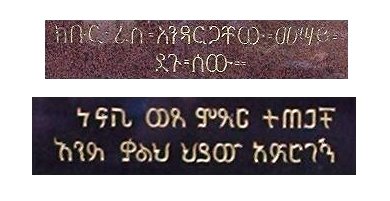
In many respects the Auraicept follows the Donatian tradition. It starts with letters, then goes onto words, gender and declension, parts of speech, and the accent. It is written in a catechistic style, with a question, followed by a retortive 'Not hard' (ni ansa), and then the answer. Notice Calder's wonderfully stiff translation, almost mediaeval in its rigidity; it faces the original Irish text. Also here is the striking assertion that Irish (Gaelic) is the perfect language because it incorporates the totality of other languages. Later it is said that Irish contains the best of each language, carefully distilled by Fenius at the time of the Tower of Babel—a precursor to the Enlightenment notion of the 'perfect language', and specifically to the experiments of Esperanto et al. This strand of Celtic linguistic mysticism would have a brief revival with the insane scribblings of Rowland Jones and L. D. Nelme in the 18th century. The Auraicept blossoms into a hierarchical symbolism of Babel around the number 72—which, as twice 36, already had significance in the sexagesimal post-Chaldaean numerological tradition, often abbreviated to 70, as for instance with the Septuagint, or the disciples sent forth by Christ (Luke 10.1)—and the number 72 was long associated with the number of races and languages on earth, for which see Hermann Weigand, ‘The Two and Seventy Languages of the World’, Germanic Review 17 (1942)—so we get this:
Leaving aside the technicalities, there's a wonderfully romantic quality to this writing—the anchoring of the abstract in the concrete. The letter itself becomes a concrete quantity, thanks to a fanciful etymology from Priscian:
Links and more further reading about the Auraicept here.
The history of grammar is probably most people's idea of Dullsville, PA. But it's one of those random byways I happen to find quite interesting, and know a little bit about—specifically, the history of grammars of Indo-European languages. The earliest extant work of this kind is a Sanskrit grammar dating back to about 500 BC, composed by the Indian scholar Panini, whose name now evokes little more than a popular Continental snack. There was a flurry of grammatical activity in the research centres of Alexandria and Byzantium around the third and second centuries BC, but little survives from this period. The earliest piece we have is a scrappy Greek grammar attributed to Dionysius of Thrace, which is available online here, and has been translated by Alan Kemp (Historiographica Linguistica 13.2/3 (1986), pp. 343-363). The two great Latin grammars, which would continue to be used throughout the Middle Ages and Renaissance, were by Aelius Donatus (c. 350 AD, the teacher of Jerome) and Priscian (c. 500 AD at Constantinople). The former work was one of the very first texts printed by Gutenberg, while the latter, considerably more sophisticated, introduced the discussion of syntax for the first time. Vernacular grammars were a long time coming. The heroic Alberti produced a rough Italian piece in 1443, while Nebrija trotted out a Spanish one in 1503, and William Bullokar got around to the English in 1586.
Long before Alberti, however, was this bizarre treatise. The Auraicept, known in English as The Scholars' Primer, is a grammar of Middle Irish as well as a guide to the secret Ogham characters in use at the time—that time being an indefinite date between 650 and 1100 AD. (The always reliable Language Hat quoted me Hermann Moisl that it is 'early eighth to the eleventh century'; George Calder, however, notes its close dependence on 7th-century materials like Isidore and Maro Grammaticus, which admittedly doesn't prove very much.). The Wikipedia article attributes the work to a Longarad, though I've no idea where it gets this name from. George Calder lists four (semi-pseudonymous) authors: Cenn Faelad (d. 679), Ferchertne, Amergen and Fenius.
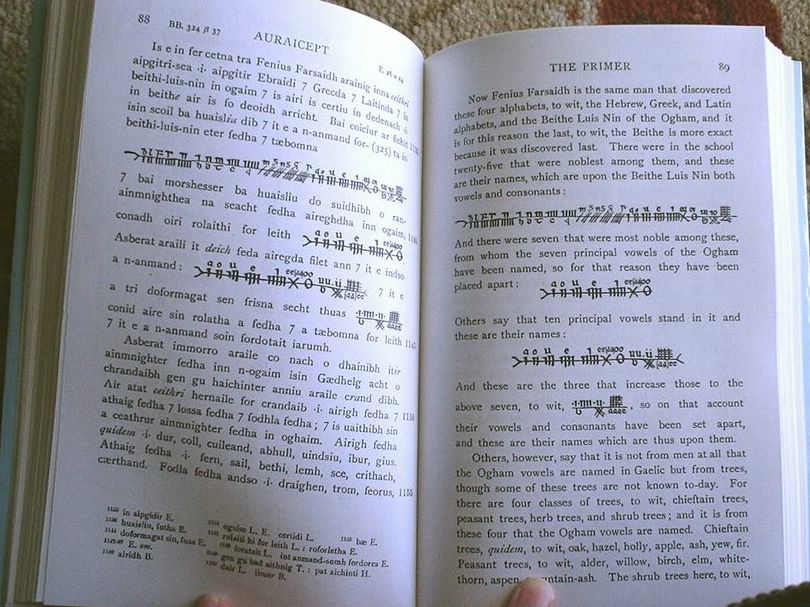
In many respects the Auraicept follows the Donatian tradition. It starts with letters, then goes onto words, gender and declension, parts of speech, and the accent. It is written in a catechistic style, with a question, followed by a retortive 'Not hard' (ni ansa), and then the answer.
To what is this a beginning? Not hard. To the selection that was selected in Gaelic since this is the beginning which was invented by Fenius after the coming of the school with languages from abroad, every obscure sound that existed in every speech and in every language was put into Gaelic so that for this reason it is more comprehensive than any language.
Notice Calder's wonderfully stiff translation, almost mediaeval in its rigidity; it faces the original Irish text. Also here is the striking assertion that Irish (Gaelic) is the perfect language because it incorporates the totality of other languages. Later it is said that Irish contains the best of each language, carefully distilled by Fenius at the time of the Tower of Babel—a precursor to the Enlightenment notion of the 'perfect language', and specifically to the experiments of Esperanto et al. This strand of Celtic linguistic mysticism would have a brief revival with the insane scribblings of Rowland Jones and L. D. Nelme in the 18th century. The Auraicept blossoms into a hierarchical symbolism of Babel around the number 72—which, as twice 36, already had significance in the sexagesimal post-Chaldaean numerological tradition, often abbreviated to 70, as for instance with the Septuagint, or the disciples sent forth by Christ (Luke 10.1)—and the number 72 was long associated with the number of races and languages on earth, for which see Hermann Weigand, ‘The Two and Seventy Languages of the World’, Germanic Review 17 (1942)—so we get this: Query, what are the definite numbers of Nimrod's Tower? Not hard. Eight of them, to wit, 72 counsellors, 72 pupils, 72 races of men, 72 languages, the languages in his school, 72 peoples whose were those languages, and the races, 72 artificers to work at it, 72 building materials including lime, bitumen, earth, and cement in equal layers, 72 paces in width. . .Languages become part of the edifice, like bricks in a whole. This is why the Auraicept goes onto say that according to different accounts, 'only nine materials were in the Tower, to wit, clay and water, wool and blood, wood and lime, acacias, flax thread, and bitumen', which correspond to 'noun, pronoun, verb, adverb, participle, conjunction, preposition and interjection'. Which is only eight. Oops. I imagine clay and water to be the noun and the verb, solid and liquid, the two primary components; blood for the personal pronoun, flax thread for the conjunction and fiery bitumen the interjection. I don't know about the others. You'll notice that 'participle' is listed as one of the parts of speech; this follows the classical notion (see Varro 6.36) that words can be divided binomially according to whether they possess time (verbs), case (nouns, adjectives), both (participles) or neither (everything else—commonly divided into adverb, conjunction or preposition, and sometimes interjection).
Leaving aside the technicalities, there's a wonderfully romantic quality to this writing—the anchoring of the abstract in the concrete. The letter itself becomes a concrete quantity, thanks to a fanciful etymology from Priscian:
the letter [litera, expanded to legitera] is as a road for reading [legendi iter] inasmuch as it prepares a way for the reading:Then a Gaelic equivalent is attempted, the word for 'letter' being gutta:
voice foundation [guth fotha], ie. foundation of the voice is that: or voice sent [guth fuiti], in respect that voices are sent through them: or voice ways [guth seta], in respect that they are ways of voices. . . or a voice place [guth aite], ie., they make a voice in place: or they vocalise [guthetait], ie. in respect that voice comes through them alone.The process of etymologising here is not to find the true root (etymon) of the word, but as a sort of magic with words, a temurah, the notion being that all products of the same sounds are ultimately equivalent. And language is wood, too, for the Ogham is the Bethe Luis Nin, the tree alphabet, letters carved into bark. As Cassiodorus delights in reminding his reader, liber (book) is from liber, free, as the bark (liber) from the tree. And 'Fidh, wood, is from the word funo [φωνέω], I sound, or from the word fundamentum, ie. foundation. . . Now, as to fid, wood, good law is as its meaning, both artificial and natural'. Taebomnai or consonants are the sides of oaks, 'from the fact that material for the words is cut out of them'. Wood was the stuff of the universe for the Greeks, first xyle then hyle. I always wondered about that fact. The connection was made for me also by George Guess, who concocted a syllabary for the Cherokees in the 1810s, and who gave his native name to the Sequoyah tree. I wrote a poem about it once.
This general shaman tells heavens to the earth,The Irish literature of the early mediaeval period is a goldmine, full of strange linguistic adventures, such as the Hisperica Famina poems, written in bizarre macaronic Latin. The Auraicept is a product of that sensibility, overflowing with ideas, words, stories, a light in the dark, grammatic fantasy, a memory of religion and language made into new systems, and a fertile tributary in the river watering the immense gardens of Finnegans Wake.
his red wood pricking the elements;
in his girth, in his height, in his signed barks,
in the light that sparks on his moss-lined trunk,
in his xylems and fluid phloetry, in ants patterning him,
in the galed twittering of branches,
most of all in pulp, paper—read wood—
this tree whispers encoded heavens to the earth.
Links and more further reading about the Auraicept here.


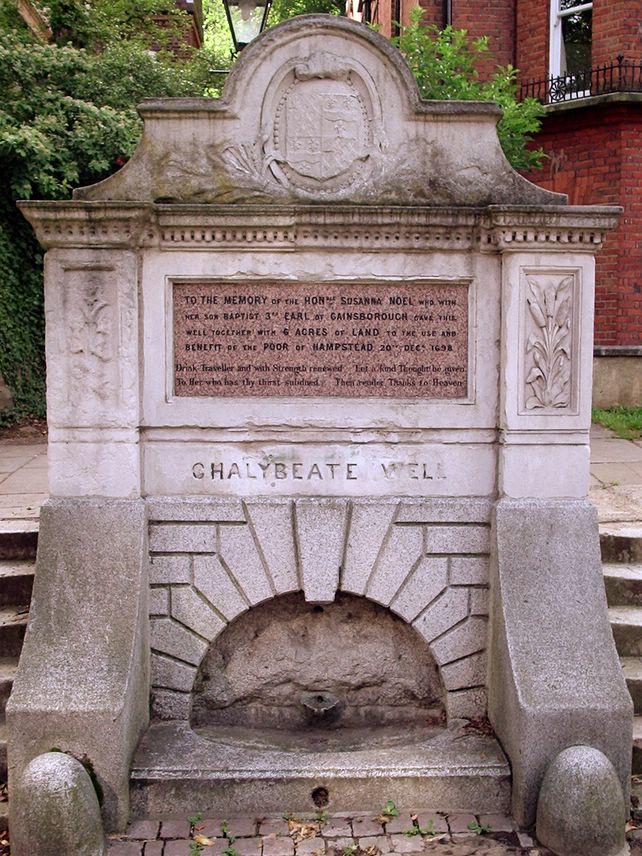


 wrote a 20-page poem named Chalybea. The name, playing off so many related words, had so much resonance for me that a whole world seemed to spill out of it. It evokes the currents of a water deeper than all men, a spring or an ocean of thought, and the iron rising out of it, the iron in the blood, the iron of the steel of our new architectures, with water hardened into glass, and also the chalybeous blue of case-hardened steel, the blue of the deep, of piano notes, and of watch-springs, of the hidden mechanisms of time, stopped. I imagined a city with rivers of liquid glass, where a shortage of steel forces men to strip their clocks and watches for the springs, stilling the movement of time. The poem's protagonist, an admiral named Conrad, stages revolution from the sea against the city, but achieves nothing. Chalybea to me was an object of love, a face half effaced peering out from a wall, a goddess presiding over the iron and the waters of time, and of the unfinished act—'Her who has thy thirst subdued'.
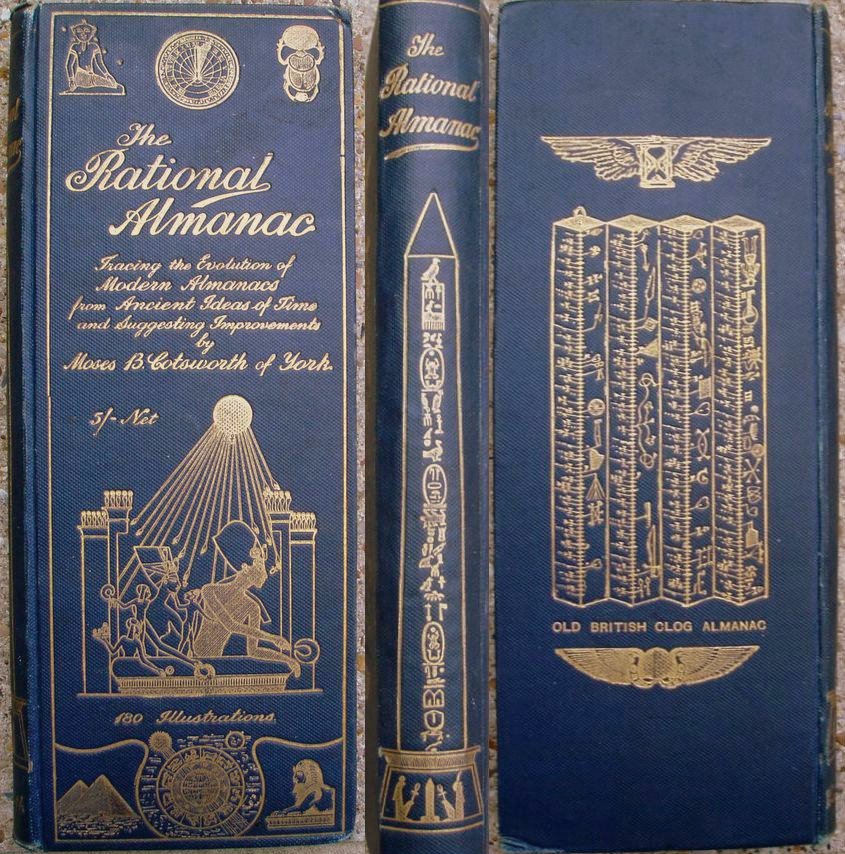


 In honour of my favourite tree (right), I offer notes on the history of English etymology, taking as examples the words monkey and puzzle. The OED chickens out on both counts with 'Origin unknown', venturing timidly in the former case that it is a Low German corruption of a proto-Romance word.

 The cemetery is dead entirely, not just under the earth. By the car-park I watch a fourbyfourful of blonde proles in faux-Chanel, there for a lunchtime's flowersetting, dead as could be. The gardeners seem to have been there for eternity, merrily pottering away, friendly for a good morning—though eyeing my shirt mistrustfully, as if with what a pansy! in mind, or envisioning in it another plot for their shovels—and quite content with life, having set aside a comfortable space for themselves among the lawns. Desperate for a drink, I am directed to the general taps in the gents' room, where I imagine the water running over the carcasses of Victorian aristocrats, and quite suddenly I taste, by the sheer power of suggestion, a little iron here, a spot of mud there, and the flavour of cholera. The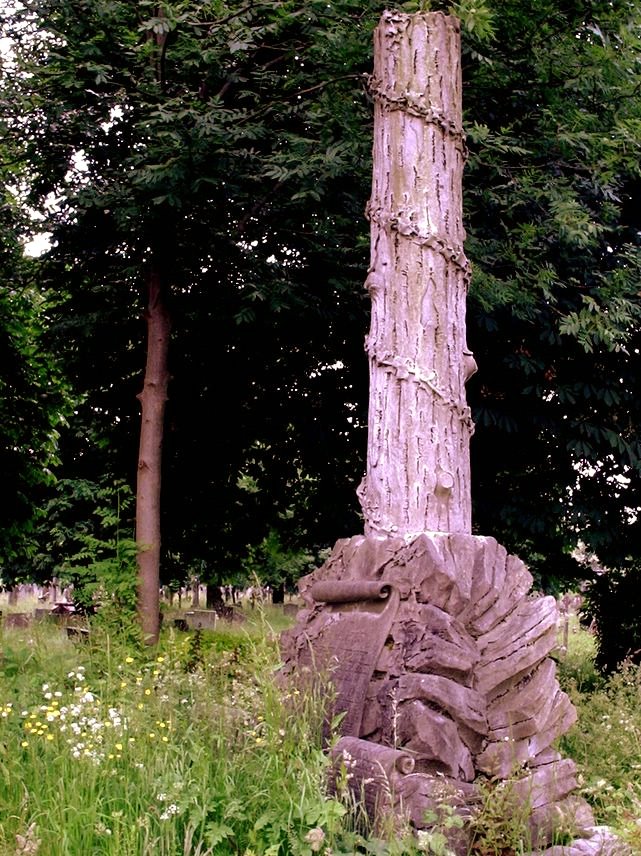
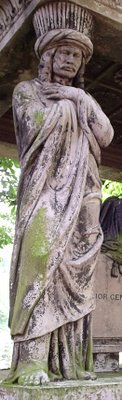 I accept Kensal Green as a nation's face averted, retaining upon it all the idiosyncrasies of what once surrounded it. The Victorian ghosts are evident in their mania for colonial accumulation—the frequent Egyptian motifs, the neo-Gothic stonework, the Greek portico around the chapel, these Indian telamons (pictured right)—and in their endless capacity for simple poetic sentiment, a reaction, perhaps, to the pressures of the sprawling cityscape and all its new machines. In their ideals, too, what people would be remembered for—military success, Christian piety,