19 December, 2006

Poetics and the Curse of Irony

Hayden White, Metahistory (1973)
Douglas Robinson, The Translator's Turn (1992)


The similarity between these two books is not immediately evident—the one a critique of nineteenth-century historiography, the other a translator's manifesto. Both, however, have their roots in the tradition of American literary criticism represented by Kenneth Burke and Northrop Frye—brilliant outsiders who have remained hugely influential without becoming part of the mainstream, a position analogous to that of, say, de Chirico in modern art. White and Robinson, like Burke and Frye, aspire to philosophical system: they create grand structures into which they fit their analyses. And like Burke and Frye, White and Robinson see language—tropes, plots, speech-acts—as the basis of their systems. They are therefore sceptical about language, interrogating it, suspicious of its tactics and subtleties. They are, in another word, ironists, which is to say they are members of that vast crowd of postmoderns avant la lettre.

In The Rhetoric of Religion (1961), Burke describes religion as the arbitrary canonization of a single principle, a rhetoric confused for a metaphysics. For Burke, religion is ultimately poetic, and so just as a poem can have a guiding metaphor, so can a faith; he calls this guiding metaphor a 'master-trope' or 'god-term'. Frye, in his late and lesser-known The Critical Path (1968), compares Marxism and Christianity as examples of 'myths of concerns', patterns of rhetorical language designed only to convince:
The real enemies of such movements are not those who oppose but those who are indifferent: the opposite of faith is not doubt, but the inability to see what all the fuss is about.
Both Burke and Frye deny to religion what they deny to literature—that which structuralists call 'positive truth', the notion that a claim has any validity beyond the confines of its own contextual system. There is only a circular 'relative truth', created by sophisticated structures of linguistic tropes. These tropes go back to Aristotle—metaphor, metonymy, synecdoche, irony. They are, in essence, ideals of the relations possibly existing between two objects: metaphor is the relation by similarity, metonymy the relation by contiguity, synecdoche the relation of part to whole, and irony the relation by inversion. (Individuals will quibble about the exact definitions.) And by this extreme analysis, complex ideologies and patterns of thought are reduced to their conceptual atoms. Without objective validity, these units form not a science but what both Burke and Frye, following Aristotle again, call a poetics, a structure of contingent associations, a vocabulary of parts and aesthetic networks.

*

Burke and Frye, then, turned religion and literary criticism into poetics; in the same manner, White turns historiography into a poetics—'I have attempted to establish the ineluctably poetic nature of the historical work'—and Robinson does the same for translation studies. White will use the four poetic tropes to classify modes of writing history, and Robinson will use them to classify methods of translating.

The debts are explicit—White makes copious reference to Frye, and Robinson to Burke. In his masterpiece, Anatomy of Criticism (1957), Frye recycled and developed Aristotle's fourfold classification of drama as epic (romance), tragedy, comedy and satire, and found these archetypes in the entire run of Western literature, from Homer to Joyce. White, likewise, recycles Frye's expanded categories to classify historiographical writing of the 19th century—Michelet writes romance, Ranke writes comedy, Tocqueville tragedy, and Burckhardt satire. These words have become loosed from their conventional meanings, but not completely—satire, for instance, is revealed not as the moralistic surrision of Pope and Swift, but as the monstrous absurdity of Jarry and Beckett, and is shown to deny all comprehension of man's struggle among his own and with the natural world. Burckhardt, with his aestheticism and his distrust of objective historical accuracy, becomes a sort of gloomy fantasist, painting the Quattrocento as he would have dreamt it, as a moment of perfect light and liberty, between the ecclesiastical repression of the Middle Ages and the political conformism of modern times. Satire, in its turn, corresponds to the trope of Irony, which subverts the connection between a word and its referent.

There's a lot more to White's system—he adds more fourfolds, such as (radical, anarchist, liberal, conservative) and (mechanist, organicist, contextualist, formist)—and much of it is convincing. At times, however, the patterning wears a little thin. Frankly, it is difficult for me to keep in mind the image of Burckhardt as a nihilist jester, abandoning the narrative plots of Michelet and Ranke for an impressionist pointillisme of his subject. The abstract here comes too forcefully before the particular.

But irony is what interests White the most. It would not be too great an exaggeration to say that he perceives irony to be his bugbear, his nemesis. Such a perception is the hallmark of the postmodern condition. White diagnoses twentieth-century historiography as a largely unsuccessful attempt to escape the grip of irony—a mood which distrusts the grand narratives of historicism, preferring the simple and mythical, the direct and fragmentary—and which leads to a stifling scepticism towards intellectual endeavour. Yet White fully admits the irony of his own work:
It may not go unnoticed that this book is itself cast in an Ironic mode. But the Irony which informs it is a conscious one, and it therefore represents a turning of the Ironic consciousness against Irony itself.
Unfortunately, Irony is a stronger foe than White credits, and indeed a stronger combatant than White himself. Umberto Eco, in a rare moment of lucidity, put the postmodern condition, the condition of irony, like this:
A man who loves a very sophisticated woman knows that he cannot say to her, "I love you madly," because he knows that she knows (and that she knows that he knows) that these words have already been written by Barbara Cartland. Still, there is a solution. He can say this, "As Barbara Cartland would put it, 'I love you madly'." At this point, having avoided false innocence, having said clearly that it is no longer possible to speak innocently, he will nevertheless have said what he wanted to say to the woman: that he loves her, but he loves her in an age of lost innocence.
I find something unpalatably, uproariously true in these words. And so they come irrefragably to mind when I discover White caught—unintentionally—in the same state, writing about two key metaphors in the work of Benedetto Croce:
I shall forgo the temptation to interpret them in a Freudian manner as phallus and womb, not because Croce condemned every effort at psychoanalytical historiography, calling it "valet's history" and deriding its practitioners as pseudo scholars seeking a cheap interpretation without the work required by true historical comprehension; but because, in accordance with this prejudice, Croce refused to reveal enough about his private life to permit muster of the kind of detailed evidence that alone can render a psychoanalytical interpretation convincing.
In 'forgoing' this temptation, of course, White has succumbed to it—he has no need of spelling out the Freudian interpretation, only of suggesting it. The ironic condition manifests itself as insecurity, the need to defend oneself against all possible charges of omission. This process reached its nadir in Sorrentino's fascinatingly awful novel Mulligan Stew (1979), which opens with a series of arch replies to editorial rejection letters, in this case richly deserved. In academic terms, the condition was strongly developed by writers like Frye and Burke, who removed the objective foundations of criticism, and who wrote in a polemic and defensive mode to compensate. I try to conquer this insecurity in my own writing, but not with complete success, as this very sentence attests. And so the great and terrible monster Irony consumes me, just as it consumes White—Irony cannot be turned against Irony, as the only thing that can defeat Irony is ignorance, which is impossible to achieve except by senility, lobotomy, or a nasty fall. Once you eat from the tree of knowledge, then your eyes shall be opened, and ye shall be as gods, knowing good and evil. And you shall know that you are naked, and hide yourself. There will be no going back.

*

Hayden White's Metahistory is designed to prove that what we consider good historiography is only one possibility of several, all equally valid. Douglas Robinson's The Translator's Turn is designed to prove that what we consider a good methodology of translation is only one possibility of several, all equally valid. His particular aim is to debunk the hegemony of 'sense-for-sense' translation, something for which I've always felt some distaste. As a reader who likes surfaces, I find sense-for-sense translation over-conservative and stifling. Robinson clearly feels some kinship not only with Burke and Frye (both of whom critique the valuation of content over style) but also with Barthes and Derrida, whose pompous projects are really no more than attempts to recover the value of the signifier over the signified, style over content, or in Derrida's terms, writing over speech. It is the latter allegiance which causes Robinson to reproduce in a later book some terrible Sokalian piffle, Derrida on 'iterability':
Because the possibility of reuse (and thus what may in some new use need to be defined as a misuse) is present in every "original" or "ordinary" context, a wedding in which the minister says "I now pronounce you husband and wife" is never simply "one" context which, subtracted in a philosophical discussion, would yield the "null context." It is always a fraction between one and zero, a fractal between binary poles, a fractured context or contextuality.
This is Robinson, lacking any real command of language, at his worst. But there is fruit to be salvaged from his project. In the earlier book, he posits a series of methodologies under the rubrics of rhetorical tropes (just as White had done for historiography), which Robinson calls (following Burke) 'master tropes'. Since irony has been a theme of this post, let's look at what Robinson thinks an ironic translation is:
The ironic translator wants to succeed this way too [ie. to overcome the impossibility of translating perfectly], but not by seeking equivalence—rather, by denying its possibility.

There are a number of ironic translation stances. One says, "The SL [source language] text is too brilliant, I can't translate this, I'm not a good enough translator, maybe nobody is." A second says, "This isn't the original, this is just a translation, don't start thinking you're reading the real thing, here." A third says, "Look how bad the SL text was, I'm just rendering it faithfully, don't kill the messenger."
Here we see the same anxiety, and the same attempt to forestall criticism, as we encountered above with White, Sorrentino, and myself. Robinson mounts a stirring polemic defence of the translator's art: he is desperate to show that the translator is not inferior to the original writer, and that he should not show obeisance or humility towards the text with which he is working. In other words, Robinson advocates an ironic attitude for the translator—and his various other tropes amount to the same consciousness via a different route. It explains Robinson's more outlandish propositions, for instance, that the translator should make shit up, especially when rendering functional reports:
The meteorological translator [ie. of weather reports] who feels bored can begin to vary his or her translations, experiment with variety, staying at first within the bounds of acceptability—referring to groundhogs or bunions, livening up his or her discourse with sportswriter-type verbal creativity—then carefully pushing past those bounds, testing the water. This means risking his or her job, of course; but then, surrendering to the boredom means risking his or her sanity, and one has to set one's priorities in this sort of thing. . . it is arguably better to quit after six months of subversive delight than after six months of mind- and body-numbing boredom.
Who can fail to admire this sort of brio? Naturally, Robinson's anti-authoritarian (though irritatingly PC, as evidenced by the relentless 'or hers') aesthetic leads him to delight in Zukofsky's Catullus, an example of the 'homophonic translation' covered at Languagehat here. There's an amusing passage where he gives a literal paraphrase of 'Minister wet to lee, pour the Falernian', etc. The result is total nonsense, of course. Robinson attempts an innovative translation of Jorge Guillén's poem 'Desnudo', admitting, with a modesty false but nonetheless warranted, that 'I am no poet'. The irony is that someone full of ideas, and with a keen insight into the wretched clichés and prejudices of translation studies, should turn out to be completely incompetent at translating. Robinson is gorged on the theories of others—Burke, Derrida, Thomas Kuhn, later Grice and Austin, even the cutting-edge neuroscience that would beget Damasio's Descartes' Error in 1995—and yet he dismisses theory, or rather advocates theory as a way of transcending theory, in favour of practice. But in practice, Robinson has no feel for the English language. With Robinson, as with White, we see the triumph of the abstract over the particular, theory over practice. Their formal systems are full of valuable observations, and yet amount, for all their sophistication, to symptoms of the same ironic condition that afflicts us all.

16 December, 2006

Latin: an alternate history

I never trust a language without palato-alveolar sibilants. But this could just be the Jew and Teuton in me. You need a thickness in a tongue, a roughness, and the closest Latin comes is a labiodental fricative, although the voiced variety would arrive only in the first century AD, when the Latin V started becoming consonantal. The sibilant deficiency gives the language a cold, precise quality, a mood augmented by its elaborate inflectional system, and (in contrast to Greek) by its syntactic brevity—a rhetor like Demosthenes could deploy a full panoply of articles and particles, lacking in Latin, to organise and embellish his thoughts.

What I most dislike about Latin, however, is its lexical conservatism, a resistance to fancy quite alien to our (my) sensibilities. Homer could roll out elaborate compounds like the rhododaktulos and koruthaiolos with which we're familiar; Pacuvius, Ennius' nephew, tried to do the same in Latin, as in a line preserved by Quintiliannerei repandirostrum incurvicervicum pecus, 'The flock of Nereus snoutuplifted, neckinarched'—but it didn't catch on. Indeed, Quintilian sneers at Pacuvius for such an attempt, calling the effect 'harsh' [dure]. The orator then offers a classification of different compounds—the sort of thing we have Sanskrit names for now, delightfully—listing those built from different languages, of two or three elements, etc. He concludes:
But compounds are better suited to Greek than to Latin, though I do not think that this is due to the nature of our language: the reason rather is that we have a preference for foreign goods, and therefore receive κυρταύχην with applause, whereas we can scarce defend incurvicervicus from derisive laughter.
Interestingly, Quintilian denies that compounding is not suited to the nature of Latin; but the history of the language suggests otherwise. One can talk about the nature of a language not in any existential, Hegelian terms, but just insofar as Quintilian himself discussed consuetudo, ie. that which the speakers of the language are accustomed to doing. True, there are compounds, even some in verse, where metrical difficulties apply—such as Vergil's auricomos, 'golden-tressed', applied to the Bough—but it is not the norm. L. J. D. Richardson's essay, 'Virgil and the Homeric Epithet', Greece and Rome 1943, examines some of the issues involved.

The mainstream history of Latin through the Middle Ages and Renaissance is a history of dogged adherence to classical models, falling away, and then again reviving, an adherence which reached its peak with the cult of Ciceronianism in the 16th century. Erasmus makes fun of these classical pedants in his dialogue Ciceronianus (1528), whose stock fool Nosoponus has compiled an alphabetical lexicon of all the words and phrases used in Cicero's works, a lexicon to which he limits himself in his own writing. It was not so far-fetched—the real-life humanist Nizolius had already compiled his Thesaurus Ciceronianus for the same purpose. (An old tutor once accused me of being a 'Nizolian engrosser of blotted pie-dish linings', an insult which for some reason has lingered with me.) Within 100 years, Justus Lipsius and Joseph Hall would be channelling Seneca in Cicero's place, terse instead of fully periodic.

*

But there have been at least two attempts to make Latin interesting—the first in seventh-century Ireland, the second in High Renaissance Italy. By 600 classical Latin had definitively given way to mediaeval—Gregory of Tours is sometimes taken as the first 'bad Latinist'—and in the British Isles the language remained a somewhat alien commodity. It was here, after all, that scribes began adding spaces between words to aid reading, something unknown on the Continent. It is quite possible that Adrian of Canterbury introduced to Britain the North African tradition of decadent Latin found notably in Apuleius. Graves notes in the preface to his tight-arsed Golden Ass:
In my translation I have made no attempt to bring out the oddness of the Latin by writing in a style, say, somewhere between Lyly's Euphues and Amanda Ros's Irene Iddesleigh [Graves is obviously thinking of this essay]; paradoxically, the effect of oddness is best achieved in convulsed times like the present by writing in as easy and sedate an English as possible.
These words were written in 1947, eight years after Finnegans Wake, in the dusk of High Modernism, by a snivelling reactionary. But Apuleius, with his rhyming alliterations and occasional unusual forms ('famigerabilis') is quite tame compared to the verbal bestiaries of the seventh century Isles. I've already written about that bizarre Irish grammar of this period (or a little later), the Auraicept. The body of Hiberno-Latin poetry known as the Hisperica Famina, available in a modern edition with translation by Michael Herren, preserves many such oddities:
Uelut innumera apium concauis discurrunt examina apiastris
melchillentaque sorbillant fluenta alueariis,
ac solidos scemicant rostris fauos.

Titaneus olimphiam inflamat arotus tabulatum,
thalasicum illustrat uapore flustrum
flammiuomo secat polum corusco supernum,
almi scandit camaram firmamenti.
Or glaucicomantes cellium, 'bluemantled hills'. Apparently there's some Hebrew loaning in here too, but I don't remember where. From these roots, historically speaking, grew the literary tradition in England—most scholars read Aldhelm, the first great English writer (of Latin), as a writer in the 'hisperic' tradition, though this is disputed.

Still more interesting is the work of the mysterious Virgilius Maro Grammaticus, a grammarian of sorts from 7th-century Britain or Ireland. His treatises, the Epitomae and Epistolae, are full of odd collocations and deliberate perversions and obfuscations. He has been commonly taken as a parodist, though Vivien Law reads him rather as an arcanist. Words in his text are like gnostic spellwords, little observing Latin morphology—at one point he lists Twelve 'Latins', his jargon spewing out in a torrent of letters: assena, semedia, numeria (nim, dun, tor, quir, quan, ses, sen, onx, amin, ple), metrofia (dicantabat, bora, gcno, sade, teer, rfoph, brops, rihph, gal, fkal, clitps, mrmos, fann, ulioa, gabpal, blaqth, merc, pal, gatrb, biun, spadx), lumbrosa, sincolla, belsavia, presina, militana, spela, polema. H. A. Strong, better known as the translator of Hermann Paul, wrote a marvelously speculative 1903 article on these words, which if you have access to JSTOR is available here. Elsewhere Virgilius deliberates about the declension of ego, and specifically about its vocative case (how do you say "O I"?). He writes of word-scrambling, scinderatio fonorum—as if from Greek φωνη—
Scinderatio autem litterarum superflua est, sed tamen a glifosis sensuque subtilibus recipitur; unde et fona breuia scindi magis commodius est quam longa, ut Cicero dicit: RRR SS PP MM N T EE OO A V I, quod sic soluendum est: Spes Romanorum perit.
With these examples, Latin is played with by outsiders. In humanist Italy it would be played with again. The relationship of Latin to Italian—specifically, to Tuscan, unquestionably the queen of Italian dialects—had been of great interest since Dante's De volgare eloquentia (1305). In 1435 a debate was held at the Papal Chancellery in Florence. All the greats were present—Flavio Biondo, Poggio Bracciolini, Leonardo Bruni, and so on. Bruni argued that Tuscan had evolved out of the vernacular Latin spoken by the ancients; Biondo, on the other hand, argued that Tuscan had arisen from the clash of Latin with the tongues of barbarian (Lombard) invaders in the early Dark Ages. The debate was politically charged, of course—Bruni the Florentine, whose earlier work had established Florence as heir to the Roman Republic, and Biondo, based at Rome, the man who had coined the 'Middle Ages', desperate to restore classical Latin free from impurity. Biondo was right, in any event.

The debate was still going with Machiavelli in the next century. So when works started being written in the 'Macaronic style', mixing Latin and Tuscan in the same sentence, it must have been a rude shock. As the humanists were gaining a historical consciousness of their language and culture, so the Macaronic poets would dissolve history in their linguistic conflations. The first great monument of the style is the legendary 1499 Hypnerotomachia Poliphilii:
Peritissimamente quivi la dulciloqua Logistica fece alquanta narratione: physiculabonda laudava la praestante factione et la nobilitate della materia et arte et inveto (quale non se trovarebbe in Muriano) et vituperando la sua natura, et dixe. . .
A first edition of this work is still available on abebooks for $185,000; alas, I could only afford the modern translation. Like Graves, Joscelyn Godwin admits in his introduction to having made no effort to reproduce the book's style in English, only his reason is laziness, not pointed stylistic conservatism.

The canonical writer in the genre, however, is Teofilo Folengo, aka. Merlin Coccaius, a favourite of Rabelais's. When I was last in Florence I walked into an Einaudi, and my eye alighted on a copy of Folengo's great epic, Baldus. It was a beautiful edition, with a facing-page translation into modern Italian, and illustrated with contemporary paintings in full colour. The clerk was amazed that I wanted to buy it, especially as my Italian was only barely adequate to make the purchase. Later I spent an entire evening in my hotel-room, deciphering the first page with a bad Italian dictionary. It was fun!
Magna bachiocheries hominis, ratione dobati,
et cui soletto fazza levata datur,
velle per has tenebras orbum seguitare mulazzum.

Grande è la coglioneria dell'uomo, pur di ragion vestito, se pur lui solo in su la faccia rivolge al cielo, quando per le tenebre si mette a inormar le peste di un mulaccio cieco.
This is a typical excerpt, three lines from Folengo's lyrics Zanitonella, XVIII, with an Italian prose gloss. We see here, as in the Hypnerotomachia, the conflation of Italian (fazza, seguitare) and Latin (ratione, datur) forms, the combined form (mulazzum) as well as the plain weird (bachiocheries).

Of course, this material is all immensely difficult, and at the last count beyond my meagre capabilities. It pleases me, however, to know it exists, and some day I'd be interested to explore further. Why were these two places, the early mediaeval British Isles and flourishing humanist Italy, so diametrically opposite in culture, the twin loci for such verbal experimentation? Was it the heightened conflict, at each time, of elite Latin with the thriving vernacular? The degree and direction of cultural appropriation is difficult to discern in both cases. None of the above writers has given Latin palato-alveolar sibilants (although by this time Ecclesiastical Latin had provided a tch for the hard classical c); nor have they diminished its inflections, nor increased its verbosity. But they have provided a new rhythm, allowed not just new words but new ways of forming words, and put the slangiest of speech into written letters, just as Rabelais would allegedly comb the French shores for unrecorded billingsgate.

I leave you with this modern hispericum, C. A. Carruthers' Latin rendering of Lewis Carroll:
Est briligum: tovi slimici
In vabo tererotitant;
Brogovi sunt macresculi,
Momi rati strugitant.
Update: Languagehat links; further discussion of the vocative I, unexpectedly, at Jabal al-Lughat, which cites a reference to Virgilius from Eco's The Name of the Rose.

Update 12/08/07: "zmjezhd", née Uncle Jazzbeau, links, with more to say on macaronism.

13 December, 2006

Two compositions

Insomnia is a terrible thing. I feel trapped in the apartment, with the wife asleep, and only the company of my thoughts. It can be too asphyxiating to read, or at least read seriously, and yet there is little else to do. I work on some German, or on some auction catalogues. I listen to Ys for the fiftieth time.


When morning comes the world is of course irreproachable. Dawn has become cold even here, and from my balcony the fraicheur, and the vague forms of the distant mountains—so unlike what I have grown up with—and the exoskeletal plant stacks, with whose forms I find myself almost obsessed—all are caught up in the nets of cables overhead. The landscape of Tempe, in all its stripsprawling lowrise aridity, is dominated by verticals—palms, lights, beams, and the nearby presence of 'A' Mountain.


So walking home at night, past the playing-fields, the attenuated verticals come to assume the solemnity of men. In a pictorial frame, narrative is unconsciously created by imbalance. I have never crossed the two low guards on this path, nor will I. For to do so would make what lies beyond all the less mysterious.

11 December, 2006

Gedichte: I


Wenn du an meinem Herzen liegst,
So eng und weich und warm,
An meine Brust dein Kaeppchen schmiegst,
Vergeht mir Leid und Harm.—

Durchs Fenster scheint des Mondes Strahl,
Der laechelt mild herein;
Weisst noch? Als uns zum ersten Mal
Vereinigt sah sein Schein?

Und wenn ich ihn seitdem erblick'
Gruess' ich ihn still vertraut;
Er war's, der unser junges Glueck
Zu allererst geschaut!—


When upon my heart you rest
So close and soft and warm,
Nestle ridinghood against my breast,
Shrug off all bale and harm.

From the window comes the shine
Of moonrays mildly smiling and sublime—
Remember, how his gaze, benign,
United saw us, once upon a time?

And when I've seen him since, in tryst,
I greet him trusting, quiet in thought—
It was his glance, his light, that caught
Us first so young, in love, in bliss!

1 November 76

*

This is my first effort, an untitled lyric in a fairly legible hand. The original is not wonderful, and neither is my translation, but it's a start. I don't dislike the poem at all: the verse is calm and formal, romantic but not overdone. More interesting is the poem's tension between its gentle mood and the presence of the moon as a third party, almost voyeuristic—the moonlight 'saw' (sah) and 'looked upon' (geschaut) the lovers. [The following sentences, while false—see the comments—are still to be taken as if true. It's better that way, really.] The hint of darkness is compounded by the lover's Käppchen, which means a cap, and specifically the Catholic skull-cap also called a zucchetto or pileolus—but here it suggests something else, namely the story of Rotkäppchen or Red Riding Hood, hence my translation. The word vertraut, which connotes familiarity and trustedness, begins to suggest the trust of Rotkäppchen for her 'grandmother'. What big eyes you have! All the better to see you with.

10 December, 2006

Gedichte

I never set eyes on the single most significant clan ancestor in my life: Dr. Arthur Rochs, my mother’s father. He took on a mythic quality in my mind. Other cultures might well have said that his soul had entered my body. It did in fact, if you accept my idea of a secular soul. My mother was the most important influence on me and he was the most important on her; the continuity is clear. It didn’t hurt that when I was a small boy all the people would exclaim that I looked just like Doktor Rochs – to the extent that my first, and by no means worst, pun on record is saying that even the chickens said "doc, doc, doctor Rochs." (In the guttural German it sounds much more like chickens: "duk, duk, dukter ruks.")
So wrote my grandfather's brother, Walter Goldschmidt, in his recent memoirs. He's an eminent anthropologist based in California; when as an inquisitive teen I read The Teachings of Don Juan, I was taken aback to discover that he had written the preface.

My great-great-grandfather, Arthur Rochs, took his doctorate in philology at Halle in 1880, writing his dissertation on mediaeval romance. It must have been an exciting time to be there; in 1817 Halle was merged with the ancient University of Wittenberg—where Hamlet had studied—and since the 18th century it had been home to such lupine titans as Christian Wolff and F. A. Wolf, an epicentre of the Enlightenment. Between 1873 and 1876, just before Rochs arrived, the great linguist Hugo Schuchardt was teaching Romance Philology there. The tradition remained alive.


At the time Rochs was still living in Erfurt, home of iconic mediaevals, like the scholastic grammarian Thomas, and the mystic Meister Eckhart. Rochs quotes Eckhart, a man of particular local significance, for an epigraph to his poem Wermud—"Die wollust der creaturen ist gemenges mit bitterkeit", the lust of created beings is mixed with bitterness. This poem was written when Rochs was 19—which goes to show how much more erudite was teenage angst back then. It is from the fourth volume of a set of poetic notebooks written in Erfurt, 1875-1877; as I noted here, these notebooks were sent me by my uncle, who had been in possession of them since boyhood. Reading them is a great challenge: the two barriers are my limited German, and Rochs' ornate but compressed hand. Still, I'm going to transcribe and translate a few verses from these volumes, one at a time, for your curiosity and delight. That's what humanists are supposed to do, after all. I'll start with the shortest, clearest pieces, and work my way up—this will be an ongoing series, and I hope to produce the first tomorrow.

07 December, 2006

A man for one season

This piece takes as its genesis an argument I made recently at Heaven Tree. In his post 'A Man For All Seasons', Gawain posted a photograph of a statue of Scipio Africanus (presumably this one) from the Uffizi, apparently taken on the sly; his justification for this, and our subsequent debate, went as follows, edited slightly:

*

GAWAIN. The Uffizi, like most museums, won’t let us photograph; but they will not photograph for us, for money, either. Ergo, you may wonder, what is, exactly, the point? The policy certainly does not make the Uffizi any money. (And, besides, as a public service, should they even be allowed to make money from reproductions of works of art the taxpayers paid to acquire?) The policy really amounts to nothing more than taking things off the market and hiding them from he rest of us. So, Africanus is here partly as a protest.

CONRAD. As for the Uffizi—well, I am sympathetic to them. After all, the world has become so homogenised now—you can have a strawberry at any time of year, and see things from around the world without leaving your desk. Isn't there some value in retaining a mystery about a place—in withholding the beautiful from the casual eyes of the dilettante? Perhaps this will encourage the Goethes of the world to make the pelerinage to Florence, or wherever. The best things in life, like the best men, pace Thomas More, are not For All Seasons, but only for one.

GAWAIN. Conrad, my man, your sentiments re: museum's penchant for acquiring works of art and hiding them are endearing coming from you, but as defense of their policies from their mouths, not acceptable. (Which is why they say nothing and pretend it is not an issue.) (And even your defense does not work in cases where they by something and then lock it up in their vaults.)

CONRAD. My defense does work in such cases. . . for the true connoisseur must not only be in the right place, but there at the right time, and/or in the right capacity. . . !

AMANDA SISK, AKA "JOY IN LIFE". It's a bit like a flash of ankle or elegant wrist (Hugo's Les Miserables has an excellent example of this, wherein the fellow viewing the feminine grace is incensed that casual eyes may follow his to this glimpse, and for a gender reversal, try a wonderfully charged moment in the film The Winslow Boy). . . what matter if the rest is obscured? This does not define a future condemned to one view.

*

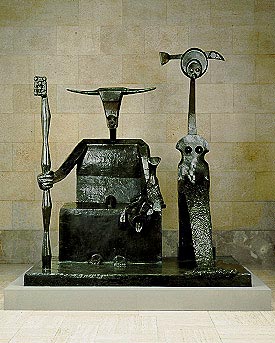
My argument was both specific and general. Specifically, one of the best things about artworks is that they are unique—modern sculptures, yes, are reproducible, as I discovered when I saw Max Ernst's Capricorn for the fifth time, and then there are lithographs, but leave that aside—and that they require an investment of time and money just to see. The art-world is inherently an elitist institution. Chris Miller thinks—if I do not burlesque his opinions—that this is terrible. I do not. This is because, quite simply, I am an elitist, and proud of it.

Gawain's point that the museum itself does not make the argument is fair, but naïve. There is no way that the Uffizi could officially make such an argument—explicit elitism is not tolerated, even though it is implicitly accepted and enforced at all times.

Elitism is frowned upon because it is equated with 'class elitism', and thus with 'looking down your nose at blacks and Cockneys'. People don't like this sort of behaviour, for obvious reasons. But this isn't really the essence of elitism, just a common manifestation of it, and not one I personally endorse. For me, elitism is simply the general notion that things are better when fewer people have them, and that the few (whether groups of one member or 500) should be (and are) hostile—snobbish—to the many. There are, of course, an infinity of fews. Everyone belongs to several. And the pleasure of belonging to a few—especially if that few is just oneself—is derived from the fact that it is not a many. Such a pleasure is concurrent with the pain felt by those outside the few who want in; nevertheless, our pleasure outweighs their pain, and I see no reason to deny ourselves the satisfaction. Everyone benefits in the long view.

A corollary of this argument is that everyone is on the outside of most elites. I don't mind the threat of scorn from, say, boffins, fraternity boys, quantum physicists, erudite classicists, professional musicians, the working class, the aristocracy, connoisseurs—from anyone better than me, which is to say, everyone. But elites are not just stable social and professional groups—they are also accidents of time and place. This is where Gawain's post comes in: I am quite happy not to have access to some of the Uffizi's treasures. Those who do get access to these treasures would, I hope, derive all the more pleasure from them. As visitors, they constitute a temporal and temporary elite—and the connoisseurs who have access to the vaults are an even greater, more distinguished elite. When I was last in Siena I visited the Pinacoteca Nazionale, which contains a wealth of Sienese Trecento, one of my favourite periods. I got to see a painting I'd only heard about, Ambrogio Lorenzetti's tiny City on the Sea—truly exquisite. No postcards were available of it, and at the time it was not on the web—it is now, though I won't point you to it, and it's a pretty crappy reproduction anyway. So, my enjoyment of it then, as something that would not last, was all the sweeter, as is my present memory of the occasion.

*

Gawain's post, naturally, has only created another elite. His readers will delight that they have had a rare glimpse of an obscure masterpiece, its aura of greatness only increased by the fact that it is unavailable elsewhere on the web. If everything truly were available online—a situation slowly approaching us—then, I am afraid, Gawain's show-and-tell might just be out of business. His leisurely digressions and gentlemanly philosophy, thankfully, would not.

Update: Aaron Haspel, bless his anti-Conradian soul, rules in Gawain's favour. 'Tis pity, but there you have it.

05 December, 2006

Surrision

I was delighted last week to discover that French has a word for 'nth', as in 'to the nth degree'—énième. I don't know why this should have surprised me, but it did. I was also overjoyed to learn the word bugonia, not in the OED but attested in scholarly literature, and referring to the supposed generation of bees from an ox-carcase.

Then seek they from the herd a steer, whose horns
With two years' growth are curling, and stop fast,
Plunge madly as he may, the panting mouth
And nostrils twain, and done with blows to death,
Batter his flesh to pulp i' the hide yet whole,
And shut the doors, and leave him there to lie.
But 'neath his ribs they scatter broken boughs,
With thyme and fresh-pulled cassias: this is done
When first the west winds bid the waters flow,
Ere flush the meadows with new tints, and ere
The twittering swallow buildeth from the beams.
Meanwhile the juice within his softened bones
Heats and ferments, and things of wondrous birth,
Footless at first, anon with feet and wings,
Swarm there and buzz, a marvel to behold;

. . .

But sudden, strange to tell
A portent they espy: through the oxen's flesh,
Waxed soft in dissolution, hark! there hum
Bees from the belly; the rent ribs overboil
In endless clouds they spread them, till at last
On yon tree-top together fused they cling,
And drop their cluster from the bending boughs.

— Vergil's Georgics IV.
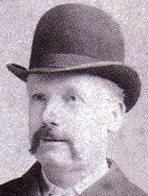
Meanwhile, I want to coin a new word. We already have the word risible, for something worthy of laughter (ridere, 'to laugh'). But how about those things less risible than the risible, worthy not quite of laughter, but only of smiling? I propose surrisible (sub-ridere, 'to smile', whence the nonce-words subride and subrident—but surrisible is more natural English, following surrogate (sub-rogare), surreptitious (sub-repticius), etc.). We can all think of examples of surrisible things. If I absentmindedly confused shaving-foam for deodorant in a blearyeyed morning, Mrs. Roth would think it risible, but to you, it would probably be only surrisible. Likewise, we find surrisible a freshman paper marked by my wife, casually claiming that the man behind the bar in Manet's Folies-Bergère (right) is in fact Jack the Ripper. We had no idea what would lead someone to such a conclusion: the date's almost right (painting—1882, Jack's spree–1888), but the country is off and in any event it's completely nonsensical. We now know, it turns out, what Jack looked like: he has a harder, squarer physiognomy than Manet's man, though he wears the same moustache. A google search turned up the obvious reason for the nincompoopery, a paragraph in a piece by Jonathan Jones tossed off a few years ago for the culture snobs at the Grauniad:
And who are you? The top-hatted stranger, of course, the Jack the Ripper whose ghostly reflection approaches her with such menace in the mirror. Manet captures the coolness, cruelty and glamour of modern life. This is one of the keystones of modern art.
Perhaps this, also, played a part:

Like Jack the Ripper zonked on laudanum and champagne sitting at a table with Toulouse Lautrec at the Folies Bergere, waiting for the girls to get off work.
Thus the perils of not properly reading what you find online. Idly browsing the Wikipedia article on Jack, however, it struck me that another identification was more plausible. Take another look at Manet's man—and then cast your glance at George Lusk (right), head of the Whitechapel Vigilance Committee that patrolled the streets at night in search of Jack, in vain. They are obviously the same man! I sincerely hope that this discovery will aid more than one future undergraduate paper on the subject. As for surrisible, I suggest you all go out and use it in a sentence (spoken or blogged) today—let's make this word a dictionary reality!

03 December, 2006

The Unknown Object: suite et fin

These are the natures which have false opinion; for when they see or hear or think of anything, they are slow in assigning the right objects to the right impressions—in their stupidity they confuse them, and are apt to see and hear and think amiss—and such men are said to be deceived in their knowledge of objects, and ignorant.
The unknown object is one of the central problems of Plato's Theaetetus, a late dialogue. It takes many forms: rational and sensory objects, elements and compounds, unmet and unrecalled. The dialogue was not an early favourite, like the Symposium, or the Timaeus; its concerns were not really reawakened until Descartes, who made the unknown object one of the criteria of doubt in his first Meditation. Since that time, the knowing and unknowing of things—now called epistemology—has replaced metaphysics at the heart of philosophical discourse. And to the philosophers the world has grown increasingly unknown, hazier and hazier behind a gauze of language. They are less likely to claim knowledge of the liknon, concealed and mythical not only as fan, but as van, corb, basket, creel and shaul, to mention only its English names.

Jane Harrison was still a primitive. We might study her mind now as something lucid, limpid, uncluttered with scepticism, a mind, as I have said, in love with the objects and truths of the past, straining to reconstruct an ancient world. Now we struggle even to reconstruct the present world. Do you see the same object as me? How might we even discover the answer? Odysseus to us is wily, panourgios—he is a beggar, and nobody—oudeis, but also me tis, wisdom—and we cast about as if blinded with a stake.

The fan was an easy problem to solve, if indeed it has been solved. And we were all delighted to discover a problem with such a ready and satisfying solution—and one which exposed so great a wealth of nerves and networks through our shared cultural history. Let this, then, be our final irony—that the fan, far from being an unknown object, is the most known of objects. We return to the land, from where we came, and no pleasure seems so rapturous as to know something whole. The land, for which yearn the Harrisons and Marxes among us, and within us, this is where things are known, clearly, without pomp or pretense. There is no need for obscurist philology when you have in your hand a winnowing-fan.

At these times I cannot help but feel that it is not only the processes of man and nature that have been kept from me, in my city, and in my urbanity—it is also the truth, and the sense of its possession. What vanity, we! I dare confess that I have succumbed, after all, to that naïve lament of the civilised, so seductive. But perhaps you will not begrudge my eyes a little mist, just a little.

30 November, 2006

The Unknown Object: Part II

. . . as I was saying, the pampered bourgeois like myself, with our overcostly educations and the guilt of privilege, have been separated from the processes of man and nature. This is why I admire a cultured man of the earth like Hank Heatly—with his keen interest in Linnaeus and Pliny the Elder—who can engage my attention on the subject of, say, tomatoes, despite my total lack of interest in tomatoes. He probably knows a lot already about winnowing; but perhaps he knows less about Homer. Either way, let us engage in some hypothetical dialogue.

The Winnowing-Fan.

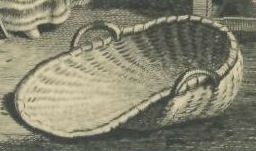
The poet sang, as we have seen, that 'another wayfarer, on meeting thee, shall say that thou hast a winnowing-fan on thy stout shoulder'. The mystery of this passage was longwhiles augmented for me by my utter ignorance in the matter of winnowing-fans. What is a winnowing-fan? It took me a surprisingly long time to find out. The Greek word is αθηρηλοιγον (athereloigon)—an oracular periphrasis, literally meaning 'consumer of chaff', and attested only here. Later commentators unanimously identified the athereloigon as a ptuon, with the normal sense of 'shovel'. So now we turn to two exquisite articles by the great Jane Ellen Harrison (Journal of Hellenic Studies, 1903 and 1904), in which are discussed, at great but untedious length, ancient methods of winnowing crops. This is one of the most well-known devices, still used today:


It is what the Greeks called a liknon, the Romans a vannum, the French a van, and the English a van, or later, fan. It is, in fact, the origin of our common 'fan'. It looks nothing like what we think of as a fan—but the connection is that both are used to create currents of air. The farmer puts the unsorted grain and chaff into the basket, and shakes it until the lighter chaff is propelled over the fan's lip, while the heavier grain remains inside. In a footnote, Harrison notes with relief that this process has not been lost to time:
Such fans are still in use to-day in Cambridge as baskets and are regularly imported. Mr. [Francis] Darwin's gardener. . . states that the 'fans' were in use for winnowing when he was a boy, but the art of winnowing with them is now only known to a few old men.

Darwin's gardener winnowing with a fan

Here we see the pampered bourgeois intellectuals of a century past, like us, fascinated with the lower orders as 'folk', innocent bearers of ancient truths and customs. There is a melancholy in Harrison's words—and a desperation to preserve, against the encroaching clarinets of modernity, and indeed modernism, the wisdom of Europe's rural past. For her the fan is a little fetish of this past, an object surviving all change and history, unknown, but promising knowledge, yet—an object to be a little worshipped. 'The word 'fan'', she writes, 'is a beautiful word of almost magical associations'. Nonetheless, she will fetishise the object further by re-christening it as a 'winnow-corb', so as to distinguish it from a modern fan. The OED only barely attests corb, listing it as an error for corf, meaning 'basket' in various specialised senses:
(WEBSTER 1828, followed by other Dictionaries, has Corb, either a misprint for Corf (omitted in W.), or perh. a local form in U.S. It is unknown in England.)
The OED does not cite Harrison—though perhaps we should contribute the reference. If American, it seems odd that Harrison would produce corb merely as an 'archaism'; we find the word used later in a 1922 article by the eminent Bostonian archaeologist Harriet Boyd-Hawes, clearly alluding to Harrison.

Harrison enshrines the object with its own obscure term, smelling of history; but more tellingly, her articles chiefly concern the mystical significance of the fan, conflated with a sacred cradle, as an emblem of Bacchus. (On this see also The Golden Bough, ch. 43.) And to develop on Harrison's theme we might throw stones into the Middle Ages, where the vannus would be called a capisterium, and attributed to St. Benedict as the symbol of a childhood miracle. You can see a rather crude carving of Benedict's fan on a mediaeval capital (taken from Pamela Z. Blum, 'The Saint Benedict Cycle on the Capitals of the Crypt at Saint-Denis', Gesta 1981):


The fan reappears, in a thoroughly secular form burlesquing the deus ex machina, in a story (#29) from Marguerite de Navarre's 1558 Heptameron, in which a near-caught lover is quickly stashed in a ceiling-loft, covered with a winnowing-fan (van). An 1894 illustration portrays the fan exactly in its modern form.

*

You've noticed something, haven't you? At the beginning of this post I noted that Homer's winnowing-fan, the athereloigon, which is really what you're interested in, was identified with the ptuon or shovel, whereas all this time I've been going on about the liknon or basket. Well spotted! But don't worry, we're getting there: Homer's fan will become more known yet.

Harrison discusses the ptuon as well. In fact, she provides more information about it than you could possibly want to know. Trust me. But she concludes, in the second of her two articles, that the ptuon looked a bit like this:


It doesn't work in the same way as the basket—the farmer strikes the mixed crops up into the air with the shovel, usually on a windy hill, and lets the wind separate the two substances for him, the chaff being blown farther away than the grain. It is this type of fan favoured by the Biblical writers of both testaments. Jeremiah 15.7: 'And I will fan them with a fan in the gates of the land', using a typically archaic reduplication—the Hebrew word is mizreh, which also appears in Isaiah 30.24, and derives from the root zrh, 'to scatter'. (Thanks to Simon, here.) The verb-form appears in Isaiah 41.16: 'Thou shalt fan them, and the wind shall carry them away'. It is obviously the ptuon that is meant here. The Greek, sadly, is not very helpful here—the LXX renders Jer 15.7, for instance, as 'diaspero autous en diaspora', 'I will scatter them in a scattering', preserving the reduplication but losing the physical object represented by mizreh. Jerome's Latin is excellent, however, rendering the object as ventilabrum ('wind-lip'), which is the usual translation of—you guessed it!—ptuon. We know this because ventilabrum is used to render ptuon in parallel passages of the New Testament, Mark 3.12 and Luke 3.17:
ου το πτύον εν τη χειρι αυτου

Cuius ventilabrum in manu sua

Whose fan is in his hand
The sense is that the wicked will be scattered in perdition like chaff blown away by the winnowing wind. From thence the winnowing-fan became a popular Christian motif, denoting the discernment of the good from the evil, a holy form of the two paths of the Pythagorical upsilon.

What of Homer, then? For Harrison, 'the prescribed planting of the oar in honour of Poseidon was a ritual replica of the planting of Demeter's shovel-fan', which can be gleaned from a passage in Theocritus:
. . . of her [Demeter], upon whose cornheap I pray I may yet again plant the great winnowing-fan [mega ptuon] while she stands smiling by with wheatsheaves and poppies in either hand.
A. D. Ure ('Boeotian Haloa', Journal of Hellenic Studies, 1949) provides a visual example of Dionysius with a ptuon instead of a liknon, from the fifth century BC:


The image is a little difficult to make out, but the god's implement can be seen extending diagonally downward from his right hand, terminating just below the pig's head to the right of the scene. Ure notes proudly that his fan is 'more oarlike' than any of the classical images in Harrison's article. A modern sculptor, Conrad Shawross, visualises the transformation in his own way:


Michael Glover, in a review for the Independent, called this piece 'perfectly delightful, perfectly useless—just as art should be'. How far we have come from Homer's world! Such a vacuous aestheticism would have been impossible, when the beauty of oar and fan derived from the harmony of form and function, and when the monumental beauty of the athereloigon derived from its sublime play with that harmony. Still, Homer's object has become increasingly less unknown to us, as we have unravelled its history.

But less unknown it shall become still. For Harrison notes another use for the ptuon—'with a very long handle it is employed for lifting bread out of an oven'—and here she footnotes—'the long-handled oven-shovel is known in English and Scotch dialect as a peel'. She remarks further that a modern folk-telling of the Odysseus story transforms the oar not into a fan but into a peel: 'the shift from the country to the town implement is very natural'. Today we best know the peel for its use in pizzerias, though only the best still use proper ovens. The object has been continually metamorphosed, thus, from the sea to the countryside to the town, remaining invariant in form—a homotopy. The ancient is present, atavistically, in the modern.

This is how we learn to cope with the unutterable and terrifying gulf of time extending ever backwards—how we make sense of a past increasingly remote, and increasingly unknown. With our objects we preserve some fragile sense that such a past was, after all, much the same as our familiar present, only rearranged a little, like our words, and like the atoms of our bodies. We retain, at the same time, the hope that we will not be lost to the future: that whatever progress the world might make, the forms of our objects and ourselves will always prevail.

Update: Hank responds, flattered and flattering. The post is well worth reading. Update #2: Languagehat links, kindly, as does Clusterflock, and John B. responds to both myself and Hank, elegantly bringing together several threads. I am honoured to have had such an impact.

Final thoughts on the unknown object here.

29 November, 2006

Apocalypto

An intermission from The Unknown Object—the winnowing-fan next time, I promise!—as I thought this was worth writing about. I attended a preview screening of Mel 'I want his intestines on a stick' Gibson's latest offering, Apocalypto; with me was the Mesoamericanist Pretzel Bender and some members of her department. The film, with its goofy Greek title ('I reveal'), is Gibson's take on the culture of the Late Postclassic Mayans in the Yucatán Peninsula, just before the Spanish invaded (presumably set some time between 1510-1520). The dialogue is completely in Yukatek Maya—so I'm told, though it could be in Swahili for all I know.

At the beginning of the film, instead of the title, Mel quotes pop uber-historian Will Durant that 'A great civilization is not conquered from without until it has destroyed itself from within'. In other words, the Mayans were goners even before Hernández de Córdoba got there in 1517. The subtext, one suspects, is even less subtle: Goddamn, those barbarous heathens needed Christianity! And barbarous they are: Apocalypto is even more graphically brutal than The Passion. Over the course of 2 hours, various characters are stabbed, shot with an arrow through the mouth, phlebotomised, decapitated, raped, sacrificed, mauled by jaguar, slashed, dashed against rocks, poisoned, near-drowned in quicksand, stung by hornets, clubbed, axed and self-mutilated. One of my party, deeply horrified, described it as 'another snuff flick'. I liked it!

Spoiler warning: Plot details follow.

Basic narrative: peaceful village (of savage animal-hunters) is captured and taken to Chichen Itza to be sacrificed à l'Aztec—think cityfuls of extras baying for heads, jabbering drugged priests, lavish costumes and monumental sets—all completely incorrect, as the academic sneerers next to me proudly pointed out—taciturn hero escapes à la Tintin, and spends the rest of the film running from bloodhungry maniacs à la The Naked Prey.

Spoilers end here.

I know nothing about the history, of course, so its accuracy is unknown to me, and in any event irrelevant. My comrades were doubtful; I couldn't find the Yukatek woman to ask her if the language was authentic. It could hardly be denied, however, that it all seems very real—there's a real flair in the small details and facial expressions, and so much texture. The camera never shies away from the visceral, the sadistic Catholic gaze carried over from The Passion—the hero sheathed in mud, or live ants stuffed in an open wound, or the innumerable piercings and other grotesque ornaments on every face. The chief slaver has human jawbones for epaulettes, a cute touch. It is this unflinching quality, so absent from the usual pussy-hearted blockbusters, that transfixes and enthralls.

Apocalypto is an odd mixture: still firmly rooted in the heroes-and-villains gothicism of his early action-flicks, it also aims at High Art, with a Message. That message, however, is anyone's guess. Near the beginning of the film the village bard tells the assembled throng a fable of man's unconquerable greed, which will one day ruin the earth—this obviously describes the cynical greed of the sacrifice-hunters, but also suggests an anti-American comment, or even an anti-Semitic one, given Mel's notorious outbursts. The Jews, naturally, have always been lucre-mad usurers among men. Apparently Gibson has compared the Mayan practice of human sacrifice to 'sending guys off to Iraq for no reason', which is patently idiotic. So the (urban) Mayans are the evil Americans, right?

But wait. Remember Durant—the Mayans, a corrupt society, have set themselves up for a fall. A fall from the conquering Spaniards, that is. The idea is straight out of Flaubert's Salammbo, a novel about the baroque decadence and internal strife of the Carthaginians in the years before Roman conquest. Flaubert's language, itself proto-Decadent, with its thick description and sensuous metaphor, is something akin to the spectacular spectacular of Apocalypto—and his hindsight view of barbarians priming themselves for a fall is very close to Durant's statement. The problem is this: if we wanted to apply Gibson's picture of 1515 to the present day, what does it most closely resemble? Surely, the Americans invading the Middle East, a mess of violent insurgents. Which puts the Americans in the (positive) role of the Spaniards—God's men bringing salvation to the barbarians. This is brought out in the film's conclusion, which I won't spoil. Another historical analogy might be to the corrupt First Temple Jews carried off into Babylonian captivity—the stepped pyramids of Chichen Itza even suggesting the ziggurats of Babylon. But what sort of comment would that make? The whole thing is a mess, if indeed it is trying to make a Statement at all; it certainly sounds like it is.

Anyway, philosophical qualms aside, it's as good a mainstream picture as you're going to see these days, and if you can stomach copious quantities of graphic violence, I recommend it.

27 November, 2006

The Unknown Object: Part I

And there nigh is the Foss of Mennon that is all round; and it is one hundred cubits of largeness, and it is all full of gravel, shining bright, of the which men make fair verres and clear. . . And there is evermore great wind in that foss, that stirreth evermore the gravel, and maketh it trouble. And if any man do therein any manner metal, it turneth anon to glass. And the glass, that is made of that gravel, if it be done again into the gravel, it turneth anon into gravel as it was first. And therefore some men say, that it is a swallow of the gravelly sea.

The Travels of Sir John Mandeville (1357-1371).
Anyone who has read Wolfgang Pehnt's textbook on Expressionist Architecture should understand that of all materials, glass is truly the most sublime. Long did I daydream upon that text of high aspect. It inspired me to purchase books by Bruno Taut and Paul Scheerbart, and to compose fragmentary epics. It is also the reason why, on a digression with D in rural Wales, bleak and brittle, I insisted that we visit the local glassworks at Rhayader. This was in the summer of 2002. At the time I was living in Bristol, which is renowned for its distinctive cobalt-blue glassware, and yet I'd never seen the inside of such a place, except the mecca of Murano, whose titivated confections have never said much to me. My father once brought me from some factory a small cylinder of perfect glass, flawlessly clear—a scytale, which with its drab perfection has captured my imagination more than a thousand particoloured glass reindeer or polyhedra. The sublimity of glass, I think, is a sublimity of the amorphous or polymorphous—of possibility. It is the sublimity of the sea of glass like unto crystal, and of that glass, verre, which we call poetry, vers. Such glass has a beauty of meaning. Too often is it wrought, as at Murano, into gaudy gewgaws and bibelots without function; thus is the beauty of meaning ruined for a prettiness of surfaces.

*

When we entered the establishment nobody was about. It was lunchtime, and this being the boondocks, security was hardly needed. We marched through the visitors' reception, into the works itself. What struck me first were all the strange tools. Strewn on the workspaces were objects of all shapes—puntils, shears, saws and blades, tagliols, jacks, blowpipes—not to mention the myriad machines and furnaces. I picked up a puntil, then still an unknown object, and examined it idly. D told me to put it back.

Soon the workers arrived back from lunch. They were very friendly, and all too keen to show us what they did. Unfortunately they had only started heating the main furnace, and it would be several days before they could demonstrate any actual glassblowing. Still, they readily offered up their tools for us to see. We talked about etymology as well: the gaffer explained to me that marver (the surface on which many operations are performed) has an Arabic derivation—in fact it is merely the French marbre, the surface originally being marble—and that the moil (OED sense 5, excess glass from a blown piece) derives from the Hebrew mohel, meaning the foreskin circumscribed from a nipper's todger in a bris. Of course, this is nonsense, and in any event the mohel is the chopper not the chopped, but there you have a striking spot of folk-etymology in the wild.

*

To an urbanised bourgeois like myself, all this is rather exotic. The objects that come into my world are fully made: they are, quite literally, fetishesfacticii. They are mostly complex and unintuitive. It is, I fear, one of the great blights of my social milieu that we have been shielded from the raw processes of man and nature, industry and agriculture. Civilised men of all ages have lamented the oppressive weight of civilisation, divisive and analytical—hence, I think, the perennial emotional appeal of Marxism—and I have no wish to participate naïvely in this tradition. Nonetheless I am fascinated at how one object might be mistaken for another, as a token of division among men.

My favourite image from the Odyssey, one of the few serious books I read as a child, has always been the prophecy of Teiresias, Book 11, lines 119-130 (repeated 23.270-275), here in Lang's translation:
But when thou hast slain the wooers in thy halls, whether by guile or openly with the sharp sword, then do thou go forth, taking a shapely oar, until thou comest to men that know naught of the sea and eat not of food mingled with salt, aye, and they know naught of ships with purple cheeks, or of shapely oars that are as wings unto ships. And I will tell thee a sign right manifest, which will not escape thee. When another wayfarer, on meeting thee, shall say that thou hast a winnowing-fan on thy stout shoulder, then do thou fix in the earth thy shapely oar and make goodly offerings to lord Poseidon.
Odysseus, the man of the sea, is to journey inland until he meets a man so ignorant of the sea that he confuses the hero's oar for a 'winnowing-fan'. The 3rd-century scholar Porphyry, who understood the Odyssey as an allegory for the progress of the soul from the material world toward unification with God, and who identified the sea with the Heraclitean flux of sensory objects, understood the prophecy, paradoxically, to concern Odysseus himself, who 'will not be freed from his labours until he has become completely free of the sea and wiped away his very experience of the sea and of matter, so that he thinks that an oar is a winnowing-fan in utter ignorance of the business of seafaring'. In other words, a man will not attain wisdom until he has utterly cast off all knowledge of the deceptive material world—what the Hindu would call maya.

What fascinated me was the symbolic substitution of one object for another, a beautiful trope. It is the pun, Joyce replacing crops with cropse to suggest the fertilisation of the dead; it is Wittgenstein's duck-rabbit, or swans reflecting as elephants. But more specifically, it meant a bringing of the sea into the land, as if shellbound wavespeech, the all-conquering march of the ocean. Odysseus is also requested by the ghost of his dead comrade Elpenor to give his body a proper burial, and to mark his grave with an oar of his ship. These are the oars that 'are as wings to ships'—a standard association, made by Vergil in reverse when he wrote of the remigium alarum, the 'oarage of the wings' of Daedalus. In this aspect, the oar appears not just as a marker, but as a communion of the sea with the land. Compare the sconce from which Thor was bade to drink by the magician Utgard-Loke:
When you drank from the horn, and thought that it diminished so little, then, by my troth, it was a great wonder, which I never could have deemed possible. One end of the horn stood in the sea, but that you did not see.
Thus appears the sea always, compressed into perfect images, chaotic and mischievous, always of two faces, amorphous, or polymorphous—the cleer Hyaline, the Glassie Sea / like unto crystal—an object endlessly unknown, but promising knowledge, yet.

Next time: on the 'winnowing-fan'.

24 November, 2006

Islands

In my inbox are urgent messages from Pellegrino Bixby, Hippocrates Sink, Elma Triplett and Melchor Prendergast—I soon realise that Thomas Pynchon has been spamming me again. In the streets the trees are smelling of semen, and the green fields are stinking of long-sown dung. I learn the word griggles, which the OED defines as 'Small apples left on the tree by the gatherer'—what a wealth of metaphoric possibility! I play online boggle, late into the night, and still, after so many weeks, have yet to find a better word than aubade, though I have found longer. Aaron Haspel writes a terrific post outlining a series of logic problems and the heuristics of George Polya. Meanwhile, Pretzel Bender forwards me an article from Science on mass data-collection. It turns out that a Finnish physicist, using data from 7 million telephone-calls, has been able to analyse social networking with unprecedented sophistication:
Van der Leij calls this the first large-scale, empirical confirmation of a theory, first proposed in 1973 by Mark Granovetter, a sociologist at Stanford University in California, that "for keeping society connected, acquaintances are more important than close friends".
I staunchly have refused to maintain acquaintances, except where necessary, as in the workplace. Such an attitude is aided, in my case, by having a large number of close friends; still, perhaps Conrad is not 'doing his bit' for Society? The Finnish study showed that without the 'weakest links' in a community, 'the system shatters into islands'. Islands, I might suggest, like the Varieties—the vain dissemination of irrelevancies, among an élite joined only by a common love of the arcane and the recondite.

23 November, 2006

De Bry: Ypsilon

This post is a little addendum to Tuesday's post on the Pythagorean Y, mainly for completion's sake. Mr. H. of Giornale Nuovo was kind enough to supply me with the verses in German and Latin that accompany De Bry's illustration; I have reproduced and translated these below. My German is not great, and especially not my Early Modern German, but I've done my best. Credit to Raminagrobis for helping me a bit with the penultimate line of the Latin.


YPSILON ein Merckzeichen was /
___Deß weisen Manns Pythagoras.
Zweer Weg es zeigt / darauff die Jugendt /
___Stracks einher geht / der ein die Tugendt /
Der ander zeigt die Laster an /
___Hütt sich darfür ein jedermann.
Unnd lencke sich zur rechten Handt /
___So wirdt er weit unnd breit bekandt.

The Ypsilon was a symbol of the wise man Pythagoras. It shows a double path; after adolescence one path goes straight on, that of Virtue; the other leads to Vice, which everyone should therefore avoid. And one should keep to the right-hand path, as he knows it becomes wide and broad.


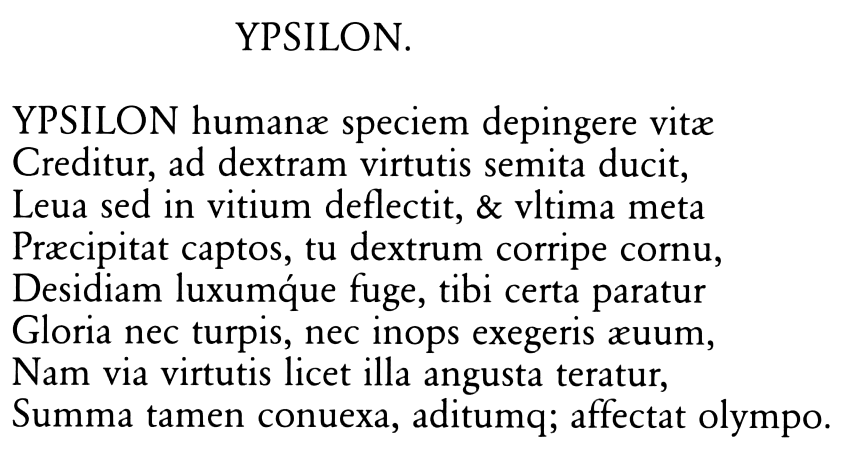
YPSILON humanae speciem depingere vitae
Creditur, ad dextram virtutis semita ducit,
Leua sed in vitium deflectit, & vltima meta
Praecipitat captos, tu dextrum corripe cornu,
Desidiam luxumque fuge, tibi certa paratur
Gloria nec turpis, nec inops exegeris aeuum,
Nam via virtutis licet illa angusta teratur,
Summa tamen conuexa, aditumque affectat olympo.

The Ypsilon is believed to depict a scheme of human life; the path of virtue leads to the right, but the left bends away in vice, and at the end hurls down the trapped traveller; you must seize the right horn, and flee idleness and excess—then, certainly, you will be rewarded with glory, and spend your life neither poor nor ugly, for although the way of virtue forms a narrow path, nevertheless the top is rounded, and aims at the entrance to heaven.
There are some curious conclusions to be made from these verses. The Latin is clearly heavily based on the pseudo-Vergilian epigram, although it has been rewritten. The last line, I think, deliberately recalls Vergil's Georgics, 4.562, on Augustus, 'viamque adfectat Olympo'. But more interestingly, the verses suggest that the De Bry image shown in the last post is backwards, like the Bade sketch. The central, straight ('Stracks') path should be on the right—the arms are the arms of valour, and the putto at the top is pointing upward to heaven; this path is also 'rounded' at the top. The other branch, which I think should be on the left, 'bends away' from the 'straight and narrow', and its putto is idly whiling away his time. The parrot seems to have little significance; as Mr. H. observes, 'there must be at least a dozen parrots scattered throughout [De Bry's] alphabet.'

21 November, 2006

The Garden of Forking Paths

This post takes as its genesis an epigram falsely attributed to Vergil through the Middle Ages and Renaissance. Our earliest source for the poem is an eleventh-century manuscript, although the version I quote is taken from a modern edition of the Anthologia Latina:
Littera Pythagorae, discrimine secta bicorni,
Humanae vitae speciem praeferre videtur.
Nam via virtutis dextrum petit ardua callem
Difficilemque aditum primo spectantibus offert,
Sed requiem praebet fessis in vertice summo.
Molle ostentat iter via laeva, sed ultima meta
Praecipitat captos volvitque per aspera saxa.
Quisquis enim duros casus virtutis amore
Vicerit, ille sibi laudemque decusque parabit.
At qui desidiam luxumque sequetur inertem,
Dum fugit oppositos incauta mente labores,
Turpis inopsque simul miserabile transiget aevum.

A prose translation of a prosaic verse: The Pythagorean letter, divided into two horns, seems to present an image of human life. For the steep way of virtue, to the right, offers the viewer a difficult approach up a mountainside, but at the top it provides the weary with rest. The left way shows a pleasant journey, but at the end it hurls down the trapped traveller among rough rocks. For whoever has conquered hardship from his love of virtue will be rewarded with praise and honour. But he who follows a life of idle decadence, thoughtlessly skiving, will spend eternity [or, 'a lifetime'] poor, ugly and miserable.
This piece is about that very littera Pythagorae, the 'Pythagorean letter'.

*

Classical ethics has as its foundation the concept of free will, liber arbitrium; the quintessence of free will is an individual's choice between right and wrong. One of the key tasks of a moral teacher was to persuade his student that virtue, though difficult, was in the student's best interest in the long term. One finds this in Plato, for instance, all the time. Thus the path of virtue was portrayed as harsh or steep, and the primrose path of vice as easy and gentle.

The dualism of this choice, between vice and virtue, was traditionally symbolised by the left and right hands. The right hand, with which one fought and wrote, has always been positive in connotation; its counterpart the left, weak hand. If one surveys the words for 'left' and 'right' in European languages, one finds that the latter are groups of cognates—dexios, dexter, destra and diritto, dereche, direita, droit, rechte, right, deis—and the former mostly unrelated—laios, sinister, lasciato, izquierdo, linke, gauche, left, clé. This is because words for 'left', with their negative connotations, have undergone taboo-substitution from foreign sources; izquierdo, for instance, is Basque. To call someone gauche or sinister is to insult him—whereas to call him adroit or dextrous is high praise. It is no coincidence that right should have its two primary meanings, nor that left should come from a root meaning 'lame'. The moral dualism of the hands is not left linguistically implicit among the Greeks, but explicitly formulated; a passage in Aristotle (Metaphysics, I.5.985) describes a Pythagorean table of opposites (the formatting is mine)—
A different party in this same school says that the first principles are ten, named according to the following table:

finite and infinite,
even and odd,
one and many,
right and left,
male and female,
rest and motion,
straight and crooked,
light and darkness,
good and bad,
square and oblong.
At some point in Greek history, it was noticed that the capital upsilon—Y—looked like a path branching left and right. The comparison, like so much traditional material, was ascribed to the Pythagoreans, in accordance with the dualism just mentioned; our earliest source for it, however, is as late as the Roman poet Persius (Satires, 3.56). It is perhaps not surprising that the image would have more resonance among the Romans than among the Greeks. Symbols and sigla, and even entire texts, have a greater magic as they grow opaque—hence the preservation of a Greek mass among Latin-speakers, and a Latin mass among vernacular-speakers, hence even the deliberate archaism of the English Bible. The Y, imported into the Roman alphabet in the first century, was always an alien letter, used only to render Greek names. The Y is still called the 'Greek I' in the Romance languages, retaining its alterity in the modern alphabet, a symbol of something earlier, almost occult. Thus its efficacy as a moral totem: the less it is a letter, the more it is a symbol. (Compare the defamiliarisation of Roman letters to yield opaque modern symbols—&, £, ∫.)

Throughout late antiquity, the Y was an accepted symbol of pagan ethics, of the choice between the hard path of virtue (right) and the easy path of vice (left). Lactantius, for instance, criticises the Y, cited as standard idiom, for its implication that the rewards or punishments for a man's actions occur during his lifetime, and not after his death.

*

Two paths diverged in a yellow wood.

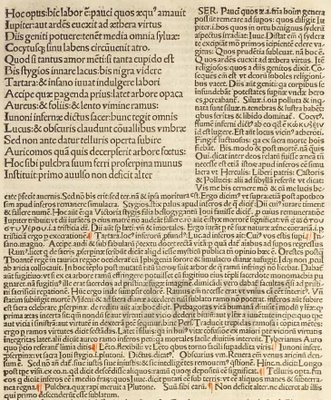
Servius' commentary on the Aeneid, written around 400 AD, finds the Y in the Golden Bough (a favourite motif of mine, see here and here):
novimus Pythagoram Samium vitam humanam divisisse in modum Y litterae, scilicet quod prima aetas incerta sit, quippe quae adhuc se nec vitiis nec virtutibus dedit; bivium autem Y litterae a iuventute incipere, quo tempore homines aut vitia, id est partem sinistram, aut virtutes, id est dexteram partem sequuntur.

We know that Pythagoras of Samos divided human life according to the letter Y, that is, because the first age is uncertain, as it is not yet given over either to vices or to virtues; however, the fork of the letter Y signifies the beginning of manhood, at which time men follow either vice (the left path) or virtue (the right path).

Servius' commentary on Aeneid 6.129-143, in a 1492 edition

This seems a rather far-fetched conflation—what on earth has the Bough to do with the littera Pythagorae? Perhaps it is not as outlandish as it first appears. Throughout the sixth book of the Aeneid, which contains the Bough, the theme of the Y is implicitly present. At lines 540-543, Aeneas finds his paths diverging in the underworld, left towards Dis and right towards Elysium, and it is at the entrance to the latter (line 636) that Aeneas plants the Bough. The goddess Hecate is present in the Bough's grove, in her Roman incarnation as Trivia—literally, 'she of three roads'—three roads that form an intersection looking much like the Y. But the Y as bough? We turn to Alfred Kallir's 1961 classic, Sign and Design: The Psychogenetic Source of the Alphabet. Kallir interprets the Y as a grander, more antique form of the V, a symbol of the outstretched arms and open vagina. (Incidentally, Pynchon's first novel, V., derives most of its symbolic content from Kallir.) The Y, furthermore, is a tree-symbol related to the Christian cross and the letter T:
Tree designs are subjected to gradual simplification. The roots, invisible in nature, disappear also in script; and to achieve greater expediency in writing, more and more lines which secured realistic representation vanish; eventually Y remains, on first sight, much more acceptable as replica of the arboreal prototype than the symmetrized cruciform Semitic character of our own letter T.
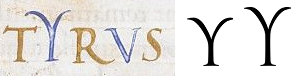
Meanwhile, Xensen and Curtis have observed (see comments) that the classical Roman Y has a curved form, much closer to the schematic tree. Below left is a calligraphic Y from a Quattrocento manuscript (by Bartolomeo Sanvito, according to Curtis), and, right, a modern typographical imitation of the monumental Roman Y, courtesy of Xensen:


Finally, the tree as a metaphor for division is a common enough trope, from the Tree of Porphyry to the tree-diagrams of modern linguistics. So in purely formal terms, Servius' reading of Vergil is not so bizarre after all. It was, furthermore, enormously influential: the reading would be repeated by Bernard Silvestris (c. 1150), Cristoforo Landino (1473), Josse Bade (1500), Jacobus Pontanus (1599) and John Boys (1660). Boys, a Royalist propagandist from York who composed the first English Aeneid commentary, expressed the Servian reading in these terms:


Boys was also the first Aeneid commentator to cite the pseudo-Vergilian epigram I quoted earlier—as he puts it, Vergil 'is the best expositor of his own sense'. He therefore quotes the first seven lines (his text is slightly different), and provides a doggerel translation:
Pythagoras his forked letter does
Of humane life a scheme to us propose;
For virtues path on the right hand doth lye,
An hard ascent presenting to the eye;
But on the top with rest the wearied are
Refresh'd : the broad way easier doth appear;
But from its summit the deluded fall
And (dash'd 'mongst rocks) finde there a funerall.
*

A. Are there any graphic representations of the littera?

M. There are. It was in the Renaissance that the cultural capital of the ancient world was fully revivified, both in text and in image. Raminagrobis tells me that a (reversed) woodcut of the Y crops up in Josse Bade's Sylvae Morales, and he's provided a photograph of a sketch of Bade's Y here. (Plato would have been none too happy about relying on an image of an image of an image of an image of an image of an image of an image of an image—but what the hell.) This, curiously, as well as having the branches reversed, is a lowercase letter (see comments, below). The next image I can locate is from Geoffroy Tory's 1529 Champ Fleury, a treatise on divine proportion and typography, on classical mythography and the mystical arts of language. It is a most arresting work, full of unexpected wealths: Rabelais would find in the work his escholier Limousin, l'escorcheur de Latin. A bibliophile's edition was produced in 1927 by the Grolier Club, designed by the legendary Bruce Rogers. You'll pay hundreds of dollars for a copy. In my possession is a Dover facsimile of it, though even that is rare. Tory treats each of the letters in turn, and the Y grec is penultimate. It is to be constructed thus: 'as broad at the head as it is high, & the foot is of the exact breadth of the foot of the said I [ie. its trunk]'. The letter was invented by Pythagoras, to represent the broad path of Pleasure, and the narrow path of Virtue. 'Vergil's' epigram is quoted. Then he offers an image of the Y, suggesting that the reader meditate upon it, as a buckler against evil:


From the left branch of the Y hang scimitar, scourge, rods, gibbet and fire—instruments of torture—from the right hang laurel wreath, palms, sceptre and crown. The moral paths are reproduced in typographic form, the left branch broad, the right branch narrow. Thus, with allegory, Tory generates the shape of the classic Roman serifed Y. Compare modern renderings, all of which have a narrow right branch:

Times New Roman, Palatino Linotype, Georgia

One might expect the Y to be a common image in the emblem-books so beloved of the age. A cursory perusal of the most important of these, Alciati's Emblemata, turned up many trees but no Y. Nonetheless, I would be surprised if there were no material here, and perhaps Mr. H. of Giornale Nuovo will come to our aid. In the meantime, this rather skewed and rococo version from the Giornale, by Theodor de Bry (1595):


The armaments of the left branch seem to symbolise military valour more than vice, while the meanings of parrot, fish and lobster remain obscure to me. Update: my further conclusions on this image here.

*

We find in the Pythagorean Y two things: an aesthetic delight in binaries or complementaries, and an ethical attempt to associate virtue with hardship—and it is only by making virtue difficult that the professional moralist asserts his central value in society. If it were acceptable to follow the road of delights and pleasure, what need would a man have for authority?

Modern structuralism, with its rage for order, embraces the dualisms embodied in the Y; post-structuralism, with its love of playful chaos, seeks to expose or invent the instability implicit in such images. Thus the structuralist focuses on aesthetic delight, the post-structuralist on the manipulation of authority. These systems of thought, like the Y itself, diverge irrevocably; but which among us are headed for vice, and which for virtue? Myself, I am left-handed. Our age has quieted its superstition on the matter. Riddled with half-digested Eastern tropes and characters, we are inclined to speak of truth as a harmony of opposites: of left and right, odd and even, finite and infinite, light and darkness. We talk of thesis, antithesis, synthesis. Has the three conquered the two? Or is the three truly the one, duality resolved in unity? Have we come to understand the Y as turned on its head—wisdom and virtue not as discernment, as the sorting of wheat from chaff, but as a holism, a confluence of diverse paths?
[Update 15/02/09: For those who read Turkish—not me, I'm afraid—C. Cengiz Çevik has a post on the Pythagorean Y on his own blog.]

17 November, 2006

Going. . . going. . .

As a contribution to the Library of Saint Victor (Pantagruel, ch. 7), or else to the Musæum Clausum of Sir Thomas Browne—two genuine items discovered in 19th-century auction catalogues, by me, as part of my professional bibliographic work.

1. Sermones eximii doctoris Dunckelspückel (MS, c. 1350).

2. Al Bistami ('Abd Ar Rahman). Al Fawa'ih ul miskiyya fi 'l fawatihi l Makkiyya. The Shedding of Musky Odours on the Meccan Gates. A Mystico-Religious Work (Constantinople, 1584).

15 November, 2006

The filthy Eucharist

Humbert. . . may well have felt that both the Greeks and Berengar could be countered once and for all by a clear, bold and strongly worded insistence on the real, physical presence of the risen Lord in the Eucharist.

. . . Berengar threw the logical conclusions of Humbert's statement in his opponent's faces. Are we to believe, Berengar smirked, that "little chunks" of Christ's Body would be spread about on all the altars in Europe to be savaged by the faithful? Does this mean a little more Jesus is made each day as thousands of Masses are being said?

. . . Guitmund agreed that the verb, attero, to crush, can mean just to touch, or to press, really hard. Since both Thomas and the holy women touched the risen Lord, albeit lightly, surely there is no indignation involved in Humbert's assertion that the Body of Christ is touched very hard by the teeth of the faithful. Besides, teeth are cleaner than hands. Just think, Guitmund mused, of all the filthy things you touch with your hands that you would not dare to put in your mouth. Even Guitmund must have sensed that this line of thought was becoming (literally and figuratively) a bit messy, so he then asserted that even if the Body of Christ were divided by teeth or hands, no indignity would result.

— Gary Macy, 'The Theological Fate of Berengar's Oath of 1059: Interpreting a Blunder Become Tradition' (1983)

A second teaching associated with Berengar early on in the dispute concerning the Eucharist was stercoranism, that is, the belief that the Body and Blood of the Lord are eaten, descend into the stomach and are subject to digestion, and finally, as the name of the teaching suggests, undergo defecation.

. . . Guitmund also accused Berengar of teaching that the Body and Blood of the Lord descend into the stomachs of mice or other animals. Guitmund went on to respond as well to those who claimed to have seen animals eat the consecrated species, and then later to have found the remains in their bodies. . . The question of what the church mouse eats if it gets its little paws on the reserved species would remain a bedeviling and fascinating question for medieval theologians.

— Gary Macy, 'Berengar's Legacy as Heresiarch' (1990)

The officiating priest was required to swallow the remaining contents of the chalice, flies and all if need be, and to ensure that not a crumb of the consecrated wafer was left behind. . . Medieval stories relate how the Host was profanely employed to put out fires, to cure swine fever, to fertilise the fields, and to encourage bees to make honey.

— Keith Thomas, Religion and the Decline of Magic (1971)

13 November, 2006

Eumpina translata

I came across this poem by Ausonius while hunting through a 1674 Anthologia Latina for a pseudo-Vergilian epigram on the Pythagorean Y—it turned out to be absent from this edition, though I eventually found it. Still, this silly little fable was a good discovery, I think. I'm going to give you my translation of it at the end of this post—if you're not interested in all the preparatory material, feel free to skip it.


Ausonius (310-395) was from Bordeaux—he wrote much of local interest, such as poems about the Moselle, and about the local grammarians. His verse, like much verse of his century, was rather baroque, and a bit odd. For instance, one of his poems ends every line on a monosyllable—a somewhat Oulipian feat in Latin. In another of his works, he stitches Vergilian hemistichs into a naughty epithalamion—Raminagrobis translates a bit of it here. (This bizarre technique, known as the cento, was popular in the fourth century; Faltonia produced a Life of Christ by the same method, turning the Golden Bough into the Tree of Knowledge.) Anyway, the present epigram (no. 10) is more straightforward; it has been labelled above 'On the poison-crafting adulteress', but elsewhere 'On the adulteress Eumpina', or for Scaliger 'Eunapia', and it is about a cuckolding wife who poisons her husband. The Latin text:
Toxica Zelotypo dedit uxor moecha marito:
Nec satis ad mortem credidit esse datum:
Miscuit argenti lethalia pondera vivi,
Cogeret ut celerem vis geminata necem.
Dividat haec siquis, faciunt discreta venenum:
Antidotum sumet, qui sociata bibet.
Ergo inter sese dum noxia pocula certant,
Cessit lethalis noxa salutiferae.
Protinus & vacuos alvi petiere recessus,
Lubrica dejectis qua via nota cibis.
Quam pia cura Deum! prodest crudelior uxor,
Est quam fata volunt, bina venena juvant.
The poem actually functions as a syllogism in Barbara: the minor premise is given first—the wife poisons her husband twice—then the major premise, which is that two poisons always neutralise each other—then the conclusion, marked by the word ergo. Some difficulties with the Latin: that irritating Vergilian petiere for petierunt, which always throws me, and the genitive plural Deorum contracted as Deum. The spelling lethalis is not classical, and should be letalis. There are some nice plays, however; for instance, the mercury or 'living silver' (to give the true meaning of 'quick' in quicksilver) turns out to be that which brings life, and the lethal division of the two substances seems to mirror the social division of the married couple. I haven't read a German translation of this poem, but they have the excellent opportunity to play on datum, as Gift in their language means 'poison'.

The poem seems to have been popular during the Renaissance. Henry Peacham included it in his 1638 Valley of Varietie to illustrate the argument that every cloud has [thanks to God] a silver lining:

Thus, he concludes, 'one poison expels and prevailes against another'. Peacham's text, we note, is slightly different. Leaving aside the ligatured cessit, and the rewired punctuation (especially in the penultimate line), he 1. substitutes congerat for cogeret—the two words mean much the same—2. et for est, and 3. cum for quam. The modern recension, incidentally, from which I translate, prefers the Anthology's cogeret and Peacham's et and cum. In addition to Peacham, Robert Burton (Anatomy, 3.3.4.1) cites the epigram for its (supposed) moral, and Dryden cites it in defence of a plot-device. We should hardly be surprised, therefore, that it was translated in this most Ausonian of centuries, by the Cavalier poet Richard Lovelace. Here's his version:
Her jealous husband an adultresse gave
Cold poysons, too weak she thought for's grave;
A fatal dose of quicksilver then she
Mingles to hast his double destinie;
Now whilst within themselves they are at strife,
The deadly potion yields to that of life,
And straight from th' hollow stomack both retreat
To th' slippery pipes known to digested meat.
Strange care o' th' gods the murth'resse doth avail!
So, when fates please, ev'n double poysons heal.
Lovelace omits lines 5-6 here; otherwise the rendering is pretty literal, and in fact quite good, although the penultimate line is a bit weak. So, you want my attempt? Well, here goes:
A wife, promiscuous, gives her spouse—the jealous type—
a venom she later fears not strong enough to kill.
Then she ponders, and mixes quicksilver, so lively
lethal, as one to quicken death, to dumb him, and to still.
While separate, each potion as poison keeps its oath—
he has himself an antidote, a cure, who drinks them both.
And ergo, as the noxious pottles wrestle in his gut,
the lethal turns salubrious, the venom is outshut,
and both are valved and voided, from his bowels receding
to those lubricious chutes well-worn with well-digested feeding.

How mindful the gods, that make boon of so cruel a wife—
since the fates intend that venoms, twinned, comprise not death, but life.