Illius me paenitet dux
It was soon decided that tonight's dinner should be roast duck, preferably bloody. We had it and all, with shredded cucumbers and delicious hoisin sauce.
Labels: London
George: You want me to roar?
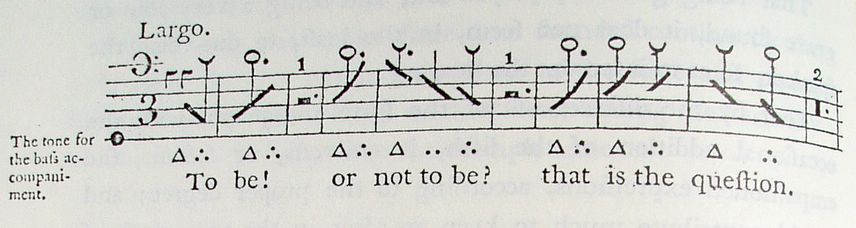
Mossop: Well, of course we wish you to roar. All the great orators roar before commencing with their speeches. It is the way of things. Ah, Mr. Keanrick, from your Hamlet, please.
Keanrick: Hh-hm. (orates) OOOOoooohhhhh. . . To be or not to be.
Mossop: From your Julius Caesar.
Keanrick: OoooHHHHOOOOHHH. . . Friends, Romans, countrymen.


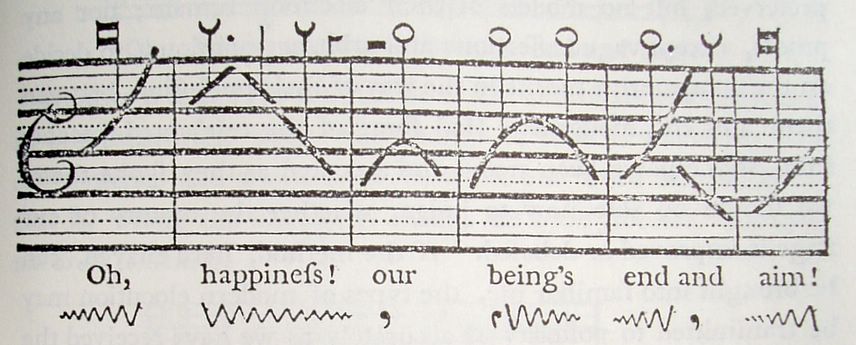
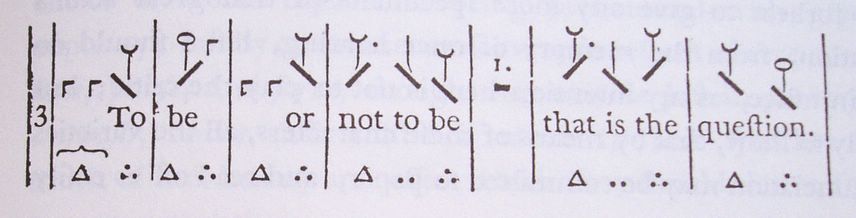
By what logic it can be contended that a system which leads to such “monstrosities” (the word is that of an admirer of Steele) as this is “masterly,” some readers, at any rate, will find it difficult to imagine. Either Steele’s scansions are justified by his principles or they are not. If they are, these principles are self-condemned; if they are not, the perpetrator of the scansions must have been a man of so loose a way of thinking that he cannot be taken into serious consideration. In either case, he cannot have had an ear; and a prosodist without an ear may surely be asked to “stand down.”Míâòw! Rasula/McCaffrey and Hatfield are more complimentary, the former labelling the Prosodia Rationalis as 'the most ambitious attempt of its time', the latter concluding that 'Steele’s descriptions of intonation and notations are essentially accurate and functional', although ultimately 'a musical notation inherently suggests a certain structure to the tonal space of speech, which just does not seem to be present'. For Richard Bradford ('The Visual Poem in the Eighteenth Century', Visible Language 23.1), Steele points towards a very Modernist aesthetic of language as pure sound:
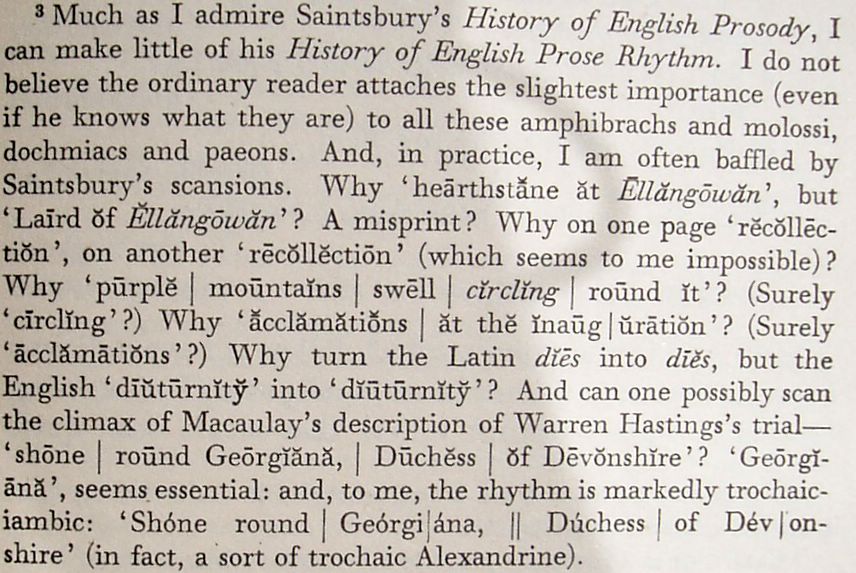
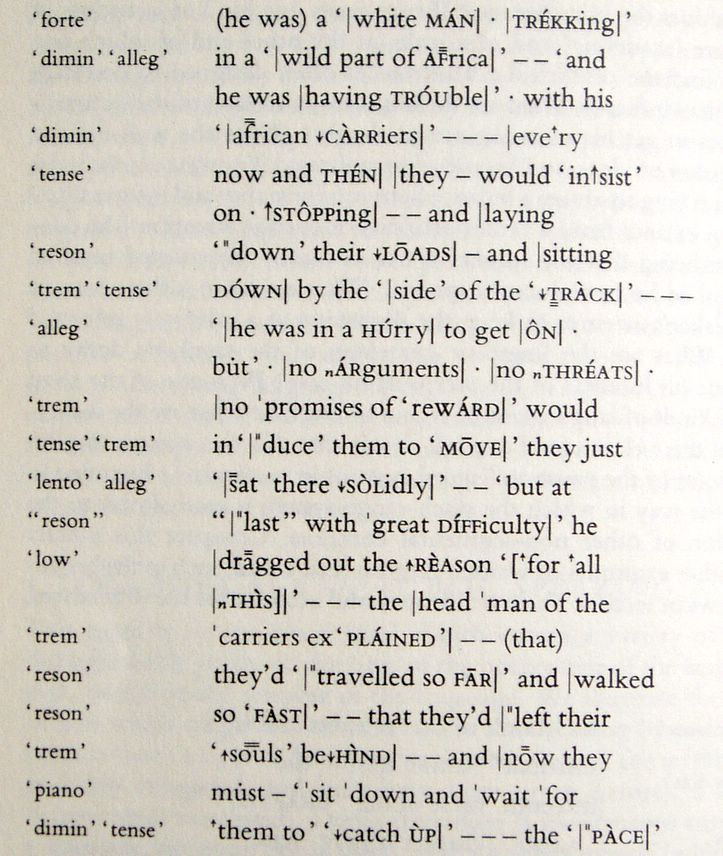
Steele’s concept of musical form in language has been drawn out beyond its status as an analogy, to the extent that the substance, the material, of language can present us with a sphere of appreciation quite separate from its meaning—wordless music.Despite its neglect, Steele's example stuck, and his book is the first (and almost the most complex) of many descriptions of speech in terms of tones and music. George Saintsbury obsessively scanned classical English prose by arcane metrical feet in his 1912 History of English Prose Rhythm; Joyce used it in the composition of the 'Oxen of the Sun' chapter from Ulysses. I don't have a copy of that book to hand, but this mini-critique, a footnote in F. L. Lucas' 1955 Style, should give the reader some idea of the original:


Labels: Early Modern, language
Labels: Conrad, philosophy
Labels: commonplace, Early Modern, history of science
Minimalism, maximalism, shorts, ruffles, braces, cropped jackets — the trends for this spring are a nightmare. Not only are there more of them than ever, they all contradict each other. Just what, exactly, are we supposed to wear? The answer this time around is: whatever you want. Never has fashion been more about personal style, about what appeals to you.— Tiffanie Darke, Sunday Times Style section, March 19, 2006.
Labels: commonplace

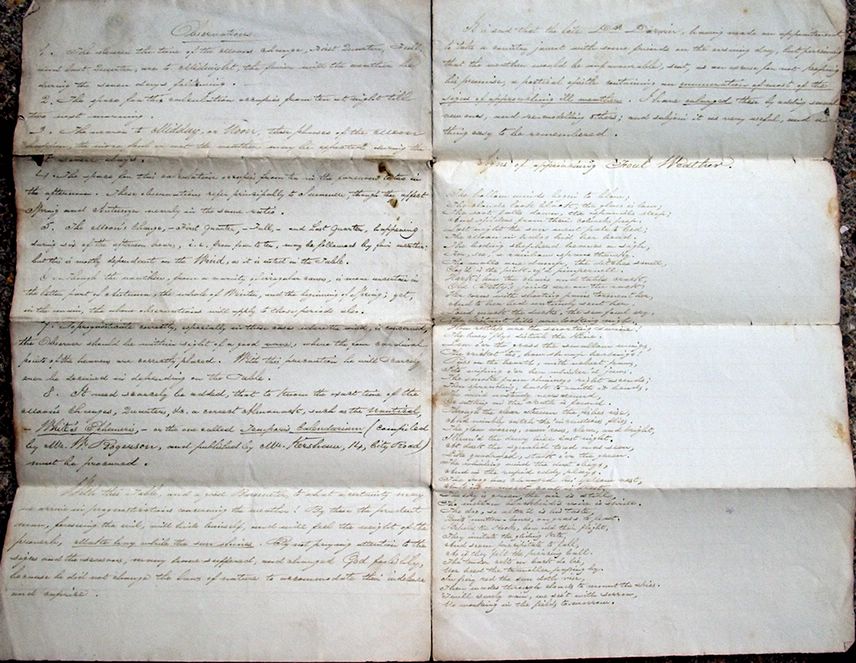
The halo sometimes seen round the moon is called the 'bor' or the 'burr', and when it is near the moon the rain is far—'Near bur. Far rain.'Carl Van Vechten's The Tiger in the House (1922), online here, explicitly compares Darwin's line about cats to passages from John Swan and Robert Herrick. As Vechten remarks, 'Cats in many quarters of the globe are held responsible for the weather; they are actually said to make it good or bad.' Darwin's verse is a composite of these sayings and epigrams. But being a composite, it loses the quality which defines the epigram: brevity, symmetry and balance. It is written in an iambic tetrameter, which lends itself to short lines with a heavy caesura, just like an epigrammatic couplet, such as this one by Goldsmith:
When oxen low and midges bite
We all do know ‘twill rain to-night.
When dogs eat grass there will be rain.
When cattle lie much rain is expected.
When the smoke rises straight up from the chimney, it will be fine, but when smoke donks it will rain.
A coming storm your shooting corns presage
And aches will throb, your hollow tooth will rage.
For he who fights / and runs awayThe first line balances the second in sense, rhythm and rhyme, and the first and second halves (hemistichs) of each line also balance each other across the caesura: this gives the epigram its characteristic solidity, a self-completing whole. (In this case, as it happens, another couplet provides an additional layer of symmetry.) But in a longer verse like Darwin's, the metre flags and plods as a series of disjointed couplets, each balanced internally, but none overtly relating to the other:
May live to fight / another day.
The sky is green, / the air is still,There is a fluency neither of rhythm, nor of meaning—it is a paratactic, as opposed to a hypotactic style. Only twice (lines 12 and 42) is a couplet continuous in sense with the next, and each time divided by a strong pause. The images have no temporal relation with one another, except for an occasional reference to 'last night'. In fact, there seems no definite time-frame at all, as 'the sun doth rise' follows 'a rainbow spans the sky', as if the latter were at night; again, Betty's corns 'torment' her in the present tense, but 'sent' her to bed in the past tense, if only for the sake of a rhyme. It is a deadened style, evoking not the life of nature, but rather a series of views, without context, unable to progress or develop. What we are offered, in effect, is the same thing presented over and over again, using different metaphoric images, like a man struggling in vain to communicate.
The mellow blackbird's / noise is shrill.
The dog, / so alter'd is his taste,
Quits mutton-bones, / on grass to feast.
And this also is a sore evil, that in all points as he came, so shall he go: and what profit hath he that hath laboured for the wind?In fact, the behaviour of wind in this poem is pretty strange. Contrast:
1 / The hollow winds begin to blowto:
25 / The wind unsteady veers around
33 / The whirling wind the dust obeys
37 / The sky is green, the air is stillLine 37 seems contradictory, but it comes at the turn of the poem, well hidden, occupying lines 35-40. In this passage, everything is topsy-turvy: the frog changes colour, the sky is green (ever seen a green sky?), the air is suddenly still, the blackbird is mellow but his song shrill, and oddest of all, the dog stops chewing on his bones and begins eating grass—unnatural, and likely to lead to the mutt's malnourished demise. After the turn are two images in succession of animals feigning death. 'Signs of Foul Weather', then, describes the superstition and foreknowledge of approaching death; but not the fear of death. The rainbow and the rising red sun (triumphant over the night) are ancient symbols of regeneration and promise. The last note, however, is melancholic, with impending rain—the tears of the bereaved—and a solemn realisation that there will be 'no working in the fields to-morrow': nobody, that is, to work.
Labels: literature
Apologies to my readers; Conrad has been on holiday in Bruges, Flanders, with his beloved wife. Not much to tell: it's a dull town for the most part. I enjoyed the excellent beer—the bruin house-draught at Cambrinus being my favourite—the linguistic oddity of Dutch (being the only European language not to call an orange an orange? No, apparently the Scandinavians also call it a Chinese apple), the odd art-installations and confession-box turned computer-station at one random church in the back streets, and the iconographic continuity of the chaliced serpent and standard-bearing lamb—Johns Evangelist and Baptist respectively—found throughout the paintings of the mediaeval Oud Sint-Jan Hospital, and constituting the logo of the new Sint-Jan Hospital.
Normal posting resumes tomorrow.
Labels: adventures
bedecktsamiger StapelThe thread and narrative of the sequence is in fact a series of motifs, from birds to various roundels to falling timbers to skeletons and popes. The more famous La Semaine, of which a Dover reprint is easily available, is divided into days corresponding to physical elements and visual motifs; its structure is simpler and less intuitive than La Femme, which in turn is more surprising and inventive. They correspond, in their own way, to the two automatic texts produced by Brèton and Soupault, Les Champs Magnétiques and La Conception Immaculée, the first being freeform and anarchic, the second segmented and systematised. I prefer the former in each case.
mensch nacktsamiger wasserformer
("edelformer") Kleidsame nervatur
auch
!umpressnerven!
Labels: art, literature
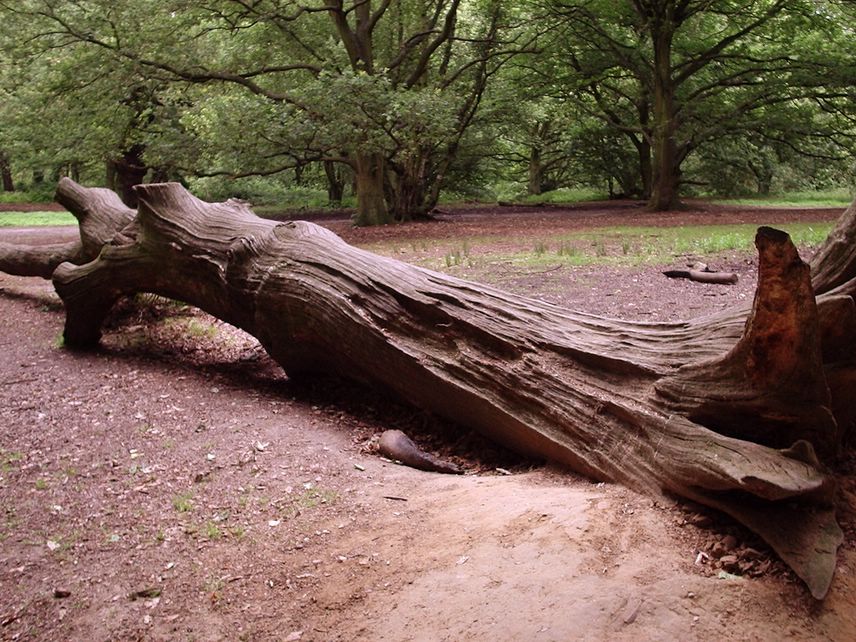
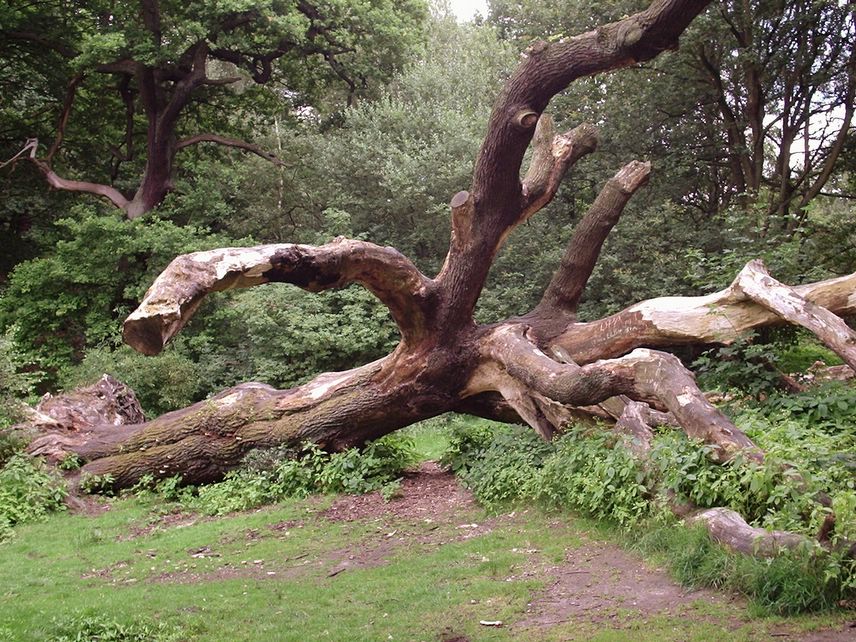
He pretends to be clumsy and knocks the chess pieces over with the hem of his coat. He looks up at DEATH.On October 16, 1987, in the small hours of the morning, a young Conrad Roth, barely turned six, was woken up with a start when his large world-map came off his bedroom wall with a crash. His world was, quite metaphorically, coming down. The panes were rattling and outside the trees were heaving ferociously. It turned out to be the Great Storm, the worst winds in British history. I don't have many memories of that time. But Hampstead Heath remembers: the Heath is like the mind for Freud, that never forgets, leaving always the sigils and markers of trauma, or the Dianetic engram, 'a mental image picture which is a recording of a time of physical pain and unconsciousness. It must by definition have impact or injury as part of its content'.
KNIGHT: I've forgotten how the pieces stood.
DEATH (laughs contentedly): But I have not forgotten. You can't get away that easily.
DEATH leans over the board and rearranges the pieces.


Labels: London

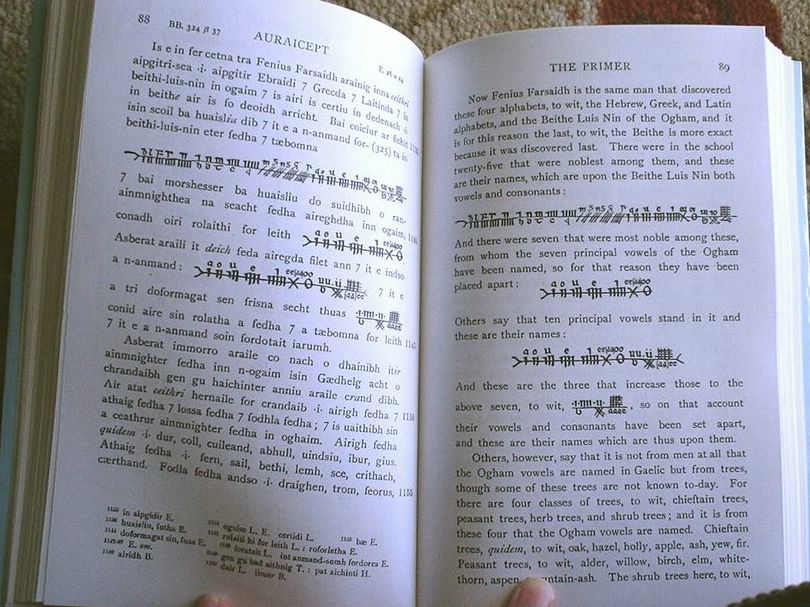
To what is this a beginning? Not hard. To the selection that was selected in Gaelic since this is the beginning which was invented by Fenius after the coming of the school with languages from abroad, every obscure sound that existed in every speech and in every language was put into Gaelic so that for this reason it is more comprehensive than any language.
Query, what are the definite numbers of Nimrod's Tower? Not hard. Eight of them, to wit, 72 counsellors, 72 pupils, 72 races of men, 72 languages, the languages in his school, 72 peoples whose were those languages, and the races, 72 artificers to work at it, 72 building materials including lime, bitumen, earth, and cement in equal layers, 72 paces in width. . .Languages become part of the edifice, like bricks in a whole. This is why the Auraicept goes onto say that according to different accounts, 'only nine materials were in the Tower, to wit, clay and water, wool and blood, wood and lime, acacias, flax thread, and bitumen', which correspond to 'noun, pronoun, verb, adverb, participle, conjunction, preposition and interjection'. Which is only eight. Oops. I imagine clay and water to be the noun and the verb, solid and liquid, the two primary components; blood for the personal pronoun, flax thread for the conjunction and fiery bitumen the interjection. I don't know about the others. You'll notice that 'participle' is listed as one of the parts of speech; this follows the classical notion (see Varro 6.36) that words can be divided binomially according to whether they possess time (verbs), case (nouns, adjectives), both (participles) or neither (everything else—commonly divided into adverb, conjunction or preposition, and sometimes interjection).
the letter [litera, expanded to legitera] is as a road for reading [legendi iter] inasmuch as it prepares a way for the reading:Then a Gaelic equivalent is attempted, the word for 'letter' being gutta:
voice foundation [guth fotha], ie. foundation of the voice is that: or voice sent [guth fuiti], in respect that voices are sent through them: or voice ways [guth seta], in respect that they are ways of voices. . . or a voice place [guth aite], ie., they make a voice in place: or they vocalise [guthetait], ie. in respect that voice comes through them alone.The process of etymologising here is not to find the true root (etymon) of the word, but as a sort of magic with words, a temurah, the notion being that all products of the same sounds are ultimately equivalent. And language is wood, too, for the Ogham is the Bethe Luis Nin, the tree alphabet, letters carved into bark. As Cassiodorus delights in reminding his reader, liber (book) is from liber, free, as the bark (liber) from the tree. And 'Fidh, wood, is from the word funo [φωνέω], I sound, or from the word fundamentum, ie. foundation. . . Now, as to fid, wood, good law is as its meaning, both artificial and natural'. Taebomnai or consonants are the sides of oaks, 'from the fact that material for the words is cut out of them'. Wood was the stuff of the universe for the Greeks, first xyle then hyle. I always wondered about that fact. The connection was made for me also by George Guess, who concocted a syllabary for the Cherokees in the 1810s, and who gave his native name to the Sequoyah tree. I wrote a poem about it once.
This general shaman tells heavens to the earth,The Irish literature of the early mediaeval period is a goldmine, full of strange linguistic adventures, such as the Hisperica Famina poems, written in bizarre macaronic Latin. The Auraicept is a product of that sensibility, overflowing with ideas, words, stories, a light in the dark, grammatic fantasy, a memory of religion and language made into new systems, and a fertile tributary in the river watering the immense gardens of Finnegans Wake.
his red wood pricking the elements;
in his girth, in his height, in his signed barks,
in the light that sparks on his moss-lined trunk,
in his xylems and fluid phloetry, in ants patterning him,
in the galed twittering of branches,
most of all in pulp, paper—read wood—
this tree whispers encoded heavens to the earth.
Labels: language, literature
Lo! the Bat with leathern wing,
Winking and blinking,
Like Dr Johnson.
Aldiborontiphoscophornio!
Where left you Chrononhotonthologos?
Let the singing Singers
With vocal Voices, most vociferous,
In sweet Vociferation, out Vociferize
E'vn Sound itself.
. . . all the magic Motion
Of Scene Deceptiovisive and Sublime.
King. What ails the Queen?
Aldi. A sudden Diarrhaea's rapid Force,
So stimulates the Peristaltic Motion,
That she by far out-does her late Out-doing
And all conclude her Royal Life in Danger.
Day's Curtain's drawn, the Morn begins to rise,
And waking Nature rubs her sleepy Eyes:
The pretty little fleecy bleating Flocks,
In Baa's harmonious warble thro' the Rocks
Say she has got the Thorough-go-Nimble.
Whole Magazines of galli-potted Nostrums
Pity that you, who've served so long, so well,
Shou'd die a Virgin, and lead Apes in Hell.
He sleeps supine amidst the Din of War:
And yet 'tis not definitively Sleep;
Rather a kind of Doze, a waking Slumber,
That sheds a Stupefaction o'er his Senses;
For now he nods and snores; anon he starts;
Then nods and snores again: If this be Sleep,
Tell me, ye Gods! what mortal Man's awake!
¿Qué es la vida? Una ilusión,
una sombra, una ficción,
y el mayor bien es pequeño:
que toda la vida es sueño,
y los sueños, sueños son.
— Pedro Calderón de la Barca, La Vida es Sueňo
Henceforth let no Man sleep, on Pain of Death:
Instead of Sleep, let pompous Pageantry
Keep all Mankind eternally awake.
Labels: Early Modern, literature

Labels: miscellaneous
This does not—repeat not—mean that the Lit. Supp. will not on occasion censure a book, or even damn it, with all the critical fervour and talent at its command (which is considerable); but of this much you can be certain—it was well worth damning.Meanwhile, Barclays Bank quotes Browning and uses language like 'the colour of dangers and alarums' and 'We cannot, alas, scatter these facilities with a fine, careless rapture'. How quaint! As for the articles, they just pile up, one after the other, about the bleak loneliness of modern life, some scientific, others emotional, with some charmingly trite poetry too ('I do not want to be consoled / because this grief is all I hold'), literary quotations, and cartoons without punchlines. The most interesting thing in the book is a piece by the Chicago journalist and scriptwriter Clancy Sigal about alienation among intellectuals.

Labels: philosophy
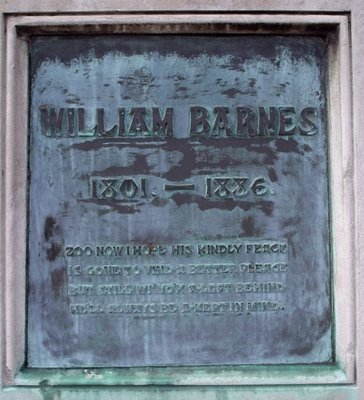
ZOO NOW I HOPE HIS KINDLY FEACE3. On the high street, an expressionistic memorial plaque for the Tolpuddle Martyrs.
IS GONE TO VIND A BETTER PLEACE
BUT STILL WI' VO'K A-LEFT BEHIND
HE'LL ALWAYS BE A-KEPT IN MIND
Labels: adventures
PHAEDRUS: I should like to know, Socrates, whether the place is not somewhere here at which Boreas is said to have carried off Orithyia from the banks of the Ilissus?The making myth of a place is fundamental to us; it is, in fact, the making of place out of mere space. Ancient peoples gave meaning to their environment by investing it with signs and stories, and by orienting themselves around key natural monuments. A great deal is lost now; space has become dull, without shape, without significance. The myths and stories of London have become concreted over, and half-lost with the postwar renovations, with the estates, the chainstores, and with the scrabble for lebensraum.
SOCRATES: Such is the tradition.
PHAEDRUS: And is this the exact spot? The little stream is delightfully clear and bright; I can fancy that there might be maidens playing near.
the forgery(Much later, Primo Levi refers implicitly to the Chalybes in a story ('Lead') from The Periodic Table (1975): 'they were crude folk and from their accounts it was hard to understand what metal they were referring to; also because not all spoke the same language and no one spoke mine, and there was a great confusion of terms. They said, for example, 'kalibe' and there was absolutely no way to figure out whether they meant iron, silver or bronze.')
Of brazen shield and spear, the hammer'd Cuirass,
Chalybean temper'd steel, and frock of mail
Adamantean Proof
CHALYBEATE WATERS (Ferruginous Waters) contain iron (usually as a bicarbonate, occasionally as a sulphate) as their active principle, and in considerable proportion; they have a styptic taste, and become purplish-black with tannic or gallic acids. . . Chalybeate waters are divided into carbonated and sulphuretted; the former being brisk, sparkling, and acidulous, the latter containing hydrogen sulphide. To be of first quality these waters should contain considerable iron and but little of other mineral ingredients, and should be highly carbonated.From the mid-17th century, such waters were considered highly salubrious, despite their nauseating taste. Thomas Sydenham, for instance, prescribed the waters for hysteria in 1693, and two centuries later Thomas Clouston prescribed them for neurosis. (This information from Jonathan Andrews, 'Letting Madness Range: Travel and Mental Disorder, c.1700-1900', in Wrigley and Revill, eds. Pathologies of Travel, online here; for further reading consult footnote 75.) Iron is indeed the stuff of life, bonding oxygen in the bloodstream; anaemia, the deficiency of iron in the body, causes pallor, fatigue, weakness, dyspnea, lack of appetite—a diminishment of life itself. It was an early-recognised condition, first called chlorosis, and treated with iron salts by the aforementioned Sydenham. Chalybeate wells are to be found all over the world: America (there exist towns of the name in Kentucky and Mississippi), Russia, Continental Europe, and Britain—countless early modern spas were founded on these sites, quackably advertising the restorative and vitalising power of the waters. By the 19th century, doubt had set in, although Victoria regularly drank at Tunbridge Wells. Samuel Hahnemann, propounding his own homoeopathic quackery, expressed scepticism about the waters in the Materia Medica Pura (1833):
It is mere charalatanry to call solutions of iron steel-drops, and chalybeate mineral waters steel-waters, steelbaths. By these expressions it is intended to convey the notion that they indubitably possess an absolute strengthening power in a high degree; for to steel is a metaphorical expression for to strengthen. But iron only becomes steel when its peculiar elasticity and hardness are developed. In its solution by acids the steel disappears; the solution then only contains a substratum of iron, and the oxyde (iron ochre) collected from chalybeate waters, when smelted, produces nothing but ordinary iron.

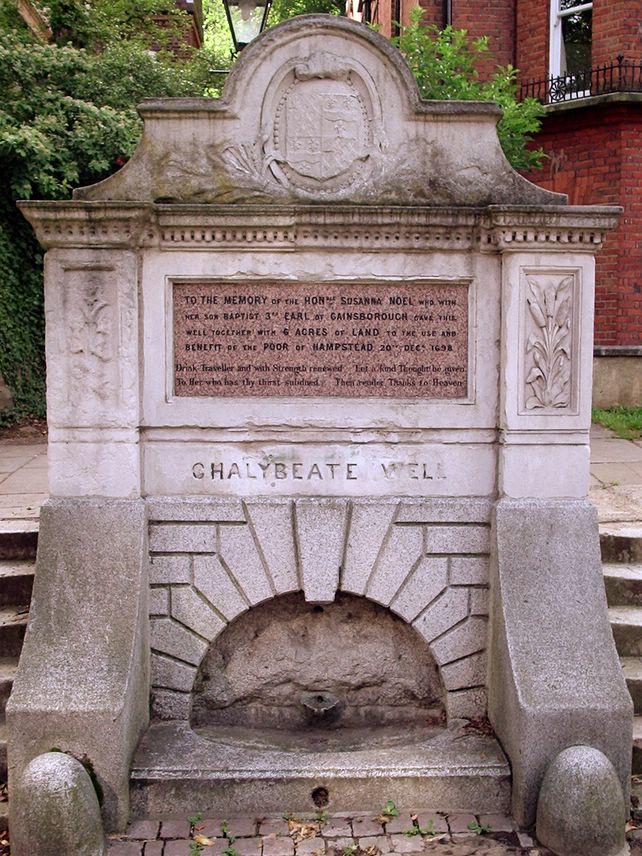
In 1684 the Earl of Gainsborough received permission to pipe water from springs in his manor of Hampstead to the City and suburbs. The chalybeate spring given by his widow to the poor of Hampstead in 1698 was probably thought unsuitable for this purpose because of its salts. When, however, the mineral waters were exploited, the vestry retained control over the springhead north-west of the well and in 1700 ordered water from the springhead to be piped into the town, apparently to raise money to relieve the poor rate rather than to meet any scarcity of water.The stone is to be found on Wells Walk, adjacent to Flask Walk. Simon Jenkins, in the Companion Guide to Outer London, explains the latter: 'This street takes its name from the flasks of well water which were bottled here to be sold in London 'at the Eagle and Child in Fleet Street every morning at 3 pence per flask; and conveyed to persons at their own homes for one penny per flask more. The flask to be returned daily'.' The quotation, irritatingly, is unattributed. These streets adjoin that part of the Heath known as the Vale of Health. As is so often the case, then, the local names record the history. But little else remains. According to Jenkins and others, the popularity of Hampstead Wells soon waned in favour of the less urbanised Bath and Tunbridge Wells; the pump room was converted into a chapel in 1732, with minimal revivals of interest later in the century. In contrast to this account, an 1868 gazetteer of Great Britain notes:
In various parts of the county are springs of mineral water, some of which have been in great repute for their medicinal properties, as Acton, Bagnigge and Sadler's Wells, Clerkenwell, Hampstead, Hoxton, Tottenham, and White Conduit House; but none of them are now much frequented, except perhaps Hampstead, which is strongly chalybeate.Aside from the stone, two ornamental fountains can be found at the base of the hill: one at the bottom of the ravishing Fitzjohns Avenue, overlooking the statue of Freud outside the Tavistock Centre, and the other in South End Green, by the Royal Free Hospital. Health of the mind and the body. Both fountains are much later than the wells, but each conjures that magical image of waters bubbling up out of the ground, bringing life.

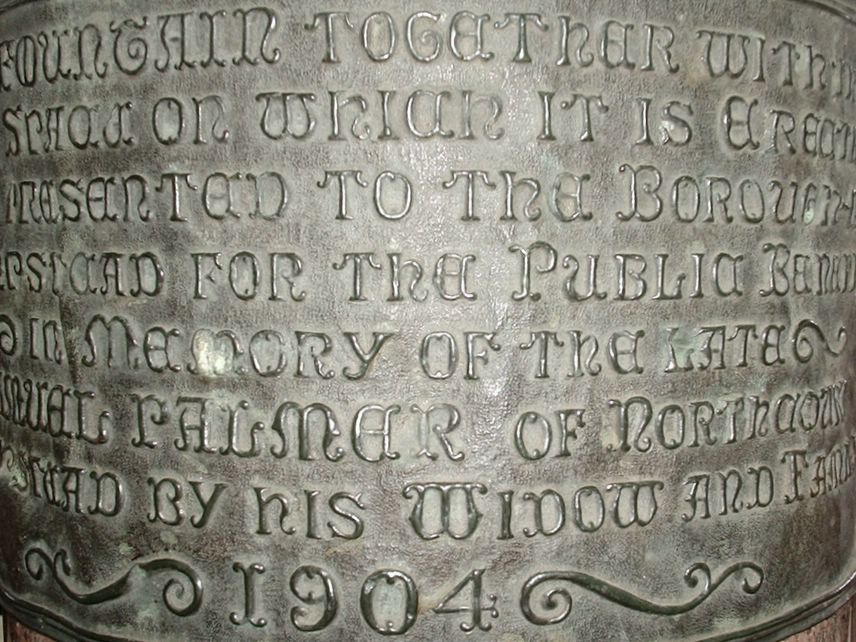
Belsize was supplied by tributaries of the Tyburn, one rising near Belsize House, which it supplied by way of a pond, another in Shepherd's Fields, northwest of Rosslyn House, where the public spring was conduited and known by 1829 as Shepherd's Well.The present fountain was built in 1904, as its own plaque (with a lovely baroque-uncial typeface) explains. Both plaques, interestingly, like the inscription on the Wells Walk stone, emphasise that the waters are given over for the benefit of the public. We see here the tributary of bourgeois and aristocratic socialism that would flourish in the 19th century; the conviction that these medicinal waters are for the weal of all, not just for those with the means to pay. This is a legacy of Hampstead: the generosity of a classless earth, fertile and rejuvenating.

But whosoever drinketh of the water that I shall give him shall never thirst; but the water that I shall give him shall be in him a well of water springing up into everlasting life. (4.14)Adam Clarke follows Zimchi's [Kimchi's?] reading of Isaiah's waters as the Torah, necessary to the sustenance of mankind. But John's waters are quite different, not external but internal, the well of faith in the human soul, the illapse of the Spirit through the message of Christ—a characteristic shift between the Testaments. Had John lived in early modern Europe, perhaps he might have spoken of the chalybeate waters, the fortifying power of dissolved iron, flowing rivers of living water into the belly.
He that believeth on me, as the scripture hath said, out of his belly shall flow rivers of living water. (7.38)
wrote a 20-page poem named Chalybea. The name, playing off so many related words, had so much resonance for me that a whole world seemed to spill out of it. It evokes the currents of a water deeper than all men, a spring or an ocean of thought, and the iron rising out of it, the iron in the blood, the iron of the steel of our new architectures, with water hardened into glass, and also the chalybeous blue of case-hardened steel, the blue of the deep, of piano notes, and of watch-springs, of the hidden mechanisms of time, stopped. I imagined a city with rivers of liquid glass, where a shortage of steel forces men to strip their clocks and watches for the springs, stilling the movement of time. The poem's protagonist, an admiral named Conrad, stages revolution from the sea against the city, but achieves nothing. Chalybea to me was an object of love, a face half effaced peering out from a wall, a goddess presiding over the iron and the waters of time, and of the unfinished act—'Her who has thy thirst subdued'. In my yard there's a pool, I used to angle thereThis is why I am so fascinated by the forgotten springs of my birthplace; the iron in the waters is as the vitality of my lifeblood, and of my mind. Hampstead is a place where swimming-pools are converted into porch-steps, where small families cycle by and ring their bells in musicbox harmony. To walk now in these labyrinthine alleys, among the stately churches and relentlessly elegant terraces, under all the trees, on the pavements over the soil over the deep-coursing waters, one experiences the pleasure of a lost memory. It is still a homestead, even if its streams are long gone.
on warm nights. I thought the mirrored constellations
a plenum of iron fish, an angel felled for each failed wish.
Often I'd play harpsichord, or a glass Steinway, well-tuned,
always adagio. She'd lie cocooned in song, Chalybea.
Labels: Bible, history of science, London, photography

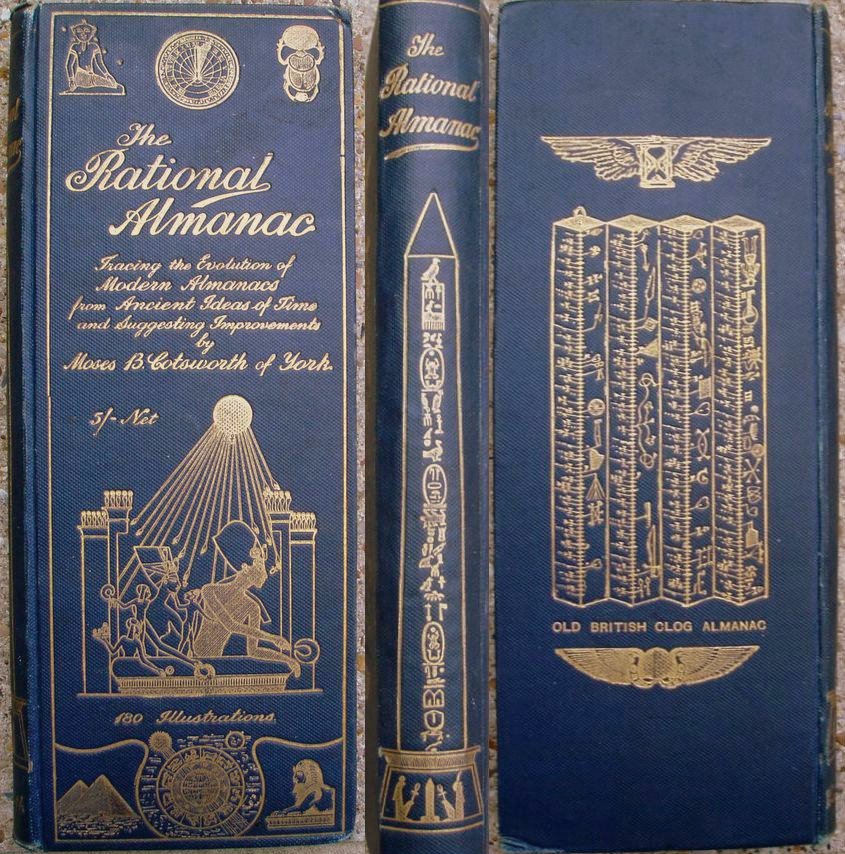
When, therefore, my medical adviser ordered me abroad to the sunniest climate available, to get rid of serious throat illness, I promptly started for Egypt, though that meant a serious tax on my limited means.The Great Pyramid, Cotsworth claims, is essentially a huge sundial, measuring year-cycles by variations in the length of its shadow; Cotsworth demonstrates exactly how this might have been done. Not until the pyramid was constructed (and he notes that similar structures exist all over the world, including most importantly the Tower of Babel) could men reckon time accurately by the year. Before that, he argues, men calculated in terms of months, five months, six months. This explains the outlandish longevity of the Biblical patriarchs—as the 'year' modulus became longer in the period between Noah and Moses, the patriarchs' apparent lifespans diminished accordingly.
I am convinced that the true length of the Year was never found out until after the Pyramids were built to solve that greatest problem early communities had to solve, for until that gave the measure of apparent yearly motions of the Stars it would be quite impossible for star observers to locate the Seasonal positions of the Stars, whilst obviously, as they saw that the Sun caused the Seasons, they could not be expected to seek out the solution of the Year apart from the Sun as its cause.This is powerful material, rich in suggestion and conviction, despite its uncritical reliance on religious texts. The Rational Almanac is not just a summation of history and a plan for the future, but a history informing that plan, a reform which enters into the fabric of history and furthers its progress—the book is thus the encapsulation of an entire world-view. Cotsworth makes an impassioned plea for the reader's support of his scheme:
May I ask readers who favour these suggested Reforms, to fill up and return to to me the enclosed post card, notifying their support, and follow that up by kindly using their best efforts to enlighten public opinion by bringing this question before Members of Parliament, Public Authorities, and their friends, to ensure practical reform.It is this utopian spirit which I have always enjoyed so much—and which moreover forces something sharp in my throat. It fills me with the hope that things might change, at the expense of my inner sneering sceptic. This is the appeal of all those Victorian movements which wanted to change everything all in one go, the comprehensive view of the whole. If only the measurement of time could be reasonable, we might ourselves become reasonable. Mankind, after all, is governed by its understanding of time, as we can see by the cultural evolution of ancient races with their slowly-advancing chronometric technologies. It's the same thought that governs the language-reformers, who thought they could make men reasonable by making their grammar fit to neat rules. The most recent example of that was the Basic English programme of Ogden and Richards, damned by Whorf and lampooned by Orwell as Newspeak, despite transition's translation of Finnegans Wake into the language. Now this stuff is old hat, a relic of late Enlightenment superstition. What next: decimalization?
Labels: history of science, literature
Me: "Why should the fact that a book was Intelligently Designed (I use this to designate the product of a mind, rather than specifically of a good mind—that would be begging the question) affect your analysis of it?"Just to spell this out, John is drawing an analogy between baseball and literature. Baseball consists of concepts and rules (or, in Euclidean terms, definitions and axioms), which are agreed upon by convention. We could interpret a baseball game according to different concepts and rules, but we wouldn't have an accurate understanding of what was going on. Just as baseball is incomprehensible without an a priori knowledge of the concepts and rules, so literature is incomprehensible without an a priori knowledge of X. The content of X is never made entirely clear; but it seems that the intention of the author (analogous to the intentions of the batters and pitchers, which are in turn based on the concepts and rules of baseball) is part of it. For John, (part of) studying literature is assessing how well a given author achieved what he was trying to do, how well he realised his intention—just as part of studying baseball is assessing how well the players realised their intentions, strategies and so forth. In his own words, "our understanding of baseball events is enhanced by our understanding [of] what baseball players are trying to do. Similiarly [sic] for literature." This assessment is what we are calling 'evaluation', and it has a central place in literary studies.
John Emerson, replying with a rhetorical question: "Why would our awareness that certain events in [baseball] count as "runs" and are attributed to "teams", and that one of the "teams" will win and the other lose—why should that affect our interpretation of the physical events on the field? Isn’t it ethnocentric and subjective to apply the normative framework of "baseball" to these events?"
Labels: literature, philosophy