29 June, 2007

Kitap Mitap: a shaggy dog story

For the last month, I've set up camp in the Rare Books room of the British Library, where between reams of Sotheby's catalogues I entertain myself with the perusal of unusual volumes—Maupertuis's 1745 Vénus Physique, for instance, or Cato's De Re Rustica (aka. 101 Uses For Amurca), which, in the 1934 Loeb edition bound with Varro, reveals behind its spine a column of paper pasted in from another little Loeb, so tantalising in its final words:
in other languag
ly. The variety
Sotheby's turns up a Vulgate on uterine (foetal) vellum; a manuscript ascribed to 'Anicius, Manlius, Severinus et Boethius'; Abu Ishak's Pole Star of Pleasure from Wines; and Rules for Roman Catholic Criminals, whose contents are described by the auctioneer as 'ludicrous and amusing'. It also turns up a Wycliffe Bible from the 15th century, sold on July 28, 1863, for the sum of 850 350 pounds—an enormous amount of money. To put this in perspective, your average Vulgate manuscript was going for around 6-20 quid. Update: Arnold Hunt, Curator of Historical Manuscripts at the BL, has been so kind as to send me (unsolicited) the July 28 entry from the diary of Sir Frederic Madden (1801-73, palaeographer and BL keeper of manuscripts). Madden notes the £350 sale of the Wycliffe with three exclamation marks, and comments:
The first three lots were purchased by Parker & Stevens for America! It is remarkable, what madness exists at present in regard to the MSS of the Wycliffite Versions of the Bible. Yet the man who would give the absurd price of £350 for a MS of the New Testament, of no particular value in regard to the text, would grudge £4 to buy a copy of my edition of both Wycliffite versions of the entire Bible with the various readings of all the best MSS extant!
Many thanks to Dr. Hunt for this additional contemporary insight into the sale. Perhaps Mr. Stevens had been swayed by the rhetoric of the catalogue note:
The extraordinary rarity of Manuscripts containing Translations of any portion of the Holy Scriptures into English is too well known to require comment, but is not to be wondered at when we consider that the mere possession of such an article, if it became known to the Priests, would have probably brought its owner to the stake. The followers of Wyclif were persecuted to the utmost as heretics, and the Transcripts of his Version seized and rigidly destroyed. Hence the difficulty to Bible-Collectors of finding any specimen to enrich their collections.
The persecution of Wycliffe is still a totem of mediaeval Church evil. But as David Daniell remarks, in his already-classic 2003 The Bible in English, nobody had ever been persecuted for reading a vernacular Bible before 1401. That year was when Henry IV passed his law De haeretico comburendo. And in 1408 Thomas Arundel, recently voted 'Worst Briton of the 15th Century', established his quasi-legal Constitutions of Oxford, the 6th and 7th items of which attacked Wycliffe and his vernacular Bible:
VII. CONSTITUTION. That the text of the Holy Scriptures must not be translated into the English language.

It is a dangerous thing, as Saint Jerome attests [Letter 57 to Pammachius, written in 395], to translate the text of the Holy Scriptures from one idiom into another, for in translation it is not easy to retain the original in all its senses, just as Saint Jerome, even though he had been inspired, still acknowledges frequent error; therefore we state and ordain that henceforth, nobody may by his own authority translate the text of the Holy Scriptures into the English language or any other, whether into a book, a booklet or a treatise, nor may anyone read any book, booklet or treatise recently written by John Wycliff or his associates, or any about to be written, either in part or whole, in public or in secret, under threat of major excommunication, until the translation has been approved by the local bishop, or if necessary the provincial council; whoso acts against this will be punished as a promoter of heresy and like errors.
Strange, then, that according to Daniell, and contrary to the Sotheby's writer, 'About twenty surviving [Wycliffe] manuscripts of the 1380s are of the whole Bible, almost ninety of the whole New Testament. Over 250 manuscripts survive, a larger number of copies than for any other medieval English text.' The Canterbury Tales, by comparison, exists in 64 copies. I can only imagine that by 1863 the majority of Wycliffe texts were already in official collections—there are dozens in the British Library, and in the Bodleian. The next part of the Sotheby's description allowed me to trace the manuscript:
The present copy, written in the old orthography, appears to have been purchased in May, 1576, by "Robert Ardern of Barwicke" from "Mr. Englatt the Mr of the singyng chyldren in Chryste Churche in Norwich" for "twentye shillings."
Robert Ardern here should not be confused with Shakespeare's grandfather, Robert Ardern (or Arden) of Park Hall, who died in 1556. Englatt of Norwich, however, is the lead we want, and points us to this manuscript in the New York Public Library. Among the ownership notes are some verses:
By chaunce this Holy Booke came to my view,
It's worth the keeping, for it's very true.
I haue not seene it's fellow, and believe
Nor any man, that is this day aliue.
Giue God the praise for this his auncient Work
Who hath preseru'd it both from Pope & Turk
Both wch if they might haue had their desire
Would haue exposed it vnto the fire.
But God will alwaies keep from such bad men
His holy Writt: Giue glory to him then.

12 Nouembris 1661.

The aforesaid Mr John Booker casually seeing this booke as it came from the binding forthwith composed & writ the above verses being affected with this Antient Manuscript.
Sotheby's, in fact, quotes these last lines, but not the verses, and finally remarks that 'John Booker was one of the antagonists of Taylor the Water-Poet'. We can do better than that. Booker (1601-67) was a professional astrologer, and a successful one. In the mid-century, English astrologers were divided into Royalist and Parliamentarian factions; Booker, and the more famous William Lilly, were on the latter side. (Booker's anti-Royalism was also an anti-Catholicism, as he accuses Charles of popery—associated in the above verses with the suppression of Wycliffe.) Principal on the Royalist side was George Wharton, who published almanacs and prognostications from 1641 under the anagram 'Naworth'. Booker attacked Wharton—'No worth'—in his 1644 Mercurius Coelius (The Heavenly Herald), and Wharton immediately replied with Mercurio-Coelico-Mastix (Scourge of the Heavenly Herald). Booker's next salvo was A Rope for a Parret, published on March 6th, two days after the appearance of Mercurius Vapulans, also against Wharton, by the pseudonymous 'Timotheus Philo-Bookerus'.

It was at this point that the aforementioned John Taylor, the 'Water Poet', famous Royalist satirist and pamphleteer, stepped in on Wharton's behalf. Taylor's No Mercurius Aulicus, subtitled 'the breaking of BOOKER, the Asse-tronomical London Figure-flinger, his perfidious Prediction failing, and his great Conjunction of Saturne and Iupiter dislocated', was published on July 10th. (Mercurius Aulicus, incidentally, being an important proto-newspaper produced by the Royalist John Birkenhead.) Taylor accuses Booker of slander and disloyalty to the King, and concludes:
Thus (Master Bookerus) I have anatomized and skellitonized your railing Pamphlet and ridiculous Prediction: it is known too well, that the expectation of some mischievous events was the ladder on which your meditations mounted. You were believed amonst a company of catacoxcombrian Plebeians, as amongst the Heathen the Delphian Oracle;
Readily apparent is the stylistic imprint of that great pamphleteer Thomas Nashe, whose work Taylor so admired ('Tom Nash a witty pamphlet did endite / In praise of Herrings, both the red and write', from In Praise of Hempseed). The same fantastical coinages—especially 'catacoxcombrian'—are fully in evidence in Taylor's pamphlet.

But what of Booker? The astrologer ups the ante in his own reply, published on July 19th—No Mercurius Aquaticus, 'but a CABLE-ROPE Double-twisted for IOHN TAYLER, the Water-Poet, who escaping drowning in a Paper-Wherry-Voyage, is reserved for another day, as followeth'. (The reference is to Taylor's penchant for taking wacky trips on the Thames in a paper boat.)
And now thou Thames Otter, thou Malignant Dive-dapper, thou Jack Tayler, thou Motley, Sea-green, Ditch-water villain, that hast more Malignant flowings and ebbings in thy Waterish Brains, then the Thames hath Tides. . . I perceive that your language is as foggy and fulsome as your Ale, your conceits smell too much of the Malignant Onions and Garlick of Egypt, you have so much Irish and Spanish, that I cannot understand you with my Wits.
It gets even better!
I shall goe no father than Mahomet and his Alcoran, and there I finde the word, Thorny Ailo, the wise Anagram of thy Name, to be thus Anatomized and Skellumatized. Thorny in the Arabicke, signifies a villaine, and Ailo in the Syriack a Rook, otherwise called in the Greek Abaddon, which being Englished, is a destructive Villaine; or an Antichristian Prick louse, which tacks together all sorts of Fustian, as impudent lies, Slanders, and far-fetch'd Bumbast, in the behalfe of Popery. . .
Notice that 'skellitonized' has become 'Skellumatized', after 'skellum', meaning a villain or scoundrel (compare Pepys). Booker goes on to suggest another anagram for Taylor—'Joyn Halter is a most compleat Anagram, than which none could ever have framed a better to speak thy deservings'. Also of interest to language geeks is Booker's mockery of Taylor's spelling of his own name (with 'or' rather than 'er')—a very unusual sort of criticism at the time:
What is the reason Sir, that you spell false? Is it because your Skellumship would not have the world to thinke, that your Pedegree was derived from such a Lowsy, Snip snap Originall, as to have thy Ancestors thought to be Taylers?
True enough, John Taylor did not stay silent. His reply, still in 1644 but undated, was Iohn Taylor being yet unhanged sends greeting. It is more of the same relentless raillery and invective, and seems to have been the last of the exhange. Taylor scoffs at Booker's silly wordplay, while suggesting his own anagram ('O Harty Lion'), and insists that his rival has only the wits to go where he leads:
As when Christopher Columbus (an Italian) first discovered some small part of the (then unknown) America, Vespusius (a Spaniard) sailing the year after, with the Chart or Card, Compasse, Mappes, and Mariners, that formerly Columbus had used, the said Vespusius discovered more Land, as the golden Peru, and other vast Continents, and at his returne (being at dinner with Columbus and others) Vespusius bragged that he had onely found that new and rich World, at which words the Italian took an Egge in his hand, asking Vespusius, if he could make the Egge stand on one end upon the Table, to which he answered, he could not do it, then the other said that he could do it, and presently he put the Egges end into the Salt, and it stood upright; then the Spaniard said, that he could do that tricke as well as he, to which the Italian replied, so you could finde America when I have shewn you the way.

It is a much-repeated story, known as Columbus' Egg, and has its own Wiki page. Taylor's telling is unusual on two accounts—first, it involves Vespucci by name, and secondly, Columbus stands up the egg by putting it in salt, rather than by breaking the bottom on the table, as is commonly recounted. The story comes from Girolamo Benzoni's 1565 History of the New World, and was itself lifted from a tale told by Vasari of Brunelleschi; it was probably known to Taylor via the 1613 Pilgrimes of Samuel Purchas—
Euen the Spaniards themselues, not only by the tale of the Pilot before mentioned [ie. Columbus], but by light esteeme of his worth haue shewed a contemptible contempt of him: some of whom obiecting to himselfe the easinesse of this Discouerie, as he sate at Table, he prayed to make an Egge, which then he gaue them, to stand on end; which when they could not, hee bruising the shell, and making the end flat, made it to stand thereon: thereby insinuating, how easie it was for them to doe that which they had seene and learned of him.
Why the addition of Vespucci to Taylor's telling? Men in the 1640s—Peter Heylin, for instance—were still suggesting that America had been misnamed, and should rather be Columba, or Cabotia. Thus the name of Vespucci gave the anecdote a particular sapor, although I do not know why Taylor thought him Spanish. The sand, again, I cannot account for. Perhaps Taylor wanted to show that, unlike Vespucci, he did not need to follow others; his solution is, if anything, more elegant than that of his predecessors.

23 June, 2007

On Academia, Part Two

(Part One here.)

In 1578, Laurent Joubert, the Montpellier physician whom we last met here, published his book Popular Errors, in which he takes apart medical superstitions and subjects them to good hard sense. In the most enjoyable passage, he quotes two reports, by midwives in Béarn and Paris, each of whom had been sent to determine if a particular woman had lost her virginity. Here is what the three Béarn examiners report, in Gregory de Rocher's semi-translation:
Whence we the aforesaid sacristans examined and scrutinized all with three lit candles, touched with our hands, saw with our eyes, and probed with our fingers. And we found that the podads were not rent, nor was the halhon displaced, nor the barbolo beaten down, nor the entrepé wrinkled, nor the reffiron opened, nor the gingibert split, nor the pepillou flattened, nor the dame dau miech withdrawn, nor the tres out of place, nor the vilipendis scraped, nor the guillenar dilated, nor the barrevidau turned up, nor the os Bertrand broken, nor the bipendix chafed. The whole we the aforesaid matrons and sacristans thus state by our report and fit judgement.
While the Paris report runs:
And all having been seen and examined with the fingers and with the eyes, we find that she has the barres broken, the halerons displaced, the dame du milieu withdrawn, the pouuant rent, the toutons out of place, the enchemart turned up, the babolle beaten down, the entrepet wrinkled, the arrierefosse opened, the guilboquet split, the lippion flattened, the guilheuart dilated, the balunaus hanging down.
It is an extraordinary array of formulas. (Points will be awarded my readers for imaginative and/or convincing etymologies.) Joubert draws up a table of the terms, comparing the Béarn list to the Paris, and concluding that all but two words correlate. The concern is purely formalist—as if matching one child's nursery balbolect to another's. For he correctly observes that only the dame dau miech or dame du milieu—ie. the hymen—is of consequence in determining the loss of a maidenhead. He writes, 'Let us leave undiscussed the other signs put forth by the matrons, in terms that are proper and peculiar to them alone, which are like terms of the trade, or a jargon of their craft, understood by very few people'. Note that in both cases, the examiners insist that they have observed with their hands and eyes—one wonders then if the midwives are barefacedly lying, or if rather they are wholeheartedly imagining the myriad parts of the genital anatomy, suffused in a cloud of mythical language.

At this point the academic steps in. He (or she) says that the words, more like incantations, serve to transgress the boundaries imposed on women by the authority of 16th-century medicine—the authority of the patriarchy. Like any dialect or private code, they are integral to the self-fashioning of a community, and protect the few from the many; they are thus akin, perhaps, to rhyming slang or shelta. The system of understanding that they betray is no more a myth than the complex programme of modern science, and perhaps one better suited to its time. References are made to blazon and emblem literature, to the dissection and anatomization of the body in the sixteenth century. Ong and Sawday are quoted. The academic probably insinuates that Joubert is a misogynist, and above all is excited by the graphic, militaristic nature of the language used to describe the results of performative intercourse. He (or she), heir to Bataille and Bakhtin, and to all their epigones, delights in the rupture of bodily surfaces, as a sublime metaphor for—well, for all that fine Marxist blather we know so well. Bataille, incidentally, would have loved these passages; compare the entry for 'epornuflate' from the exquisite Encyclopaedia Da Costa, penned by his followers just after the war—
To seize a patient by the right emfle and emarcillate him in a fixed arstene while keeping the free end of his pelin a short distance from the emorfilator. The verb is also used in the sense of dispersing fallions with blows from a charn.
With a pastiche of scientific jargon, as jargon made meaningless, Costa reinvents science as a fantastical art. That was in 1947. But it is the humanities, now, that are threatened and fascinated by the limits of meaning in jargon: hence this. Even 'meaning' itself has become jargonistic, despite the best efforts of Ogden and Richards—at In the Middle, a well-meaning commenter describes me as 'into meaningfulness as mourning the death of meaning'. Now this is just the sort of thing one learns to expect from readers of Heidegger. So is the academic's response to Joubert an adequate or interesting one? Is the table of synonyms worth analysis, or only unfettered delight?

*

The Romanian philologist Lazare Sainéan (Lazar Shineanu), in his classic two-volume La Langue de Rabelais (1923)—a copy of which I purchased triumphantly from the second-hand department of the UCL Waterstone's, for only twenty pounds, about three years ago—devotes an entire chapter to 'erotica verba', in which he lists all the naughty expressions and metaphors used by Rabelais and his contemporaries, including Noël du Fail and Bonaventure des Periers, even suggesting etymologies where he can. One of Rabelais's favourites is callibistris, a word for the cunt which, according to Sainéan, is 'still living in the Norman dialect of Yères, where it is employed as a term of affection'. Sainéan derives it from caille (quail) and the dialectal bistri or bichtri, meaning 'a plug to stop up a hole in a cask'.

But Rabelais is more interested in cocks than cunts—the wordlist for the former is much the greater, including caiche (cf. Italian cazzo), cotal, vietdaze, pine, courtaut, bracquemart (a sabre), balletrou, dressuoir and pendilloche. Fucking, meanwhile, winds up as brimballer (literally to ring clock-bells), bubajaller, gimbretilletolleter, rataconniculer, sacsachezvezinemasser, and so on. Sainéan argues that 'the writers of the Renaissance exhaust the subject, so to speak: the following centuries added nothing essential'. Rabelais and his friends were writing in the humanist tradition, embodied in Erasmus' De Copia, of finding as many verbal variants for the same concept as possible, so as never to repeat oneself. It was, in fact, a key point of classical rhetoric, and Augustine had memorably toyed with it—'Christ's sacrifice was prefigured by many rites [in the Old Testament], just as many words are used to refer to one thing, to emphasize a point without inducing boredom' (City of God, 10.10). Rabelais merely took this sober precept to a delirious extreme.

Laurent Joubert lived in the generation between Rabelais and Montaigne, heir not just to the linguistic innovations of his bawdy forebears, but also to the spirit of wordplay itself. The Popular Errors is crammed so full of anecdotes and stories that it resembles that Menippean hodgepodge, Le Moyen de Parvenir (1610), as much as its own intellectual successor, Browne's Pseudodoxia Epidemica (1646). Sainéan, in fact, cites Joubert, who like Rabelais uses the metaphor of the field to describe the womb—champ de nature in Joubert, larrys ('terrain en friche') in Rabelais. The passage of the examiners is a grisly inversion of classical copia: thirty odd words referring to one thing (the hymen), or else to nothing at all. It is a suffusion of language without reference, the ultimate humanist sin—and in his 1560 Treatise on Laughter, Joubert had written scornfully:
I find another laughter, called agriogele, of the jabberer and blabber-mouth, who amuses himself with nonsense and banter, laughing fearlessly, without keeping himself in countenance.
Such a suffusion is exactly what is celebrated by the irrationalists of our day, who swarm to give signifier (word) an equal footing with signified (thing). (And, they might well argue, the signifier has been a slave to the signified for so long that it too demands affirmative action, not to mention reparations.) What else is language but a sort of endless babbling of podads and gingibert?

18 June, 2007

Surrealissimo

On Salvador Dali, Hitler, and the limits of political ethics.
In a vacillating era people are shy of anything absolute and autonomous; for this very reason then, we no longer care to tolerate either genuine fun or genuine earnest, either genuine virtue or genuine malice. The character of the times is patched and pieced together like a fool's coat, and worst of all, the fool buttoned in it would like to appear serious.

— The Night Watches of Bonaventura (c. 1805)
In 2002, to coincide with a major exhibition of surrealist art at the Tate Modern, BBC4 commissioned a one-hour film about Salvador Dali's engagement with the Surrealists during the early 1930s. Written by Matthew Broughton, the film is called Surrealissimo, and you can watch it in six parts on YouTube, starting here. It has no more than two real characters—Dali himself, played with camp panache by Ewen Bremner—and his nemesis André Breton, Surrealist ringleader, for whom Stephen Fry was an excellent choice. The other parts are mere clown-figures, an excuse for various cultish British comedians—Noel Fielding and Julian Barratt, Mark Gatiss, Matt Lucas, Ben Miller, and even Vic Reeves in a brief turn as Paul Eluard—to play themselves playing Surrealists.


The film centres around a real event that occurred on the evening of February 5, 1934. André Breton, having accused Dali of untoward activities—supporting Hitler, making fun of the Surrealist hero Lenin (in this painting), and generally being a bit of a creep—summoned the Spaniard to a 'trial' in his apartment on the Rue Fontaine, Paris:
Order of the day: Dali having been guilty on several occasions of counter-revolutionary actions involving the glorification of Hitlerian fascism, the undersigned propose. . . that he be excluded from Surrealism as a fascist element and combated by all available means.
Most of the surrealists signed the bill: Ernst, Brauner, Jacques Herold, Georges Hugnet, Meret Oppenheim, Perét and Tanguy. Tristan Tzara, René Crevel and Eluard, who were off sunning themselves on the Riviera, had already refused to sign—Eluard, whose Russian wife Dali had just nabbed. Nice chap! The climax of the film runs as follows:
Breton. Adolf Hitler. Adolf. . . Hitler. The most detestable man on our planet. Would Dali agree with this statement?

Dali. All disaster are beautiful to the Surrealist. Earthquake, rail accident, fire. . .

Breton. Hitler is a mass murderer.

Dali. So was the Marquis de Sade. Both men push back the boundary of taste to a fantastical extreme.

Breton. Dali admires mass murder?

Dali. The Surrealist must create his own logic, then never be consistent with it.

Breton. Dali admires Hitler?

Dali. He is a magnificent icon.

Breton. Breton asked Dali a direct question.

Dali. Yes! Hitler is a Cecil B. DeMille of massacre and death. He is a Surrealist.
Hitler was not yet a mass murderer in 1934, but we won't be pedantic. In a moment of horror, the Spaniard begins to speak in a tone quiet and distant, half awake, his eyes unfocused, while Fry-Breton rests his head in his hands, almost forsaking the whole affair:
I often dream of Hitler. Sometime he's dressed as a woman; sometime he is a woman. Sometime he is a man with six foreskin, twelve balls. I see him as a guardian angel too, standing over a crevice, filled with the dying. I see Hitler is looking at these people, their bones already sticking out. He is a spectacular sight.
Breton is tired and horrified—'Salvador, please. . .'—but Dali is not interested; he plucks a pamphlet from his jacket, rapping Breton in contemptuous accolade—
This is your first manifesto: "Surrealism is thought dictated in absence of all control by reason and outside all moral and aesthetic preoccupation", I know it by heart. Understand? I am the true embodiment of this faith, more than any of you.
Dali is quoting the definition of surrealism in Breton's First Manifesto (1924): 'Dictée de la pensée, en l'absence de tout contrôle exercé par la raison, en dehors de toute préoccupation esthétique ou morale'.

*

Quellenforschungen.

Broughton had done his homework; he evidently read at least three chief sources for the event. These sources are Georges Hugnet's 'Petite contribution à la vie secrète de Salvador Dali', from the 1954 Figaro littéraire; Marcel Jean's 1959 History of Surrealist Painting; and the account in Dali's own Unspeakable Confessions—this being his last book, fadged up from conversations with André Parinaud in 1973. The line about Cecil B. DeMille comes from Hugnet (the translation is my own):
Implacably logical, Dali advanced like a steamroller over a piece of meat, whose extra-soft superstructures and con-rods were his head and limbs, agitated by the shocks of absolute conviction. From deduction to deduction, he was drunk with delight in his own logic. He implored the surrealists to be reasonable with themselves, and presented to them a Hitler who became, in his apologia, sort of a genial director of abomination, a Cecil B. DeMille of massacre and killing.
By amusing contrast, Marcel Jean notes that Dali, 'to his eternal credit, succeeded in creating an atmosphere remarkably unconducive to any rational and logical argument'. Hitler's genitals are also from Jean's book:
At the point in his speech where he reached the phrase, 'But, in my view, Hitler has four balls and six foreskins. . .' Breton interrupted him brutally with: 'Do you intend to bore us much longer with this damn nonsense about Hitler?'
And female Hitler is from Dali himself:
Lenin and Hitler turned me on in the highest. In fact, Hitler even more than Lenin. His fat back, especially when I saw him appear in the uniform with Sam Browne belt and shoulder straps that tightly held in his flesh, aroused in me a delicious gustatory thrill originating in the mouth and affording me a Wagnerian ecstasy. I often dreamed of Hitler as a woman. His flesh, which I had imagined whiter than white, ravished me. . .
Hugnet, Jean and of course Dali were all eyewitnesses, and they agree on many details. All recall Breton in a green suit; green was apparently his favourite. All remember Dali's multiple sweaters, each stripped off in turn, and accumulating on the floor in a thick heap, upon which he knelt, bare-chested, to declare his allegiance to the Surrealist cause. And all note the presence in Breton's office of Dali's painting Gradiva:


But just as with the Wittgenstein's poker incident, the accounts of Dali's trial also differ. Dali insists that he had a fever, while Hugnet remembers a cold; Jean, the most cynical of the three, thinks Dali was faking the illness for disruptive effect. Moreover, Dali and Hugnet recall the event as a clear triumph for Dali, whereas Jean's Dali was a figure of general mockery. We note with interest a remark from Ian Gibson's impressive biography of the Spaniard:
No strictly contemporary account of the meeting on 5 February has come to light. Later ones, including Dali's, conflict, and in several cases seem to incorporate anecdotal material from previous gatherings.
With the incorporation of 'anecdotal material' we seem to be in the realm of Q and New Testament source-studies. One must ask, likewise, why Dali's account of the incident is found in the 1973 Confessions, but not in the autobiographical Secret Life of 1943. The three synoptic accounts may have been eyewitness, but in the course of decades the memories have been warped by common experience, by the talk and thought that comes to make human history human history, and not merely an enumeration of facts.

*

Breton vs. Dali.

Hugnet writes, 'We were suddenly witnessing the encounter of the two tendencies of Surrealism—of the confrontation of two men, Breton and Dali'. This captures, in a nutshell, our abiding interest in the scene. For the conflict is essentially a meeting of two intransigent ideologies—Breton the communist, bourgeois despite himself, flirting with the irrational and unconscious, even with the violent, but remaining humane and moderate in his beliefs—and Dali the faux-aristocratic jester, an embodiment of irony, full of scorn, his politics utterly subjugated to his aesthetics, and to his sense of humour. (In his Confessions he writes, 'Politics seemed to me a cancer on the body poetic', and 'The defense of my own intimate interests seemed as urgent, proper, and fundamental as that of the proletariat.' Thus also, Conrad versus the modern academy.)

For Hugnet, Breton was outmatched: 'For perhaps the first time, Breton had met a Surrealist who took the system to its limits'. Dali was 'implacably logical', while his adversary was left gasping and fumbling for words. We can understand this–Breton had defined Surrealism as thought in the absence of aesthetic and moral control, a doctrine incompatible with the engagé communism being urged on the group by Louis Aragon. Dali shocked Breton, and Breton liked neither the shock, nor the fact that he could be shocked. For he himself had admitted no boundaries of taste, and yet here were just such boundaries—religion, fascism, and shit. How bourgeois! Had Dali been betrayed by a failure of nerve?

Jean is more cynical—his Dali paints shit and Hitler not from faithfulness to his own unconscious, but merely for notoriety. His Dali is dogmatic in his adherence to the original code of Surrealism—to the 'absence of all control by reason'—a code which was obsolete, even in 1934. But was it obsolete? Breton does not disown the doctrine in his second manifesto of 1930. In that document are two principal notes: the bitter rejection of former companions—Soupault, Desnos, Masson, Artaud, Bataille—and a reiterance of the old revolutionary creed:
[Surrealism] was then, and still is today, a question of testing by any and all means, and of demonstrating at any price, the meretricious nature of the old antinomies hypocritically intended to prevent any unusual ferment on the part of man, were it only by giving him a vague idea of the means at his disposal, by challenging him to escape to some meaningful degree from his universal fetters. . .

One can understand why Surrealism was not afraid to make for itself a tenet of total revolt, complete insubordination, of sabotage according to rule, and why it still expects nothing save from violence.
Similar statements are made in Breton's semi-autobiographical novella, Nadja, published in 1928. As important as political (Communist) revolution was to Breton, it remained subservient to the holistic revolution of the individual spirit, which had always been the central motive of Surrealism. That Breton put Surrealism before Communism was demonstrated by his 1932 expulsion from the Party. So I cannot believe that 'pure psychic automatism' was in any way obsolete in 1934—and in consequence I must believe that Dali's adherence to the doctrine, as a true Surrealist, was impeccable. The genuity of his erotic Hitler fantasies—that is less important. Dali was undoubtedly an épateur; but he was not superficial, and his very real understanding of Breton's intellectual hypocrisy is well attested by this passage in the Confessions:
There was no reason for me to stop telling one and all that to me Hitler embodied the perfect image of the great masochist who would unleash a world war solely for the pleasure of losing and burying himself beneath the rubble of an empire: the gratuitous action par excellence that should indeed have warranted the admiration of the Surrealists, now that for once we had a truly modern hero!
Dali's erotic Hitler had been pure harmless outrage; these words, on the other hand, are actually dangerous, for they demonstrate the proximity of avant-garde ideals, still with us today, to the indiscutable but indisputable aesthetic appeal of totalitarianism. The key phrase in this passage is 'gratuitous action', translating 'acte gratuit'—André Gide's expression for the unmotivated and sublime action, extolled as a liberation from the constraints of engagé collective activity, and even from the prison of rationality itself—
The acte gratuit, which is detached from any ulterior or utilitarian motive, springs from a sense of intentional irresponsibility. . . Whatever its various aspects are, the acte gratuit is the contrary of engagement, in so far as it deliberately rejects responsibility—it is a caprice as Sartre calls it.
In his 1914 novel Les Caves du Vatican, Gide had explored murder as an acte gratuit: his hero Lafcadio pushes a stranger off a train, with no good reason—lacking even 'motiveless malignity'—and proceeds to listen with amusement as Gide himself, in the character of a novelist, Julius de Baraglioul, explains the idea in abstractu: 'I don't want a motive for the crime—all I want is an explanation of the criminal. Yes! I mean to lead him into committing a crime gratuitously—into wanting to commit a crime without any motive at all.' André Breton greatly admired Gide's idea, as witnessed by the most famous passage of the second Surrealist manifesto:
The simplest Surrealist act consists of dashing down into the street, pistol in hand, and firing blindly, as fast as you can pull the trigger, into the crowd. Anyone who, at least once in his life, has not dreamed of thus putting an end to the petty system of debasement and cretinization in effect has a well-defined place in that crowd, with his belly at barrel level.
But Breton's heart isn't it; a few sentences later he admits that it is only an allegory for the universal rebellion against all strictures of family, religion and State—an expression of the 'element of human despair', which must be coupled with its contrary, an affirmation of the 'gleam of light that Surrealism seeks to detect deep within us'. Those who try to trap Breton in contradiction are thus dismissed as 'bourgeois'. It is easy to see how, for a Dali, Breton lacks the courage of his radical convictions. If casual murder and the pistol in the crowd, why not the Holocaust? Mussolini and Hitler, as charismatic fascists, posited themselves as men become divine, not bound by the prisons of reason and reasonableness, and thus resembling the ancient monarchs, or the popes—as men whose actions required no common motives. That was the glorious myth of their régimes. And the culmination of their magnetism was in warfare, as recognised by Benjamin at the conclusion of his essay on the Work of Art—fascism makes war and politics aesthetic, whereas communism makes art political (and polemical). Likewise, we can see that Dali makes art of politics, but Breton makes politics of art; the two impulses are irreconcilable.

By 1945, both Mussolini and Hitler seemed like grotesque failures—the former with his risible military aspirations, and the latter with his egomaniacal world-plans, come to nothing. It was left to Dali to imagine their failures as the result of a sublime masochism—how better to aestheticise the political? How better to turn such a catastrophe into a great marvel?

*

Breton was a revolutionary, bourgeois contra bourgeois. Dali, in turn, revolted against revolutionaries. He extolled Meissonier at a time that venerated Picasso and Cézanne; he praised the old Catholic monarchs at a time of socialism and anticlericalism. He claimed to find Hitler erotic, true—but it was Dali, alone among the artists of the early 30s, who understood the gravity of Hitler's threat—he wrote to Breton in 1929 that it was imperative for the Surrealists to take a stand on the matter, which would only become more serious. It was a threat that fascinated him.

Dali was a sell-out, the prototype of Warhol—later he would advertise cigarettes, appear on gameshows, design lollipop logos, collaborate with Disney, and sign blank canvases. But at the same time he exposed faddishness and hypocrisy with a brutal humour. Nietzsche had called for a morality beyond good and evil, the criteria of the resentful oppressed. By 1930 the criteria of resentful intellectuals had become rather authentic and fake. Breton continually calls for 'moral asepsis', for a commitment to ideals. He admits, 'What could those people who are still concerned about the position they occupy in the world expect from the Surrealist experiment?' Salvador Dali was beyond authentic and fake—such was the strength of his irony. 'The only difference between myself and a madman,' he famously wrote, 'is that I am not mad'.

We bourgeois have not transcended our criterion of authenticity, which is why Dali is still routinely castigated for his post-1940 work, as a fraud and a charlatan. But to me—the more he lied, the more he swaggered, the more he punctured those pieties of artistic pseudo-integrity—the more interesting, and the more hilarious, he became. Dali took Surrealism seriously, just as long as it took him to expose its pretentions and dishonesty, rendering it useless. In truth he refused to take anything seriously for long, himself least of all—and that is the mark of a man who understands the threat of anything taken seriously. It is a genuine and incomplacent response to the horror of the modern world—the horror, for instance, of Hitler. It is, as Lear's fool knew, a sign of wisdom.

[Update: Is Dali like Dick Cheney? Update 10/07/08: more arguments with Yusef on this subject in the comment-thread here.]

15 June, 2007

Infinitas

Memories of a near-silent picture I saw, alone, at the National Film Theatre in October 1997. The film was Marlen Khutsiev's 1991 Infinitas (Beskonechnost); its extreme obscurity makes any second viewing highly unlikely, and so I cling to these fading recollections, more and more precious in the passage of time.

*

It is evening. A man is at home; he contemplates the street from his window, and mutters some remarks on life, on things coming to an end, in the quiet style of which the Russians and the French are so fond. He is old but not elderly, perhaps 50 or thereabouts; he possesses a sort of sturdy vigour. His name is Vladimir. (What name says 'Russia' more?) He decides to walk in the park, and sits on a bench beside a path that emerges from an arbour. Upon the path materialises a young woman, a silhouette in the glow of a dull sunset. She is probably beautiful; certainly muselike. Does Vladimir interact with her, or only observe? There is also a young man, who will recur throughout the film–a man who is, we are told, unless it was only ever in my imagination, Vladimir's younger self. When at last our protagonist returns home, he finds at his door a queue of proletarians clamouring to take objects from his apartment. This does not appear to surprise him, although there is no indication that he had been expecting such an event. He allows them to dismantle his home and carry off his possessions into the grey unreality beyond the frame of the camera. Again, Vladimir leaves. He decides, if I am not mistaken, to return to the town in which he was born.

The film is in colour, but I remember it in black and white, and I remember it as if it were me walking in the park, and me encountering the rabble at my door, although my recollection of the scenes is indistinct and without focus, as if it were only the fact of the memory, and not the memory itself. Or again, it is like that sort of memory which is so old, and so ritualised in one's mind, that one is no longer sure if it is real, or only the echo of a dream.


The film is almost three and a half hours long, with an intermission, and virtually no dialogue. There is a protracted reminiscence, repetitive and monotonous, of the War, of soldiers marching and drilling endlessly, and this part of the film, I believe, was genuinely in black and white, as if composed of old footage. There are trains and platforms—I remember the whistles. And there is an evening scene, a soirée, with a Strauss waltz as accompaniment.

What I remember most vividly, but still without clarity, is the film's conclusion, a long moment of deadpan poetry. Vladimir is, let us say, stranded in a field, huge and dull. A great clamour has passed on, perhaps the War, leaving in its wake a terrible quiet. He sees his younger double, and something about the double's appearance tells us that this is the last time, and indeed, that the film is about to end. The two men walk together, along a train-track, abandoned—they are talking, but we do not hear their conversation, or else we hear a little, and the rest is inferred. Again it is evening, and the sky is luminous, suggesting that ambivalence of the human soul as it comes to rest, wanting nothing, empty of moment. I recall an almost overwhelming sensation of satiety, of a journey without purpose. Soon the two men, Vladimir and himself, stray from the track, and descend into a darkened area, perhaps wooded. They emerge at a stream. The youth immediately dashes across, extending his hand to the protagonist. Come over, he says, you can make it across. Vladimir shakes his head, and indicates that he will cross a little farther up, where the way is easier. So they walk side by side upstream, parted by a few feet only, glancing at each other, still able to converse; the older man gestures continually, nodding and pointing ahead. The youth, for his part, continues to beckon, with a wide nonchalant sweep of the arm. Ahead, up ahead, Vladimir points. The stream is widening in a gradual calculus, almost imperceptibly. The men begin to stride, with added urgency, and the camera follows them from above; its eye does not flinch, but rather is steady, or as I have just put it, deadpan. The measured calm of the camera, divine but without judgement, indicates the ineluctable—the immobility of two men, who are really one man, playing a set part, as if in a dream. The stream continues to widen. Small bushes separate the men, and yet they continue to talk; then thickets, until they can hardly see one another. Their talk is lost in the noise of the waters, for the stream is now a river. We follow the water, from above, leaving Vladimir behind, and his double also, and at last the camera pans upward, showing no longer a river—but now, rather, the sea itself.

*

This scene is doubtless an allegory for modern Russian history. I do not know any Russian history, and I am glad—for if I did, that sequence of river and sea could only have been less beautiful. On the way back home I crossed the Hungerford Bridge—the old iron one (now extinct), narrow with a frail railing, badly painted and unlit, and from which you could see beneath your feet the waters of the Thames, dirty old river, green and viscous—a young couple were canoodling passionally within view of St. Paul's, lit up in the distance, grey and bright in the plum dusk. Nobody at school was interested in silent Russian films.

12 June, 2007

A health to the company

Otia Imperialia, Book II, chapter 17:
It was Hengist's daughter who introduced the well-known custom of extending a solemn invitation to drink by saying, 'wes hāl', which means 'be merry'; to this the guest in turn replies: 'drink hāl', that is, 'drink merrily'. In the British tongue the corresponding words are cantinoch and boduit.
Nowadays we write, 'wassail' and 'drink hail'—and that's 'hail' as in hale, ie. whole or healthy, rather than merry. According to the OED, the words are not attested as toasts in either Old English or Old Norse, but were probably first used as such by the Danes in England; the earliest reference is from Geoffrey of Monmouth, and in English from Lawman's translation of Wace's Brut, itself based largely on Geoffrey. The first time I toasted a health with Mrs. Roth—it was a small glass of port, my favourite drink, which she was happy to essay, and relieved to enjoy, on the occasion of her 30th birthday, spent in the City of Love; we were not yet married, but on our way—I softly called 'wassail', and was disappointed not to receive the correct response. (You say I have unreasonable standards? This I expected purely because she counts herself a mediaevalist, and an Anglo-Saxonist to boot. Still, she knew for next time.)

Gervase's editors footnote thus:
Professor Patrick Sims-Williams and Dr Marged Haycock suggest that cantinoch could be Old Welsh (or Cornish or Breton) can(t) tin uch, meaning 'with bottom up', while boduit could be Old Welsh (or Breton) bod (d)it, meaning 'goodwill to you' or 'thanks to you', influenced by Middle Irish is buide duit, 'it is well for you', or else equivalent to Modern Welsh boddwyd, 'it/he has been drowned', which is used metaphorically to mean 'celebrate'. The word can is attested in Welsh from the beginning of the seventeenth century with the meaning 'tankard'; it is quite conceivable that this loanword from English can was in the language for centuries before its first attestation, in which case the phrase would mean 'tankard bottom up!'
I was surprised to discover that the OED reliably attests 'can' as far back as 1375, from John Barbour's The Bruce—surprised because I'd assumed the word to be an abbreviation of 'canister', which, however, only appears in English in the late 17th century, and then as a learned classicism. 'Canister', it turns out, has a Semitic root, by way of Greek, while the ulterior origins of 'can' are unknown.

I approve of toasts. Not enough are drunk these days; the joy of tradition has given way to a flaccidity of least resistance. I make it a point of honour to toast when drinking in company. I approve of the call-and-response, too—it seems especially appropriate for a toast, as a means of encouraging participation among drinkers, or more generally, as an impediment to carelessness. To drink with a man must be to test his credentials as a man. How delightful, then, that the toast prescribed by the Royal Navy for Saturdays should be:
To sweethearts and wives—
and that one's compotators should respond, whether audibly or not,
. . . pray they never meet!
In two weeks Gawain is coming to visit. He has promised to bring port—real port, bought in Portugal—and I shall insist, of course, on a toast. No doubt I shall learn a Polish tradition or two; but I trust, in the meantime, that when I say 'wassail' he will be able to respond with assurance.

09 June, 2007

On the marvellous

I'm sitting in our bright new flat in Cricklewood. The early June is quite cold. That I shall take with me—the American quite. Panama, lizardskin boots, bolo tie. Every other memory of Arizona is but a dream of an ancient and unreal past. The sun is setting dully over the suburban gardens, over the trampoline, the koi pond and overwrought fountain, and the brick shed with stained glass in the windows, in a vaguely art nouveau style, to match the front doors so common in northwest London. I can still taste my dinner—a little ham and mature cheddar, and tapas olives soaked in garlic and chili. On the table is a copy of Rabelais and his World, purchased today for a mere 4 quid from a shelf of books formerly belonging to Angela Carter. Sadly it lacks annotations. A thousand ideas clamour in me, ideas for posts, let us call them essays, some requests, from the likes of Mencius and Goodwin—the only Valver who, bless his heart, condescends to read the Varieties—requests which I have been admittedly impunctual in fulfilling, but which I have not forgotten.

You know this Seamus Heaney poem, don't you?
The annals say: when the monks of Clonmacnoise
Were all at prayers inside the oratory
A ship appeared above them in the air.

The anchor dragged along behind so deep
It hooked itself into the altar rails
And then, as the big hull rocked to a standstill,

A crewman shinned and grappled down the rope
And struggled to release it. But in vain.
'This man can't bear our life here and will drown,'

The abbot said, 'unless we help him.' So
They did, the freed ship sailed, and the man climbed back
Out of the marvellous as he had known it.
(No? Well, it's very famous.) The poem is part viii of his poem 'Lightenings', from the 1991 collection Seeing Things. You know it because Heaney chose to read it when he was given the Nobel Prize a decade or so ago. He evidently considers it very special. Others consider it special too. Apparently there's just something, well, marvellous about it.

The poem is based on traditional Irish materials from the late Middle Ages; the earliest hint of the story comes from the Annals of Ulster for 748. But compare another account of the legend, this one from a Briton in France—Gervase of Tilbury's Otia Imperialia, written for Otto IV around 1215, contains this splendid passage (book I, ch. 13):
A strange [supereminentiam] event in our own times, which is widely known but none the less a cause of wonder, provides proof of the existence of an upper sea overhead. It occurred on a feast day in Britain, while the people were struggling out of their parish church after hearing high mass. The day was very overcast and quite dark on account of the thick clouds. To the people's amazement, a ship's anchor was seen caught on a tombstone [lapido tumulo] within the churchyard walls, with its rope stretching up and hanging in the air. They were advancing various opinions on the matter to each other, when after a time they saw the rope move as if it were being worked to pull up the anchor. Since, being caught fast, it would not give way, a sound [uox] was heard in the humid air as of sailors struggling to recover the anchor they had cast down. Soon, when their efforts proved vain, the sailors sent one of their number down; using the same technique as our sailors here below, he gripped the anchor-rope and climbed down it, swinging one hand over the other. He had already pulled the anchor free, when he was seized by the bystanders. He then expired in the hands of his captors, suffocated by the humidity of our dense air as if he were drowning at sea. The sailors up above wasted an hour, but then, concluding that their companion had drowned, they cut the rope and sailed away, leaving the anchor behind. And so in memory of this event it was fittingly decided that that anchor should be used to make ironwork for the church door, and it is still there for all to see.
Now, whose story is more interesting? Heaney's ending is a damp squib—it lacks power, lacks guts. I was flicking through Seeing Things today, and found it consistently gutless. It is weak to explain the meaning of one's own wordplay, as Heaney does at the end of 'Lightenings'. And tone-poem haikus hardly seem impressive from so established a poet. Likewise, 'So / They did, the freed ship sailed' is pure bathos. There is no tension, in Heaney's poem, between the world of the celestial sailors and the world of men; there is a lack of ideas.

In Gervase's version the people of our world are far less benign. It is telling that the anchor catches not on 'altar rails' but on a tombstone or burial mound. The bystanders do not aid the celestial visitor, but seize and hinder him. Tension between heaven and earth is established by the fact of the sailor's death—suggested as a possibility by Heaney, but daringly actuated by Gervase. It is, for the mediaeval, a dumbshow retelling of the life of Christ himself. Heaney feels the need to make the metaphor obvious—'he can't bear our life here'—but Gervase is happy to remain at the level of the literal; that is the quiet strength of his tale.

Gervase tells the story for a reason. He is attempting to justify the mediaeval doctrine of the 'upper water', follwing Genesis 1.7: 'And God made the firmament, and divided the waters which were under the firmament from the waters which were above the firmament: and it was so'. The upper water was, one presumes, originally suggested by the phenomenon of rain. But ever since Augustine's commentary on Genesis, theologians had been hammering away at it. Bede, thinking of the Milky Way, postulated that the water was frozen, for the purpose of cooling the fire of the stars, appearing to us as a 'stretched hide'. William of Conches, writing around 1150, dismisses Bede's theory for the simple reason that fire melts ice; for William the Milky Way is a mere trick of the light, and the upper water is just vapour. Robert Grosseteste summarises more views about the two waters in Part One of his Hexaemeron (1230). But Gervase isn't so interested in the subtle disputations of his forebears; he prefers to tell fables, poetic articles of faith. The story of the celestial sailors is followed by an anecdote in which a seaman drops a knife overboard, and back home, halfway around the world, his wife sees the same knife fall through a skylight onto the kitchen table. This is the marvellous as Gervase knows it.
In huius itaque rei memoriam de ancora illa ferramenta ostii basilice illius prudenti consilio fabricata sunt, que et publico patent conspectui.
Stuck in the world is a remnant of the beyond, reused as 'ferramenta ostii basilice', ironwork for the church door, woven into the fabric of a spiritual architecture, as befits such a fragment. I like to imagine a triple play between ancora (anchor), ancorita (monk) and ancora (hanc horam: still, yet). In Gervase's world—in mine, I think—the sublime must leave a trace of itself, token and totem, in the realm of experience—else it would remain only a dream of an ancient and unreal past. Indeed, the world is itself as a continual accretion and fashioning of the shells of the marvellous, extinct embers of the most divine and most eternal fire. This, therefore, is what I want: a poetry of ideas.

Update: J. J. Cohen, professional academic and founding member of the mediaevalist blog In the Middle, links. Fancy, two posts on Gervase's sailor-mirabilium in the space of a week! Cohen writes: 'When "our" previously invisible air becomes weighty enough to function as someone else's sea, then "our" skies become the currents by which the medieval archipelago exuberantly connects difference to sameness in unanticipated ways.' I have no idea what this means, but it sounds grand, doesn't it?

Update #2: Ray Davis condescends too.

01 June, 2007

Interview

Steven Augustine recently interviewed, or rather intraviewed, the novelist and épateur Gerard Jones. I'd never heard of Jones, but Augustine is quite a fan of his first novel, Ginny Good. The exchange is fascinating as a record of weakness—at first, the weakness of backhand serves praying for aces, boringly deflected by Augustine's subject—then the weakness of a continuous rally trying desperately to bat the same ball—and finally, as Augustine makes a discovery and starts pinching the right nerves, the weakness of Jones' neurosis emerging in insistent repetition. Go read it.

I said to Steven that I've long wanted to interview someone for the Varieties, someone beyond the world of blogs, someone 'out there'—not necessarily eminent, but with whom at least I might make some timeworthy waves. The question is who. Any suggestions?

Back to London today. A good weekend to you all.

29 May, 2007

Art and the Festering Foot Fungus

Gawain writes, in a spot of 'collegial pugilisation' directed at me:
Alas, this sort of “art history of ideas” is usually no more than the writer’s flight of fancy, a kind of free association of ideas. All it does is link some work of art, or some fragment of style to something else—some kind of signifier in the author’s brain—like Plato’s forms, or socio-economic theories, or moral concepts, or psychoanalysis. Unfortunately, proceeding by this excellent method it is possible to relate everything to everything else—“Paintings and The Proletarian Struggle”, certainly, but how about—“Paintings and The Festering Foot Fungus”?
(Why 'unfortunately', I wonder?) My obvious response was Festering foot fungus? Now there's an idea, my dear alliterative Pole. It must have been the Stephen Potter in me. Thus, for my pugilisatory friend, and of course for the rest of you as well—

*

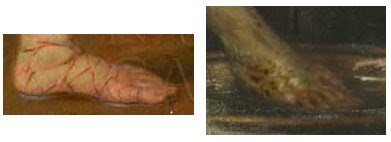
My readers may think the title quite a challenge. Not me. I knew immediately where first to turn: Venus, Cupid, Folly and Time, painted around 1547 by one of Gawain's favourites, Bronzino. Most of us here have seen the image, a grand hieroglyph of the mannerist age, but how many know the latest soundings of its mysteries? It turns out that Bronzino's Folly (also called Pleasure) provides an exquisite example of Cinquecento piede d'atleta, athlete's foot, or to give the affliction its proper scientific name, tinea pedis. Here is Folly's right foot, after a recent restoration of the panel by the good people at the National Gallery:


We can clearly see the effects of unchecked trichophyta between and along the toes; compare, for reference, a modern photograph of the condition:


Bronzino was no doubt working from a model—probably a friend or associate with the condition. Representations of tinea pedis are rare in the Renaissance, and other sorts of foot-disease were painted more often. For instance, in Poussin's Bacchanalian Revel of 1632 (left) we find a sort of scabrous welting of the whole foot, while Peter's foot in Tintoretto's Christ Washing the Feet of his Disciples (1565, right) seems to be experiencing the early stages of necrosis:


It would be appropriate, I wager, to conduct a full-length survey and analysis of the social history of foot disease in Renaissance painting; but this, of course, is beyond our present ambit, and so I offer merely a few remarks on the narrower subject of Bronzino's tinea in oils. Now, as I said, painted tineae are rare; the only other examples from this period that spring to mind—a Barocci Magdalene, and, if memory serves me aright, an allegorical leper by Scarsellino—are not to be found online; both of these, moreover, are at least a generation later than Bronzino's panel. So I know of no precedents in painting for this image, although I'm sure Gombrich could have pointed me in the right direction.

Contemporary medicine, on the other hand, provides a few clues. In 1546 a treatise was published in Venice by Girolamo Fracastoro entitled De Contagione et Contagiosis Morbis. This was the first book to work out fully a theory of the contagion and transmission of disease: Fracastoro denied the Hippocratic-Galenic doctrine that all illness results from an imbalance of humours. Thus, while the mediaeval Galenists had taught that skin diseases (including the mycosis or morbus militis—our tinea) were caused by a drying-out of the body's bile or phlegm, Fracastoro instead posited that they were transferred from one body to another by offensive particles called seminaria. (The latter word is related to the atomic semina of Lucretius, although Fracastoro's theory has more in common with the Neoplatonic concept of species or immaterial emanation: for more details, see this pdf.)

Fracastoro further linked skin-diseases in general, and mycosis in particular, to syphilis. This should not surprise us. Fracastoro was the master of syphilis; he dined and slept with it, and was its confidant, its Boswell, even its Milton. In 1530 he'd written an epic poem on the subject, in three books, entitled Syphilis sive morbus gallicus, which in fact is the origin of our word. (A French epitome of the book is online here.) The poem was a hit, and went through 50 editions in Latin alone. It would not be too much to say that syphilis was responsible for Fracastoro's career, and by golly, he was determined to capitalise on it. The precise relation between the 'master disease' and mere mycosis is never spelled out in the De Contagione, but perhaps he perceived the latter as a milder, even inchoate form of the loathsome cankers assigned to syphilis in the previous epic:
Protinus informes totum per corpus achores
Rumpebant, faciem horrendam, et pectora foede
Turpabant.

Shapeless scabs burst at once through the body
and the dread face, and foully disfigured the breast.
What is important for our present purposes is that, according to J. F. Conway's pathbreaking 1986 analysis, syphilis itself appears allegorically in Bronzino's famous painting:


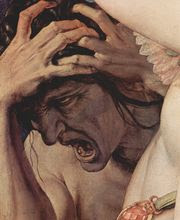
Here syphilis, generating madness as it did for Nietzsche, is the gruesome result of the triumph of lust, symbolised by the principal action. Conway makes use of Fracastoro in his discussion of Bronzino; if we allow that the painter knew the Syphilis, we may go further and suggest that he also knew De Contagione, and thus date the Venus after 1546, possibly the following year. The cute cherub with the cutaneous mycosis joins the triumph of lust, scattering his poisonous petals upon the amorous couple—an incarnation of the seminaria that carry disease from one body to another. Bronzino was adding his small vote of support to Fracastoro's new theory, a bold move; but he hardly wanted to mar the fine, glossy surface of his ducal commission with something so ugly as a fungal infection, so he confined the disease to the boy's foot, a tiny detail, which indeed had been lost to dirt and varnish until the recent cleaning.

As so often, it is the smallest elements—for Morelli an ear or a hand, for me a tineatic foot—that yield the greatest interpretive riches. Gawain would not agree, but perhaps the rest of my readership will give the idea some credence.

27 May, 2007

Brotherly love

At the age of eight I accompanied my parents, and possibly my grandfather, who was then living in a retirement community in rural Pennsylvania, to the Philadelphia Museum of Art. It was a new experience for me, and this remains my earliest memory of any art gallery in the world. I fell in love with that old bastard Picasso around this time, but what really set me off, I think, was this, Chagall's 1911 Half Past Three (The Poet)—


A green head—and upside down! It captured me. Such was the inexorable course I took towards a puberty-long love of modernist painting. I was soon to trick up a theory, too: while browsing the Musée Picasso, which was at that time my Mecca, I decided, apropos of not much, to found my own aesthetic calculus on three 'primary' qualities, each ranked out of 10: colour, weight (or solidity), and balance. The middle term charged me as something of a Berensonian, I realise now, though of course I had never heard of him. So for the next hour I scuttled around the gallery, rating each canvas out of 30. It satisfied me then. But a man changes, and I would not remain Clive Bell forever. Now Chagall bores me. Cooled, in fact, are my affections to a vast majority of the art that occupied the first ten years of my gallery-going life. But even now, as Chagalls go, this is better than average—perhaps you will agree.

*

Why the reminiscence? Yesterday I returned to the Philadelphia Museum with my wife: my first time since the first time. On this occasion we scorned the modernists, and clove solely to the pre-1500 masters on the second floor. Mrs. Roth admired the fragments of Gothic baukunst; I marvelled at the Van der Weyden Crucifixion, a primitive Navicella by Giovanni di Paolo, and some second-tier late Botticelli predellas. There was also this, unexpectedly, in a sea of orientalia to which I remained largely indifferent:


A combination-padlock securing a nineteenth-century Chinese chest, and far handsomer than its client. At six or so, as the sunlight intensified in the west, Jeff 'Tain' Watts and his band appeared for a scheduled performance in the gallery's atrium. The smart set sat on the grand stone steps; the smarter sat at tables, nibbling on salads and quaffing red—I watched with amusement from the balcony as a gourmand and his wife took turns fondling the lower back, not quite the bottom, of their young waitress as she bent over to clear the table, chastely uniformed—a little moment of voyeurage almost lost in the whobub of glasses and cutlery and Tain's frenzy on the skins.

*

With us were Paul Zenoli and his wife Marty, who had invited us, on the basis merely of the Varieties and subsequent correspondence, to spend a couple of days with them in and around Philadelphia. (Finally, an ulterior use for this thing!) They are, truth be told, a most splendid couple, whose hospitality during our short stay was impeccable—a Baucis and Philemon of our times, replete with cats and laughter, although being mere mortals ourselves we could not quite repay their generosity.

With the Zenolis we partook on foot a little of the city in its wafting glow. Through Rittenhouse Square we walked, and it thought me of Jane Jacobs, whose case study of the four Philadelphian squares is a beacon of attentiveness and crisp thinking. A graffitum opposite the fountains proclaimed, 'Life is more than just love'. But Marty was more interested in the prams and strollers, of which she spoke like an automobile enthusiast, full of love, and lovingly scornful of the overpriced and underdesigned models being jollied about under the trees by affluent bourgeoisettes in the latest summer-frocks. She seemed to know what she was talking about, and her cogent and unusual contempt was just the sort of thing to delight me.


When exploring a new city, the candescence of evening—or morning—is quite the ticket. (Though punishing rain has its merits too.) Being alone gives the experience its own thrill; having company, on the other hand, even unmet company, as we did, provides the new environment with a certain readymade familiarity. At times I was reminded of Manhattan; at times Berkeley, especially in the profusion of surface detail upon façades of brick and stone. On Thursday we took in the Mütter Museum, a latterday wonderkammer, taciturn and macabre, whose highlights included a Huttesque colon, a case of suicided skulls, and several drawerfuls of objects removed from foolish throats.


I enjoyed the Mütter; but to me the greater museum was the one outside, full of living specimens and huge, intricately-carved machines for living in. The city, for once, had just the right amount of life, neither crowded nor empty. When we emerged from the darkness, Paul's lost cap was discovered in the middle of the road, ground into the dirt by innumerable wheels in the space of an hour, yet quite intact. He wore it jauntily, undeterred.

For supper, by which time we'd all relaxed a bit with each other, Paul cooked up a polenta with onions, walnuts and bleu cheese, perfectly delicious. As I said at the time, I'm always impressed by culinary skills, so lacking am I in that department. The herbs and vegetables they had grown themselves—il faut cultiver le jardin—and all of us at that moment were feeling old, in a happy way: sated. We toasted, as was most natural, the internet, most revolutionary of modern innovations, for bringing together such an unlikely gang. And we were each just a little relieved that the others' online sanity had not, after all, concealed psychoses in the real world. All four heads were distinctly white, not green, and, thank goodness, on the right way around.

23 May, 2007

Roth's Law

When a man in conversation drops an obscure name—generally from distant history—and is called upon to explain himself, his first description of the figure in question will be that he is or was 'well-known', 'famous', or the like. The probability of this happening is directly proportional to the recondity of the explicandum. This trope, we note, serves to exculpate the careless erudition of the speaker, who could hardly have expected his interlocutor, or interlocutrix, to require clarification of so obvious a point of general knowledge.

Example.

George. The current crisis in the British educational system, so much anatomised and commented upon in the papers of late, rather reminds one of the remarks of Nathaniel Fairfax, does it not? 'Tis better to—

Cecil. Hang on there, buddy! Who's Nathaniel Fairfax?

George. Ah, my apologies. Fairfax was a very famous scholar of the seventeenth century. As I was saying, 'Tis better to question the. . .

22 May, 2007

Festina Lente

I concluded my last post with some rather compressed comments on humour; the laughter of Palaeologus, I wrote, 'is a laughter at that which breaks away from common sense, from judgement, from taste, and from the organic'. These items were not picked at random. They are, in fact, according to Gadamer, in his largely unreadable Truth and Method, the four central concepts of humanism. The humanist, as opposed to the scientist, is not concerned with method: instead he engages in a collective endeavour, guided by tradition and authority, taste and common sense. This post is about the relation of humanism, under this aspect, to the problem of humour, exemplified in the mocking of pedantry.

*

Humanism is the reaction to an intellectual life made mechanical, formal. This is not yet a definition, of course, but it is a start. Its kinship with humour is that laughter, too, is a reaction against the mechanical life. The great modern work on this theme is a slim and charming volume, Henri Bergson's On Laughter (online here), published in 1901. But first—Erasmus.


Between 1500 and 1533, the great humanist Erasmus compiled his Adagia, a collection of some 4,251 classical proverbs and commonplaces with a rich scholarly commentary—a truly astonishing achievement. One of his most well-known adages was 'Festina Lente' or hasten slowly. Aldus adopted it for a slogan, its visual counterpart being an emblem of dolphin and anchor, which he used as a printer's mark (see also here). Erasmus suggests a possible origin for the expression in a witty inversion of the Greek σπεύδε ταχέως, 'hasten hastily', found in Aristophanes' The Knights. It is most famous as the official motto of the Roman emperors Augustus and Titus; Erasmus thus dubs it the 'royal proverb', and remarks that it advocates 'a wise promptness together with moderation, tempered with both vigilance and gentleness, so that nothing is done rashly and then regretted, and nothing useful to the common weal omitted out of carelessness'. It represents, in short, the reining of passion by reason, Plato's ideal of statecraft—it is the paragon of proverbs.

Erasmus relates the adage to Aulus Gellius' discussion of the word maturus (ripe) in Noctes Atticae 10.11, and this turns out to be one of the most interesting chapters in the entire Noctes. The 'ripe' man, for Gellius, acts neither too soon nor too late: he is perfectly responsive to his environment. He embodies the ideal of 'elasticity of conduct', which we now associate with Machiavelli, and which was central to Renaissance virtue. Compare Auerbach, for instance, on the knavish Dindenault from Rabelais's Quart Livre—
He is taken in and he perishes because he cannot adjust himself, cannot change himself, but instead, in his blind folly and vaingloriousness, runs straight forward, like Picrochole or the écolier limousin, his one-track mind incapable of registering his surroundings. . . Thick-headedness, inability to adjust, one-track arrogance which blinds a man to the complexity of the real situation, are vices to Rabelais.
The idea is not limited to the Renaissance: Goethe, arch-humanist, invokes the same principle when, in the prelude to Faust, the director tells the poet to 'wandelt mit bedächtger Schnelle', 'walk with thoughtful haste'. This classical-humanist virtue, without name but embodied in the proverb Festina lente, is a reaction to mechanical life. It bids us guard against rote, habit, unquestioned assumption, casual blindness—the 'inability to adjust' that is characteristic of unthinking method, of a clock or a machine. This is the stuff of death, of scholastic dialectic, and humanism is rather the exaltation of life.

*
Why should a sausage be an everlasting jest? If I tried to answer that, I should require, as M. Bergson did, a whole volume to show the world that I do not understand what laughter is.

— Stephen N. Palaeologus
Bergson has been called a 'philosopher of life' and a 'vitalist'; his concept of the élan vital was an attempt to extract the wonder of life from the analytical scalpels of cold science. In this respect, I think, he shares the orientation of Erasmus and Rabelais. On Laughter is a short book, crammed with beautiful insights, some of them true—Bergson's chief contention is that laughter is the response of a society towards anti-social behaviour. Ridicule is the sublimation of an instinct to destroy or ostracise; it is humane because it offers its target an opportunity to change. And society specifically targets those who are pedantic, absent-minded, and arrogant—those displaying the 'easy automatism of acquired habits'—which reveal 'the gravest inadaptability to social life'.

Bergson's example is that of a man striding down the street with airs and with his nose retroussée, quite failing in his gait to notice the stray banana-skin upon which he will proceed to tumble, so gracelessly, down. The man's 'obstinacy' prevents him from negotiating the pitfalls that life presents to him—he is very much like Rabelais's Dindenault. Bergson's key word is rigidity, which he equates with the 'mechanisation of the body'. In truth, he writes, 'a really living life should never repeat itself'—a statement which at once encapsulates Bergson's vitalist philosophy and his account of laughter. It also recapitulates, as far as I can tell, the old maxim: Festina lente.

What were they saying about laughter in Rabelais's day? I have here the very thing: Laurent Joubert's 1560 Treatise on Laughter. Joubert was a Montpellier physician, like Rabelais, only one generation later. He wrote a book on Popular Errors (I own the partial translation by Gregory de Rocher)—which would prove most instrumental to Browne's Pseudodoxia Epidemica—and also a Dialogue Sur La Cacographie Française. He still lacks a Wiki article. Joubert writes,
I am astonished that not one of those noble authors who have gone before us has undertaken the search for the causes which move us to laugh, considering that it is one of the most astounding actions of man, if one examines it closely.
Most of his treatise is taken up with the physiological origins of laughter, which do not here concern us. His psychology of laughter, on the other hand, is dull and commonplace: 'What we see that is ugly, deformed, improper, indecent, unfitting, and indecorous excites laughter in us, provided that we are not moved to compassion'. This is the Aristotelian notion, and it is perfectly pious. By the eighteenth century the piety was mostly intact, although as James Beattie (1764) observes, contra Aristotle, 'men laugh at that in which there is neither fault nor turpitude of any kind'. For Beattie, rather, 'certain forms of irregularity and unsuitableness raise within us that agreeable emotion whereof LAUGHTER is the outward sign'. It is still very bloodless. More interesting to us is Sterne:
I live in a constant endeavour to fence against the infirmities of ill health, and other evils of life, by mirth; being firmly persuaded that every time a man smiles,—but much more so, when he laughs, it adds something to this Fragment of Life.
For Bergson, as for Sterne, laughter is the stuff of Life—and it is an active process, a struggle, or an aspect thereof. Laughter is the product of common sense, which
represents the endeavor of a mind continually adapting itself anew and changing ideas when it changes objects. It is the mobility of the intelligence conforming exactly to the mobility of things. It is the moving continuity of our attention to life.
For Bergson—as for Erasmus and Gadamer—'common sense' is not yet a dirty word. (Two words, if you prefer.) It is not yet the sinister, coercive common sense defined by Einstein as 'the collection of prejudices acquired by age eighteen'. We see that Einstein's attitude is essentially the same as that of Plato to opinion, or of Bacon to authority. It is an anti-humanistic attitude, in that it scorns tradition, proclaiming instead a scepticism oriented around the individual—each man must learn the truth for himself, by direct ratiocination (Plato) or observation of nature (Bacon). Gadamer, on the other hand, uses the Latin form, sensus communis, which retains some of the freshness of the idea: the sense common to all. In my last post I wrote, 'what is the new old, or the old new, but humanism itself: liberty in culture, in tradition?' Humanism represents liberty in what is common and open—the great storehouse of the past, of history, which is of course not dead at all, but rather the animating force, the élan vital, of the present. This is why for Gadamer, humanism is that which makes sense of an object not by an analysis of its contents, but by a study of its origins.

And it is why the Bergsonian ridiculous is manifested in pedantry, defined as a pathological blindness to the limits imposed by tact, by experience in society: it is 'nothing else than art pretending to outdo nature'. The humanist's laughter is a rejection of the ahistorical—of that which has no past, and which therefore repeats itself as a machine, without vitality, unable to adapt—it is a rejection of the inhuman. I think we can all appreciate the value of such a laughter.

19 May, 2007

Palaeological grammar

What follows, as promised, is a discussion of a book you've never heard of. If after reading this you want to own it, there's a copy on abebooks for 10 dollars. The post is rather long, for two reasons: first, it's a fascinating book, and second, there is not yet any information about it online. This post is also in celebration of a culture, a tweeded and surrisive aristocracy of the intellect, now long dead. So savour this, in small doses if necessary, over cheese, and a glass of port.

*
Even if Mr. Conrad cannot agree with my grammar, I trust he will pardon my taking this liberty with his always daintily scrambled eggs.

— 'Stephen Palaeologus'
A few years ago—three and a half, I'd estimate—I was browsing in the second-hand department of the Gower Street Waterstones, where I invariably find things to buy, when I chanced upon a rather ugly, dun green hardback, the title of which caught my eye—Michael Neo Palaeologus His Grammar, by his Father Stephen N. Palaeologus. Wouldn't that catch your eye, reader? Within moments of perusing its pages, I had a purchase. As we sauntered down Gower Street, N, who accompanied me, and who was now on his mobile, enthusiastically told his interlocutor that Conrad had just bought a grammar-book with playing-cards for chapter titles. This was partially true. The Grammar, after all, does have playing-cards for chapter titles. But it is not a grammar. It is, in fact, one of the most bizarre works I have ever come across. And so, specially petitioned, I shall inaugurate my discussion of the book, thus—

*

On the title-page of most J. M. Dent books from the 1920s is the graphic of a tree—don't ask me which kind, I'm not that sort—with a pendent JMD monogram. On the title-page of the Grammar, and of a few choice others, such as the Works of Landor, is instead the image of a sundial:


Shadows we are, it says, and Like shadows depart. A quick spell on the net will reveal that this legend belongs to a sundial in Pump Court, part of the Middle Temple. As Henry Frederic Reddall puts it—in 'A Temple Pilgrimage' from an 1885 issue of Lippincott's Magazine—'In Pump Court, high up on the front of a house is a large, rectangular dial, with gilt figures and stile, bearing the inscription, "Shadows we are and like shadows depart." Over the dial is the traditional Temple lamb bearing a cross.' The sundial, dating from around 1686, was restored in 1902:


Later Dent would use the same image for Reginald Hine's Confessions of an Uncommon Attorney (1949). But why in this case, for a book ostensibly about grammar, bearing the pseudonym of a Byzantine monarch? Is there a logic to it? Chance or not, the mot casts its own spell over the book's contents.

The Milieu of Palaeologus.

The title-page emblem seems to tell us nothing about the nature of the Grammar; but we have better luck with the two names singled out for thanks in its front matter. The first is A. B. Walkley, a typical Edwardian critic of the Quiller-Couch variety—jolly, sardonic and learned. He frequently quotes Sterne, and in one essay ('My Uncle Toby Puzzled') pastiches him. In another 1921 essay, on Grock, he calls for a 'philosophy of clowns', remarking that 'that is where clowns may enjoy a secret, malign pleasure; they proudly confront a universe which delights in them but cannot describe them'. Palaeologus' dedication reads, 'Ickpling Gloffthrobb squutserumm blhiop mlashnalt zwin tnodbalkguffh slhiophad gurdlubh asht'. Literate readers will recognise this as a quotation from the third book of Gulliver's Travels:
I raised my self gently upon my Knees, and then striking my Forehead seven Times on the Ground, I pronounced the following Words, as they had been taught me the Night before, Ickpling Gloffthrobb Squutserumm Blhiop Mlashnalt Zwin Tnodbalkguffh Slhiophad Gurdlubh Asht. This is the Compliment established by the Laws of the Land for all Persons admitted to the King's Presence. It may be rendered into English thus: May your coelestial Majesty out-live the Sun, eleven Moons and an half.
Palaeologus thus pays Walkley a rather ironic and irreverent compliment, very much setting the tone for the rest of the book. The second name comes at the end of a list of picture credits: 'I cannot close this list of a few of my obligations without expressing my sincerest thanks to Dr. F. C. S. Schiller, of Corpus Christi College, Oxford, for much kindness'. Schiller is now forgotten, like all the other Oxbridge philosophers swept away by the positivists in the 1920s. He is especially significant to us, however, for two reasons.

The first is that Schiller, like Palaeologus, was a prankster. He published his first work, The Riddles of the Sphinx (1891), anonymously, and in 1901 he organised and edited a hilarious volume named Mind!, a group parody of the lucubrious philosophy periodical Mind. The central target of this collection was the neo-Hegelian Idealist F. H. Bradley, whose work Schiller described as 'inhuman, incompetent and impracticable intellectualism'. Like his pragmatist mentor James, and like the positivists, Schiller relentlessly attacks the idea of an Absolute. Mind! opens with this:

It is with the utmost satisfaction that we present to our readers an authentic Portrait of the Absolute, in full panoply, R-rayed in the parinfernalia of Its Office and X-rayed by the new and powerful Shamoscope which we have recently invented and patented and can warrant to see through everything. . . All who have seen It assure us that it is an excellent likeness.
The rest of the book consists of assorted satires and pseudo-philosophical meditations on laughter itself. Schiller's editorial explains:

The jocoscopic analysis of the light of the 'Nova Mentis, 1901,' shows a pretty continuous bright spectrum chiefly composed of the 'enhanced' lines due to the presence of large quantities of the more frivolous gases.

'F. H. Badly' contributes an article on 'The place of humour in the absolute', spoofing his namesake's turgid style:
It would be easy, if one took the trouble, to prove in another way that the Absolute must take in jokes, without being taken in itself—although we may be. We can not therefore regard the Absolute with levity, but must preserve our gravity in discussions of the sort. For if we lost it, where should we be? Not in the universe, assuredly; for gravitation is universal.
Likewise, there are specimens from the Critique of Pure Rot, and a translation by Lord Pilkington (of Milkington) of Vergil's lost Eclogues, featuring Damon and Pythias swapping limericks on the pre-Socratics. The best of these is:
When issuing NOUS! A---
Was asked: "Are you sage now, or wagorass?"
He replied: "Why of that,
'Tis as plain as my hat,
Man's the measure. I hold with P-----"
But these clunkers I reproduce for the pleasure of John Emerson:
The divinest philosopher, P---,
Proved comforting very to Cato;
But our wiseacres laugh,
Immortality chaff,
And think him the smallest potato.

An Asklepiad, great A----
Felt terribly tempted to throttle
Alexander, his pup;
But they asked him to sup,
So he buried his wrath in a bottle.
Mind! concludes with a commentary on The Hunting of the Snark, identifying the Snark with the Absolute itself. It's a gem.

But Schiller is doubly interesting to us; for he also participated in a debate of some historic importance, in the October 1920 issue of Mind, the same periodical he had skewered two decades previously. This symposium, on the philosophy and psychology of language, was entitled 'The Meaning of Meaning', and its other contributors were Bertrand Russell and H. H. Joachim. It was a perfect standoff, each man representing one of the three chief philosophical schools then in competition—Joachim for Bradley's idealism, then on its last legs, Schiller for pragmatism, and Russell for positivism. The debate itself is, truth be told, very boring, and quite the sort of thing that put me off my undergraduate degree. But it resulted in one of the most famous philosophy books of the decade, Ogden and Richards' 1923 The Meaning of Meaning.

Ogden and Richards were a curious duo. Ogden is known now for translating Wittgenstein and Vaihinger, and for developing Basic English. Richards wrote on Mencius, Romantic poetry and pedagogy, as well as tutoring Leavis and Empson and founding the New Criticism. What brought them together was the belief (found also in both Wittgenstein and and the neo-Kantian Vaihinger) that much of philosophy's traditional domain would be better analysed by a study of signification and symbolism. The Meaning of Meaning attempted to set out once and for all how meaning worked—it popularised the 'semiotic triangle' of Word, Idea and Thing, and concluded with a list of definitions of 'meaning', shown to be a most slippery and polysemous word. It scorned the quibbles and cavils of the Mind debaters: 'A study of the utterances of Philosophers suggests that they are not to be trusted in their dealings with Meaning'. Schiller, for his part, gave the book a rather sniffy review in Mind. But the book, and the preceding debate, are the true intellectual ancestors of Palaeologus' Grammar.

Palaeologus, then, thanks a Shandean critic and a philosopher with a penchant for satire; it is plain that these two represent the prominent modes of the text itself. In some ways this mirrors the partnership of philosophy (Ogden) and criticism (Richards) in The Meaning of Meaning. It is worth noting, finally, that both Walkley and Schiller were connected to Corpus Christi, Oxford. Could this be a coincidence? Out of curiosity I thumbed through the college's 1880-1974 register, but alas, found no obvious candidates for the Grammar's authorship.

*

The Grammar was published the year after The Meaning of Meaning, and at times Palaeologus echoes Ogden and Richards so closely that I'm sure he saw their book before its publication. The Grammar falls into two parts: 'What happens when we think?', and 'What happens when we say what we think?'—these, indeed, are the true subjects of the book. Palaeologus announces his themes with a parable of three lions: 'my chief object will be to show what an absurd, superfluous beast is the lion that calls himself a grammarian'. On this he elaborates as follows:
Now, even if I and the grammarian lion finally agree that we have parsed [a sentence] perfectly, I maintain that if we had spent our time catching sand-fleas or trimming our manes we should have had at least something to show for our pains. What earthly use is this parsing to me? What really interests me is to discover who said it.
This is a trumpet-call against the study of grammar, the epitome of the pointless pedantry; what a similar spirit to that of Mind!, which saw Bradleian Idealism in the same light. Palaeologus' sentiment was well shared by contemporaries, in whose hands the study of language moved essentially away from grammar and towards philosophy and psychology—until the eventual reintegration of these currents, thanks to You Know Who.

In fact, Palaeologus, with a wry panache, calls his new subject grammar, only it is no longer 'palaeological grammar'—it is now 'neo-palaeological grammar'. Language, instead of being treated as a pure abstraction, is treated as something chaotic, communicative, rhetorical, and ambiguous—as alive:

Language seen under the microscope of palaeological (left)
and neo-palaeological (right) grammar.
The term "neo-palaeo-logical" must be taken to stand for a less dogmatic, less confident attitude towards language; one that starts by assuming that all we can do is to use language, to understand what we mean to mean, and to understand what we think others to mean.
In all this the Grammar is quite in line with The Meaning of Meaning, only more entertaining. Its first few chapters outline a standard account of the psychology of signification, using cartoon language. The universe is 'fizzing' and 'patchy', it says: all patches are 'suispontaneous' (ie. they are things), but some patches are also 'homispontaneous' (ie. signs of other things). Human beings match the two sorts of patches (ie. they find words for things). Like a good Lockean, Palaeologus can write: 'By using the match SUN, I can produce a fizzle in you corresponding to the fizzle of a patch which may or may not be in your way at this (or any other) time'. A later chapter expands on the communicative process: the sender of a message (called a 'here-am-I', possibly parodying the Germans) creates a 'ding' (signal), which in turn produces in the receiver either a 'ting' (information) or a 'sting' (emotional response).

Why all this silly jargon? For two reasons. First, the book is supposed to be comic, and is allegedly being written for the author's son—at times the humour reminds one of The Water Babies. (There is something inherently odd, though, about writing a comic, Kingsleyesque tome on the philosophy of language.) Second, it is specifically making fun of The Meaning of Meaning, which found Richards casually coining the word 'ultraquistic' [or recoining 'utraquistic', see comments], among others, for no good reason.

The language of the Grammar is, in fact, utterly delightful, and possibly its chief selling-point. Benign mockery is everywhere. Victorian mores are the target when the author refers to trousers as 'whateveryouchoosetocallems'. Classical philology is ribbed when Aeschylus is ransacked for the term 'hippalectors', used here to refer to advertising-executive scum. Rabelais is invoked with the coinage 'circumpiccadilliously', and also with the sausage-themed 'allantopoleosophy' or study of bias. Elsewhere we find 'algebrahmin', 'oughthorities' and the Aristotelian 'tragelaphs'. Wocky-Bocky, the name of an Indian chief in a story by Artemus Ward, is resurrected to mean 'the general public'. But some of Palaeologus' greatest triumphs of wit are reserved for the footnotes. Here, for instance, he unwittingly anticipates Joycean rhythms:

Pity that the Vicar of Bray, who must have had a singularly acute sense of the various shades of "trew," never thought of leaving a record of his opinion as to the precise mixture of Norman French and Ultramarine Saxon and Snips and Snails and Canine Latinity and Laboratory Greek and Eurafricasian Snippets and Australamerican Snaillets that precipitates "trew Englishe".
And here he defends his coinage of 'idiotomatically':
It means three things all at the same time: (1) idiomatically, (2) idiotically; (3) automatically. If someone tells you there isn't such a word, laugh at him and show him that there is. It's here.
While here he explains his portmanteau of 'sneeze' and 'laugh':
We snaugh over a name like Trzepczynski; which is no more difficult than Winstnshurtshil, whilch instead of being spelled Winston Churchill, might have been Gwynscztntschrtschyghlll, and still be as easy to pronounce.
This jest is telling, too: 'It seems to me our words are getting rather long—a tendency emphatically to be deprecated, except when a political altercation requires dignified exposition in The Times'. (Charles Kingsley, who loved to poke fun at scientific jargon, had proposed a 'heavy tax on words over four syllables', and a 'prohibitory tax' on even longer words.)

*

The book is thus written, in traditional British style, by a man with no urgency, happy to digress and divagate endlessly, and indeed to let that be the very pleasure of it. And like Shandy, the Grammar is even lovely to look at. Here's one of my favourite pages:


It is no surprise when Palaeologus remarks towards the end that 'Michael has had the run of my library and could not help noticing that I keep Tristram Shandy within easy reach'. Sterne is a constant reference, in the same way that Rabelais is for Kingsley, and for Albert Jay Nock, whose entertaining memoirs Moldbug convinced me to read yesterday. But the book is full of unexpected literary allusions; in this respect it goes one better than The Meaning of Meaning, which quoted Baudelaire and Melmoth the Wanderer. Palaeologus quotes and alludes to Cicero and Lessing, Shakespeare and Johnson, Goethe and Hume—but also More to Tyndall on 'yea' and 'nay', Gassendi's Life of Peiresc, D'Arcy Wentworth Thompson, James Russell Lowell, Hubert Anthony Shands, and last week's newspapers. The scope of reference is frankly incredible.

It is impossible to summarise the Grammar, so 'fizzing' and multifarious are its contents. It has no overarching message, and its conclusion is inconclusive. But still, the book has many things to say. It has chapters on various matters linguistic and quasi-linguistic: deixis, tense, ambiguity, quotation-marks (as an ironizing device), rhetoric and advertising, averages, bias. One of its chief messages to young Michael is a piece of anarchism, individualism, disguised as a point of grammar. 'We', says Palaeologus, is not the plural of 'I':
And our grammars are apt to mislead us in this respect (as in so many others) by suggesting to us that "I" comes first and that "we" is the plural of "I," as if "I" and "we" were either first and fourth persons or else two forms of the same. This is moonshine.
For the author, the authority invoked so powerfully by the use of 'we' is shifting and insidious: 'even when an "I" flatters himself he is being most singular, "I" is often acting under the influence of some "We."' This is essentially a warning about the rhetoric of collectives—even of the State.

For me, Palaeologus' most interesting attitude, related to the last point, is a deep-rooted pessimism about the limits of communication. Ogden and Richards had been sceptical about the ambiguous use of the word 'meaning', and about the possible limits of meaning in a polysemous text, exemplified by Shakespeare, but they never doubted that meaning is found in the text itself. In the middle of the book, Palaeologus writes:
I prefer to consider the process of ding-tinging as a both-ways concern, like the meeting of two billiard balls. . . I don't believe, as many grammarians do, that it is possible to pocket U [the receiver of a message] if U makes up his mind not to be pocketed. U can always get into positions from which I can never get him into the pocket. . . If I ever gets U to sit down exactly at X, that is done by mutual consent and in spite of distractions.
Towards the end,
A book is not a container of meaning, but a patchwork concocted, with considerable effort and pains, by an author who has (presumably) come to the conclusion that that patchwork has such and such effects on him, and that, if any fellow mind (one of US) happens to see it, the effect on him will be similar.
Palaeologus has not quite reached the total nihilism of postmodernity, but he is sceptical: he talks in mechanical terms, of cause and effect, and is uncomfortable with metaphysical words like 'meaning', which smack of the Absolute. And as Wimsatt and Beardsley would argue 20 years later, Palaeologus concludes that 'far from being the Origin of Meaning, the author is only one of the readers'.

*

According to Dent, the correct motto for the Grammar is 'Shadows we are and like shadows depart'. The book is a parodic Mirror for Princes, written in a jumble of English, with an open heart and a smile for a style. It celebrates the human, in opposition to the pure and eternal; thus its emblem must be taken in the spirit of 'Eat, drink, and be merry—for tomorrow we die'. Palaeologus invites his son and his reader to cast off the shackles of grammaticaster pedantry—which are much akin to the very fetters of social authority itself—and to be distrustful, free-thinking, concerned with language as it is germane to our active life. The author advocates not neological grammar, but neo-palaeo-logical grammar, and he himself is Neo Palaeologus: the new old. And what is the new old, or the old new, but humanism itself: liberty in culture, in tradition? Threat comes from breaks with the past, from the radically new. Kugelmass lately explained why he is not a radical—but he is only working out for himself the most ancient of stances. He understands what Palaeologus knows, and what Nock knows—that the We is not to be trusted, for its authority is only assumed.

Laughter at pedantry is one of the oldest forms of laughter—it goes back, perhaps, to Plato's neglected Euthydemus, and enjoyed a particular vogue in Victorian and Edwardian Britain. It is a laughter at that which breaks away from common sense, from judgement, from taste, and from the organic—and I will have more to say about those four things, and about humour and humanism, in my next post. For now I will say only that the Palaeological Grammar, at once bizarre and utterly traditional, is, in its vision of language, as radiant and humane as any work—and that for this reason, although it will be read by none, it deserves to be read by all.