18 August, 2006

Ekphrasis and memory

In this post I return to my recent critique of ekphrasis with a more sophisticated historical and theoretical context. Supposedly. It's longer, anyway.
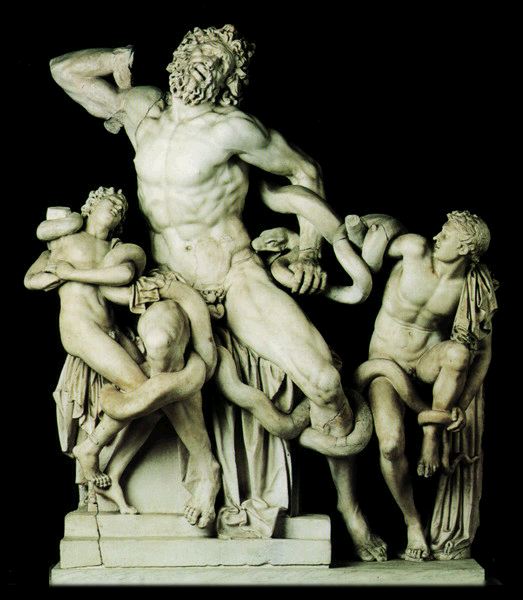

An attack on ekphrasis is one of the central themes of G. E. Lessing's Laocoon (1766), a circumambulatory and much-celebrated essay on the arts, marking something of an anticipatory watershed between the neoclassic and romantic eras of German taste. Lessing's core argument was that painting and poetry are not equivalent art-forms—a view he ascribes to several of his contemporaries—because the first deals with things side-by-side in space, and the second deals with things one after the other in time.
I do not deny to speech in general the power of portraying a bodily whole by its parts. . . but I do deny it to speech as the medium of poetry, because such verbal delineations of bodies fail of the illusion on which poetry particularly depends, and this illusion, I contend, must fail them for the reason that the co-existence of the physical object comes into collision with the consecutiveness of speech, and the former being resolved into the latter, the dismemberment of the whole into its parts is certainly made easier, but the final reunion of those parts into a whole is made uncommonly difficult and not seldom impossible.
Lessing's critique of ekphrasis is focused around Vergil's description of the demise of Laocoon in the Aeneid, which Lessing compares negatively to the Laocoon statuary, pictured above. He quotes the Mantuan: 'Bis medium amplexi, bis collo squamea circum / Terga dati, superant capite et cervicibus altis' (2.218-219), and claims that the imagination is able to see 'now only the serpents and now only Laocoön', rather than the whole picture together. When we return to Brueghel and his poetasters, we find the same problem: here we are able to see, in all its jewelled beauty, the painting which those labourers suffer so miserably to describe. All four poets enumerate one thing after the other, and yet are unable, by the very nature of their medium, to present the enchanting whole all at once—what I called its 'perfect ordonnance'. Each poem distends the image through time, abandoning the intricate relation of parts which gave the original its beauty. And so it must be.

*

150 years after Laocoon, Irving Babbitt, conservative 'humanist' and enemy of Mencken and Hemingway, published The New Laokoon (1910). The book begins as a calm, measured analysis of Lessing's work, and of artistic confusion in the Renaissance and neoclassic (or 'pseudo-classic') periods; by its finale it has descended, inexorably, into a titanic rant against the decadence of modern times. Its polemic shows through at every turn—Babbitt's good American Protestantism: the Italian aestheticians who seek to impose Aristotelian formalism on poetry are compared to the Jesuits, who 'in order to strengthen and centralize the principle of authority, were ready to multiply their minute rulings on moral "cases" even at the risk of suppressing spontaneity in the religious life'. (Pascal has left his mark!) And Babbitt's good American masculinity: he lambasts Romantic criticism as 'intended primarily for women and men in their unmasculine moods'. And so on.

(A digression on the joy of marginalia—I discover a combative pencil on the pages of my library's copy. Babbitt writes 'If all the arts are thus restless and impressionistic, the reason is not far to seek: it is because the people who practice these arts and for whom they are practiced are themselves living in an impressionistic flutter', alongside which a young Derridean has scribbled: 'Oho! Then the medicine fits the patient? Well, what's the odds? Why pray for a change of diet?'—the same wag, demonstrating a most noble contempt, later annotates a passage on man's inferiority to Nature, almost mediaeval in its snivelling humility, with the snarl, 'Wholesome yet detestable modesty'.)

Babbitt, like Lessing, is against 'word-painting'—but he attributes this vice more to the naturalism of the Romantics than to the neoclassical fallacy of ut pictura poesis. The Romantics, or 'Rousseauists' as he scornfully designates them, were so empty of serious ideas that they scrabbled to describe every insignificant thing they could get their hands on, aiming not for ideas but merely for suggestiveness:
Alfred de Musset insinuates that all this minute lingering over the senses of childhood was a convenient way of producing the maximum amount of "copy" with the minimum expense of intellect.
Babbitt is right to note the great rise of word-painting or ekphrastic poetry after Lessing. I think his condemnation of poetic suggestiveness is also on the mark. As I have remarked more than once, so much poetry is content merely to describe. And this is the other problem of the ekphrases: not only do they lose the spatial harmony of Brueghel's painting, but they are relentlessly superficial, in a way that painting can afford to be, but literature not. Lessing and the Romantics collapsed poetry onto music, but words are not purely musical, purely temporal—they have meaning, semantic content—and this is what makes literature so much richer and more important than the other art-forms. Exegesis is the way we respond intellectually to art, and it is fundamentally verbal: analysis of painting and music can only be a pale reflection of the analysis of words, of texts. This is what is meant by a coherently linguistic world-view. To find our poets abandoning the interpretive richness of language, and treating words like colours, completely superficial, and content only to describe without creating—that is the banality of decadent impressionism, and it is a Romantic excrescence.
*

A postscript on Lessing's legacy. Writers in the 20th century wrestled with the problem of overcoming the temporal nature of texts. Joseph Frank ('Spatial Form in Modern Literature', 1945) famously cited Ulysses as an archetype of spatial literature, arguing that the novel is not read but only re-read, creating not a linear temporal sequence in the mind but rather a 'system' or arrangement of objects in space, transcending time—Dublin, Thursday June 16, 1904. What is ultimately important is not the music of the words read aloud, but the picture built up by the intellective process. One might read Proust the same way, with its temporal worm-holes generated by Marcel's memorative activities, cutting against the flow of time. Or, indeed, Wordsworth's Prelude, especially in its 1850 form, where the shallow Romanticism of the original has indurated and become cold with the passage of many years.

Like Frank, Northrop Frye (The Critical Path, 1970) emphasises the internal over the external aspects of art: how the reader reads, the viewer gazes, and so forth. He demonstrates how linearly we can 'read' paintings—and Hunters in the Snow is a good example, with its diagonals that force the eye—and how spatially we can read music, as notes on staves. In the more famous Anatomy of Literature (1957), Frye essays the interpretation of poems as structural (spatial) wholes, just as Aaron Haspel did a few days ago with Ben Jonson's 'To Heaven'.
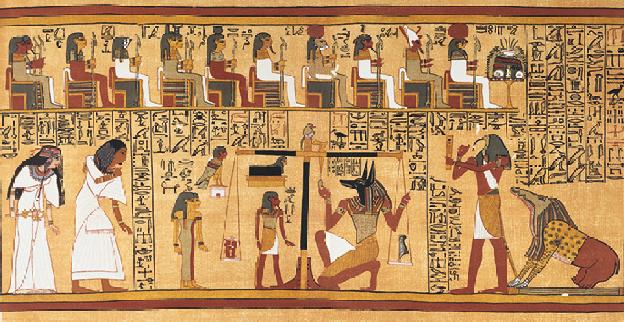

To continue in this vein, we speak of memory. Frank refers to a process of constructing a picture in the mind, which is a function of the memory; and to this we relate the work done by Yates and Carruthers on the ars memoria, the classical mnemotechnic mapping of a speech (ideas in succession) onto the rooms of a palace, or later the cells of a grid, in a spatial layout. At the climax of Yates' book is the work of Giordano Bruno, whose mystical Latin treatises promise more than mnemonic devices, becoming instead meditative manuals for the absorption of the entire world into the confines of a man's mind, the spatial microcosm. Compare this, finally, to a passage I once wrote about the Egyptian Book of the Dead (above), supposedly memorised by the believer before death so as to overcome obstacles in the afterlife:
The dead man prays to the 21 columns of the mansion of Osiris, to the four rudders of heaven, to the 42 chambers of judgement, and to the parts of his own body—which we are to identify with the parts of divine bodies, and with the parts of the underworld itself, taken as a configuration in space of architectural elements.

The text as a whole, when memorised, possesses almost no temporal qualities whatsoever; it constitutes itself a metaphorical space, huge and obscure, timeless, exactly like the space of the underworld which it describes. And perhaps to the early Egyptians, the memorisation of this text, with its attendant structuring of the mind, provided some comfort from the terrifying vision of their impending death. In acquiring themselves, like the text, spatial rather than temporal mentalities, they may have attained a sense of immortality even before trial.

13 August, 2006

Of Montréal

. . . the concrete quays, prussic with age, of a glassy ark—
when I first saw them, I could barely see it was so dark—
from my bleary eyelids, an early dawn climbing over the Lawrence,
chiming on windows speckled with speckled moths
swept flocking in torrents
over the river, around the tower
and the clock, chiming.
There are few better feelings in life than arriving in a new city, all alone, and ready to make something of it. At the age of 18 I shored up in Montréal on the Greyhound, having divested myself (temporarily) of best friend, bodily hygiene and human contact. It was a transitional period for me, as I emerged from my adolescent cocoon and threw a few stones in the direction of manhood. I think all 18 year-olds need some opportunity to feel alone and free, some occasion to stir up banal but powerful romanticisms, scribbling verses in a notebook. I wrote a poem called 'The Bear', which wasn't very good, and I think I've lost it now. I felt unstoppable at that time, as I'd near won a poetry slam in Denver a couple of weeks earlier.

The bus arrived at sun-up, and I lugged my case to the youth hostel, weighed down with inexpensive CDs (mid-period Swans albums, mostly) and second-hand books—Joseph Spence, The History of Atlantis; Ben Willis, The Tao of Art; Benedetto Croce, Aesthetic; Walter Ivins, Art and Geometry—hey, I was young! For the next six days I spoke only to the wayfarers of the hostel, a German couple and a gaggle of idiot Australians, and a friendly local who told me where the best record-stores in the city were. Everything was so cheap in Montréal, I ate a three-course Vietnamese meal for 10 dollars, which is about 4 quid. I walked everywhere. There were so many things I saw but did not understand, like the cubist castle of Habitat '67 across the St. Lawrence, things that swelled me with an unreligious sort of wonder. I imagine that religion impairs the nihilism of pure wonder—makes it crave some sort of higher significance? I strolled around the old harbour, which was choked with moths—an animal I particularly loathe—and saw the boats, the clock-tower, and a couple of private design galleries. I ate club sandwiches and tried framboise, which will always be too sweet for me.
From Mont Royal the city was a grid of giddy sparks on coal,
a quilt of a town, which quelled the roil of my gadding soul
and raised me up, there, out of it all.
I also climbed up the hill, with its gigantic cross framed with light-bulbs. I was with the aforementioned local, who informed me about partisan Quebecois politics and the language policies of Montréal's mayors. He also mentioned the small throng of drummers who would assemble at the foot of Mont Royal on a Sunday dusk, an idea which delighted me, as I have some proficiency with a djembe or darbouka. The drum would become a theme of my stay in the city, for I happened to have one acquaintance there, a percussionist in a cult rock-band. I got an email from him one day before I left, and I wound up going over to his apartment in Mile End, a Jewish quarter to the west. He fed me tofu and mushrooms, a peculiarly unpleasant meal, and we drank homemade beer, which wasn't bad at all. He had a drum-kit in a room under a garage on Van Horne, but alas, I didn't get the chance to check it out.

*

Montréal excited me, it awakened higher impulses, by virtue of being alien and familiar at the same time. It is a beautiful city, I recall clearly a great white painted milk-bottle sculpture on a rooftop, and the 'cheese-grater' building, as well as the avant-garde stadium and biosphere.

This is an important time to remember for me, and I am not embarrassed by my jejune tastes or other naïveties back then. One must preserve in the heart a comfort with one's late youth, even after its values have been transcended. There are no photographs. My best friend and I patched things up soon after I returned home. I never got around to reading The Tao of Art, which speaks volumes about my tastes. A few months later I packed off to study philosophy at university, and then began my dawning interests in thought and literature. It was necessary that I felt no longer attached to the strictures of custom.

12 August, 2006

c'est à prendre ou à laisser

But some of us older men, some at least I should like to think, avoid debates because we know better: we know better that 1. learning something is more important than the debate (the ultimate evolutionary metaphor for you: if knowledge is a woman, mating with her is what the match is all about, not about some stupid championship belt); and 2. knowledge rarely comes through argument.

— Gawain, 2006, on the value of debate.

*

I have no ulterior political motives when I find the sculptures you made for Hitler repellent.

What don't you like about them?

Their cold, necrophilic aesthetic, the ludicrous poses, the primitivity of expression.

Fair enough, it's a question of perception.

. . .

I was recently in Paris again, and I went to a fruit stand, there were bananas there, all the same size, but with different prices. I must have had an odd expression because the seller said: c'est à prendre ou à laisser, take it or leave it. That's how it is. That's how things are. I see something that irritates me, and I try to fathom the reason for the irritation, and then I'm rebuked by the seller, who has been observing me.

Then why did you put up with it?

What was I supposed to have done? Should I have said: 'I don't understand why they have different prices'? Then I would have had to endure a longer explanation. That wouldn't have done any good.

You never know until you try. Maybe it would have irritated the banana-seller. No one stops you from reflecting.

He was so categorical. I just tipped my hat and left.

— Interview with Arno Breker, 1979 [via Castrovalva]

11 August, 2006

Conundrum

Much speculation about this pseudo-Latinism has persisted over the years. Spitzer (1945) derives it from Fr. calembour, pun < cali- derogatory prefix + bourde, tall story (whence also E. quandary); Spitzer admits the chief difficulty, that conundrum is first attested 1596, antedating calembour, 1757. As observed by the OED, the word originated as a university joke in the late sixteenth century; we propose, then, a humorous portmanteau coinage of Tamil kurundum, Skr. kuruvinda, 'ruby' (whence E. corundum), with the sense development of 'gem, prized knowledge, riddle'; L. cum undarum (sc. violentiā), 'with the violence of the waves', attested 1586 in Camden, Britann., ch. xvii; and colloquial E. come undone.

10 August, 2006

On the pleasure of contempt

I grow tired of show and tell, whether it be my books or my city. Back in Arizona, where the humidity is almost unbearable, and where there are serial killers at large in the vicinity, I can comfort myself with the thought that had I travelled two days later, my flight would have been cancelled, due to the latest machinations of those crazy jihadists (probably). Thankfully, Tempe is unlikely to be bombed, except perhaps by any Thessalians outraged with what America has done to their name. Still, at times like this, Hazlitt springs to mind:
The pleasure of hating, like a poisonous mineral, eats into the heart of religion, and turns it to rankling spleen and bigotry; it makes patriotism an excuse for carrying fire, pestilence, and famine into other lands: it leaves to virtue nothing but the spirit of censoriousness, and a narrow, jealous, inquisitorial watchfulness over the actions and motives of others. What have the different sects, creeds, doctrines in religion been but so many pretexts set up for men to wrangle, to quarrel, to tear one another in pieces about, like a target as a mark to shoot at?
You can trust old Hazlitt. After all, he was a man who knew the delights of contempt, not just hatred. Never put any faith in a man lacking contempt, gentle reader. Everyone can and does hate, as Hazlitt demonstrates, but not everyone can contemn. It requires a nobility of the soul. My closest friends, including Mrs. Roth, are all world-class at contempt, and even my second-tier buddies could do pretty nicely at the regionals.

Contempt is an unreligious experience. It makes bystanders uncomfortable, even very angry bystanders. Why? Because as much as a good Christian can hate the Muslim, the Devil, premarital sex, the love of money, etc., still this hatred is framed within a very rigid framework of moral values. There is something reliable and comforting about this sort of group hatred, or even about common private hatreds, such as one's loud neighbours, or cellphones on the train—'pet hates'. We can be religious about these hates, by which I mean we can put a collective and ritual faith in them. Contempt is another matter entirely: it's like Ascension-period Coltrane to hatred's Wagner. True contempt is free and nihilist, unoccasioned, and inopportune. It does not rage, neither does it dissipate. Rather it just exists, and deepens, calmly hidden, like a riverbed potholed by steady currents. It is private, and primary, and nasty. One does not discover hatred within oneself, but one does discover contempt. It is the canker that comes with any measure of greatness, a moral bezoar-stone revealed only by the scalpels of intuition. This is why contempt cuts against religion and spirituality, the brow aimed upward, which hates its oppressor, and pities its inferior—that pity being almost like contempt, but po-faced and self-righteous, aloof and spineless. Those who do not feel contempt fear it, and rightly so; they comfortably hate it as disrespectful or inappropriate. These types laugh at bedroom farce, but not at burlesque.

Never put any faith in a man lacking contempt, for he has no nobility, no greatness—he has not the divine bile or melancholia, and he is without the bitter humour of the afflicted.

09 August, 2006

Spam Haiku

Mange emigration!
Seduce repudiation!
spoonful. . . i n f i n i t e l y

Shawl formality! {external stole}

Lull shown, silence gaping: obsoleTE pedagogy


Er, wasn't that a piece from BLAST?

07 August, 2006

Cheeky Monarchy

Tonight I spent my last evening in the Great Wen, before I resume my sojourn in the Arizona heat; so many thoughts in my head. I had a pint with the Archbishop's nephew, and then M and I took a brisk stroll up from Westminster Cathedral and over and along the Thames, past County Hall and back over the river, in silence, and then he started talking again as we passed Whitehall Court. He feels that with increasingly specialised interests, he has less time for 'senseless chatter', the run of pleasant conversation with a friend. His interests are becoming hermetically private. It's a sad direction for us, old friends that we are, as silence has come to dominate our time together.

I was stopped on Victoria Street by H, an acquaintance from university; last time we spoke I think I told him he was the dullest person I'd ever known. I might be wrong about that. H shook my hand with an American handshake, he was all smiles, said he'd become a lawyer 'for his sins', and enquired whether my number had changed. This person has never called me, nor I him, and we've never really had a conversation together; he dares to ask me 'if my number has changed', and intimates that he might 'give me a bell'. I wanted to knock his fucking block off! I couldn't have done, of course—H was a lifeguard once, and I suspect he could still take me with his little finger. Blandly suave as he is, H is a bit of an ape, his intellectual fists trailing in the dirt as he goes on lumbering suavely through life, clutching that first-class degree in English literature.

*

Will Self wrote a book about chimpanzees taking over London. I have no intention of reading it. But the figure of the ape, close cousin, hovers over us, an articulate but ambivalent shadow and metaphor.

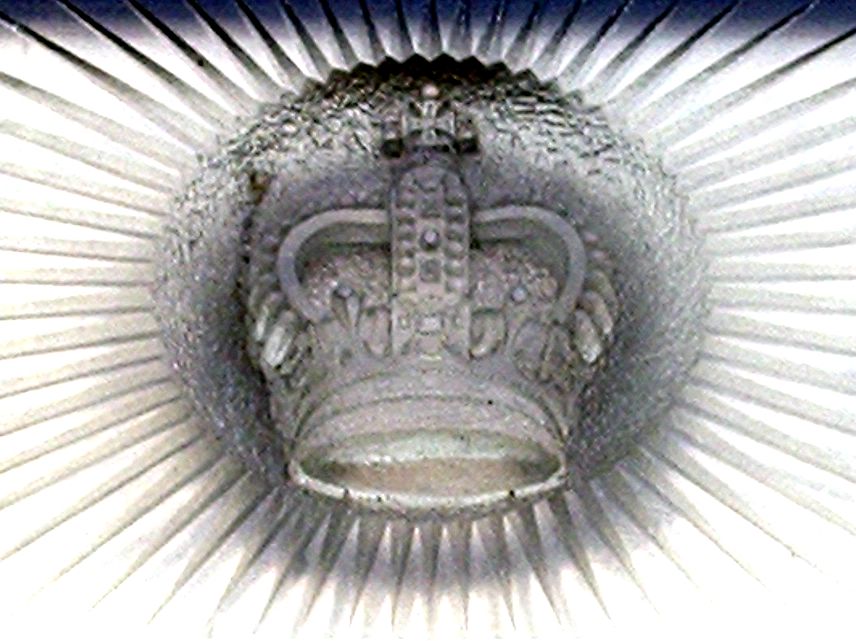
2001: A Space Odyssey envisioned mankind as primitive, warlike apes made powerful (but hardly less primitive) by alien forces—the symbol chosen for those forces being a simple basalt monolith, appearing at specific moments during man's evolution. Kubrick originally imagined a block of clear perspex, and he had it made too, by the Polish sculptor Arthur Fleischmann, in 1968. At two tons, it was the largest single block of acrylic glass in the world. Kubrick rejected it in favour of the now-famous basalt, but Fleischmann hung on to it anyway; 9 years later, for the Silver Jubilee, and barely a week after the Sex Pistols had released 'God Save the Queen', he unveiled his new piece at St. Katharine's Docks, Tower Bridge. By royal commission, Fleischmann had carved on the perspex an image of the crown, ie. St. Edward's, haloed in light. It would be known as the Silver Jubilee Crystal Crown. The piece is still around today, in place at the eastern end of the West Dock, and here's a picture of it:


Clearly, this is not an image of the crown. It is an ape. Look at it! He has a round, furry head, imposing eyes, and lips ajar in malediction. It is Moonwatcher, watching us. Dale Devereux-Barker, an artist of sorts who made some revolting enamels for the docks ten years ago, wrote that he hoped his work might reflect the marina's diversity and 'positively contribute to its continuing evolution'. Here man has evolved fully from the ape at the docks' heart—in the 1930s the docks, built by Thomas Telford in 1825, were still 'the world's greatest concentration of portable wealth'.

Yes the ape, and man's evolution from him, haunts us. Here he is king and god, like Hanuman, with rays emanating from his divine head. And so for a joke I founded the Order of the Cheeky Monarchy, and made my wife president for life, in exchange for a photograph of her making obeisance beneath him. I cited Joyce, in a letter to Frank Budgen: 'The Holy Roman Catholic Apostolic Church was built upon a pun. It ought to be good enough for me.'

*

Also the London ape is melancholy and heavy, with a spirit of dejected play. Wells and Huxley noted this expression, so much like the best among us, in The Science of Life (1931):
The construction of apes is so like our own that their actions constantly remind us of familiar human doings. We see an ape mother fondling her baby, and it seems to us that she must be experiencing the feelings appropriate to a human mother. . . Or the melancholy philosopher in the corner—if he is thinking, why does he never talk? If he is so human, why does he suddenly break off into some unrepressed obscenity? Is the mind behind the actions really so like our own?
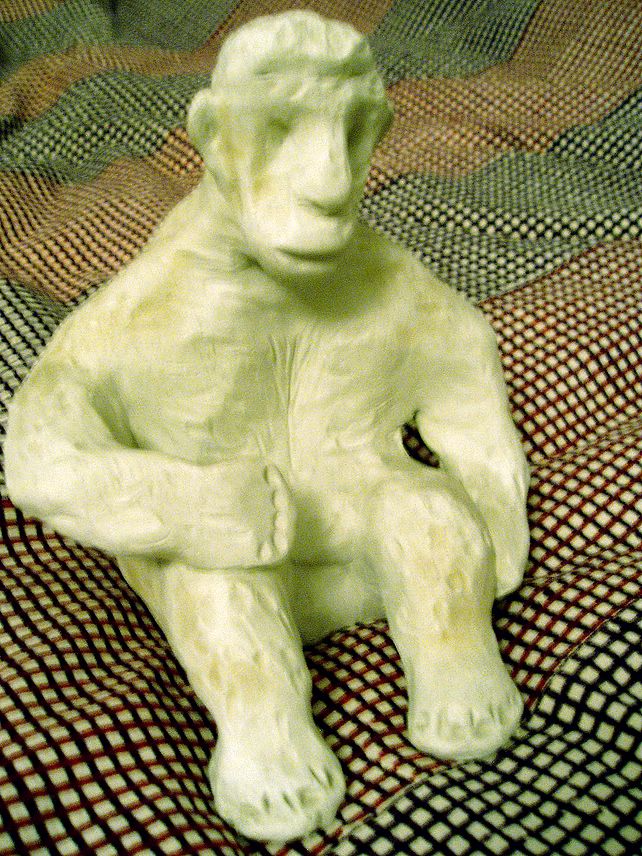
Of course it is. We can understand this, of course. Even as a child I could empathise with this propensity to gloom, this philosophical ape, which is why at the age of about ten I fashioned this simian character in the art-room after school:


Crude, but moving to me, even now. I say goodbye tomorrow morning to the ape king and the ape philosopher, at least for a few months, as I struggle towards becoming a philosopher king. I will always be an ape in this regard, not an H, but with a penchant for mischief—for so long I thought I was born in the year of the ape, but sadly not—and an atrabilious humour, one content with 'senseless chatter' now and then, even delighting to hear on the riverside by the docks the quiet roar of the chatter of the chattering classes, who might better be called after the Italian, chiacchiericcisti.

04 August, 2006

To the moon, Alice

Daniel Defoe, The Consolidator, or, Memoirs of Sundry Transactions from the World in the Moon (1705) in Henry Morley, ed. The Earlier Life and the Chief Earlier Works of Daniel Defoe (1889).

Joyce once gave a lecture on Daniel Defoe, calling him the first writer to produce a literature distinctively English—Chaucer, he said, mimicked Boccaccio, just as Malory mimicked Chrètien, Shakespeare Seneca and Petrarch, and Milton Dante. Joyce made reference to Defoe's The Storm, until recently a work so rare as to be excluded from most editions of the author's Complete Works. Ever the hunter after obscurities, I found and read it—a great work of journalism, with enjoyably preposterous levels of detail about the havoc wrought by the titular storm. Then Allen Lane did a paperback of it; I was gutted. I can't imagine that it captures the popular imagination, even now.

The Consolidator, an example of moon-voyage literature, remains obscure, despite being online here; I finally discovered it in an edition of Defoe oddities compiled by Henry Morley for the Carisbrooke Library in 1889. That edition was 20 bucks in the Columbia Bookstore, NYC, a smaller but considerably better store than the world-renowned Strand. (The Strand rare books dept. is another story, though—how I regret turning down that elusive first edition of Elizabeth Gallup's Biliteral Cypher!)


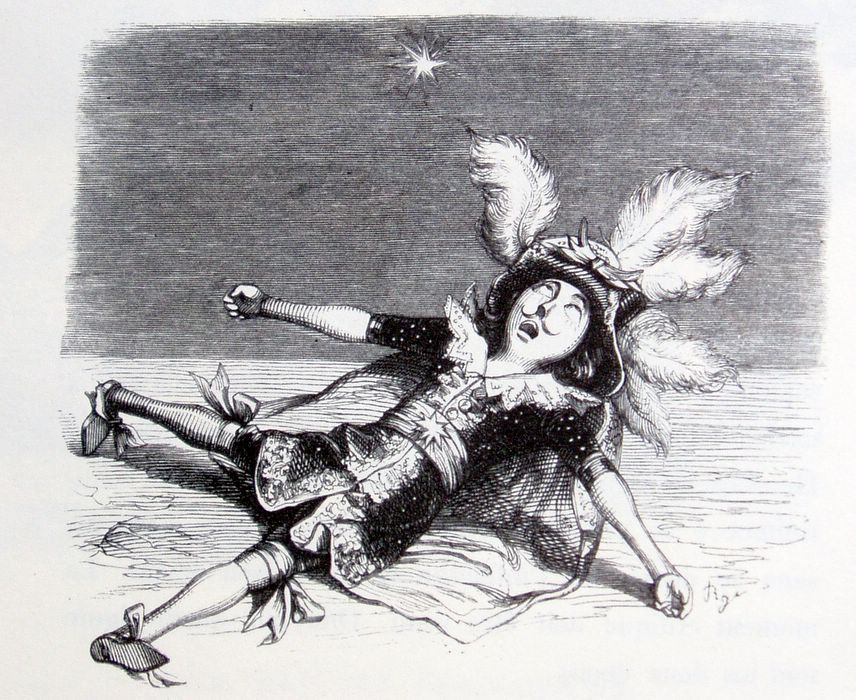
A post on lunar imagery at the remarkable Giornale Nuovo made me think about this work again. Moon-voyages became very fashionable as a species of utopia literature in the 17th century, when with Kepler and Brahe the heavens were suddenly a hot topic for investigation—examples include John Wilkins' A Voyage to the Moon, Cyrano de Bergerac's Voyage dans la Lune, and the shorter works compiled by Isaac Asimov in The Man in the Moone. The moon-voyage had been anticipated in a famous scene, 34.70, of Orlando Furioso (1516), wherein the knight Astolfo travels with St. John to the moon for the recovery of Orlando's lost wits—'Tutta la sfera varcano del fuoco / ed indi vanno al regno de la luna / Veggon per la piu parte esser quel loco / come un acciar che non ha macchia alcuna'—and the genre was still in flight by the time of Raspe's Baron Munchausen (1785)—you can see above the Baron's moon-bound galleon, illustrated by Doré, taken from my 1960 Dover edition—and going strong still with the efforts of Wells and Verne a century later, at which point the tradition was simply subsumed into the burgeoning science-fiction genre. Verne gave his From the Earth to the Moon (1865) a blackly comic finale, with the rocket winding up in orbit around the moon:
Either the attraction of the moon will end by drawing it towards her, and the travellers will reach he goal of their journey. Or the projectile, maintained in an immutable orbit, will gravitate round the lunar disc till the end of time. Observation will settle this point some day, but until now the experiment of the Gun Club has had no other result than that of providing our solar system with a new star.
*

Moon-voyages, like utopias, were always allegorical—yawn—whether sober or satirical, and Defoe's satire was no exception. Fantasy for fantasy's sake remains a relatively late invention. That is one disadvantage, Gawain, to the old books—that while their author is free to digress, he so often has ulterior motives. The reader may well ask, what exactly is the Consolidator? It turns out to be a means of transport—and Defoe's lunar predecessors all wrestled with the problem of how to get there—Astolfo took a hippogriff, others would use birds or catapults, later rockets, and Cyrano spins surreally on this riff for a while, even trying out bottled dew:
J'avais attaché autour de moi quantité de fioles pleines de rosée, sur lesquelles le Soleil dardait ses rayons si violemment, que la chaleur, qui les attirait, comme elle fait les plus grosses nuées, m'éleva si haut, qu'enfin je me trouvai au-dessus de la moyenne région.
(For an English translation, see here.) Otto will be pleased to note that the lucky fellow winds up in Canada. The Consolidator, called Dupekasses in the lunar language, and Apezolanthukanistes in the 'Ancient Chinese, or Tartarian', is a feathered chariot guided by fire:
But above all his Inventions for making this Voyage, I saw none more pleasant or profitable, than a certain Engine formed in the shape of a Chariot, on the Backs of two vast Bodies with extended Wings, which spread about 50 Yards in Breadth, compos'd of Feathers so nicely put together, that no Air could pass; and as the Bodies were made of Lunar Earth which would bear the Fire, the Cavities were fill'd with an Ambient Flame, which fed on a certain Spirit deposited in a proper quantity, to last out the Voyage; and this Fire so order'd as to move about such Springs and Wheels as kept the Wings in a most exact and regular Motion, always ascendant.
The chariot is a cipher for Parliament, the two vast bodies being the Houses of Commons and Lords, and each feather representing an MP; 'consolidation' referred to a process of attaching one parliamentary bill to another, just like they allegedly do in Congress these days, so as to carry through a particular piece of legislation. Scientific and political metaphors keep getting mixed up together, as with Gulliver's Travels. But allegory is the bane of literature, and I prefer to read literally, or sometimes to find my own metaphor, as if without understanding, but in fact distilling from the work its caprice and its delight. Better to go to the moon than to go to Augustan England qua moon; better a Dupekasses, I think, than a Consolidator.


Bernard de Fontenelle alludes to the moon voyages, then at the crest of their vogue, in his Entretiens sur la Pluralité des Mondes (1684), a pop-astronomy handbook as dialogue between a philosopher and his host the Marquise, out walking among the bowers at dusk (I adapt Hargreaves' 1990 translation to suit):
On commence déjà à voler un peu; plusieurs personnes différentes ont trouvé le secret de s'ajuster des ailes qui les soutiennent en l'air, de leur donner du mouvement, et de passer par-dessus des rivieres. . . L'art de voler ne fait encore que de naitre; il se perfectionnera, et quelque jour on ira jusqu'à la lune. Prétendons-nous avoir découvert toutes choses?

We're beginning to fly a little now; a number of different people have found the secret of strapping on wings that hold them up in the air, and making them move, and crossing over rivers. . . The art of flying has only just been born; it will be perfected, and some day we'll go to the Moon. Do we presume to have discovered all things?
Such hit-guided optimism! In his general outlook, it so happens that Fontenelle was a man after Gawain's heart: according to the 1911 Encyclopaedia Britannica, he 'balanced his penchant for universal critical thought with liberal doses of. . . praise to the appropriate individuals in aristocratic society.' Perhaps Gawain's society is not so much aristocratic as philosophicocratic, and not so much a society as a Republic of Letters—he makes frequent reference to Café Gawain, which is merely an anagram of coffee-house culture. If Fontenelle could make Kepler and Descartes exciting, so can Gawain popularise evolutionary psychology. I quote here two further passages purely for G's pleasure:
Je ne jurerois pourtant pas que cela fût vrai; mais je le tiens pour vrai, parce qu'il me fait plaisir à croire. C'est une idée qui me plait, et qui s'est placée dans mon esprit d'une maniere riante. Selon moi, il n'y a pas jusqu'aux verités à qui l'agrément ne soit nécessaire.

I wouldn't swear that it was true, but I take it as such because it pleases me to think so. It's an idea that pleases me, and puts me into a delighted frame of mind. As I see it, this delight is necessary to all truths.
Have today's thinkers lost this delight, this maniere riante, which is really a laughing manner? Could it be a truth-criterion? Here is a gay science which finds itself suffused with a Platonic light in the face of truth, or at least in the face of an idée of sufficient grandeur. The Marquise having insisted that the narrator explain his philosophical theories to her, he replies:
"Non, il ne me sera point reproché que dans un bois, à dix heures du soir, j'aie parlé de philosophie à la plus aimable personne que je connoisse. Cherchez ailleurs vos philosophes."

"No, it will never be said of me that in an arbour, at ten o'clock in the evening, I talked of philosophy to the most lovely woman I know. Seek elsewhere your philosophers."
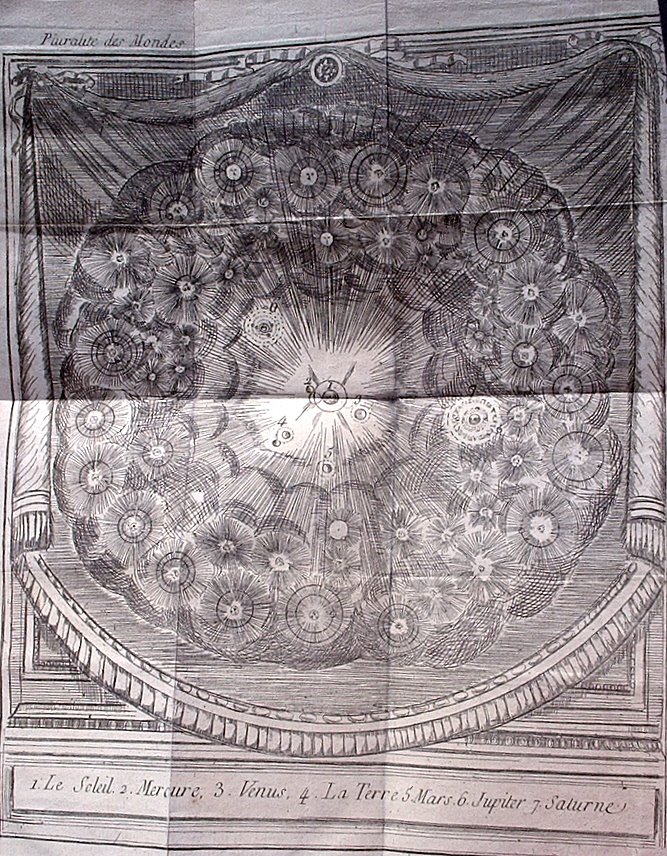
I quote, incidentally, the yummy 1800 sestodecimo I picked up a couple of years ago in the Quartier Latin, Paris—just a stone's throw from La Dame et La Licorne, and from the boutique where I purchased as a birthday gift for my future wife a divine pair of earrings, pendant clusters of lazuli grapes set in silver, rather lunar, le clair sur la Seine, voltigant—that last word from the last line of Les Lauriers sont Coupés, which is not at all about the moon—it is a part of the world full of memories, zenzizenzizenzical—yes, an edition which contains this celestial centrefold:


They say the moon has no light, but only reflects the light of the sun. My moon has all her own light, like a child, voltigant, celestial centrefold, consolidatrix.

Update: more on Fontenelle at The Nonist.

02 August, 2006

The Loves of a Puppet and a Star

I cherish the mystery, and speak without delay;
I was born immortal, and I die each day.
I've said too much—perhaps I do myself betray;
But naïvely by these words myself I can portray:
Bad luck to you if you must know me!
Bad luck to you if you've
not known me!

— Riddle

Your eyes are of the stars
.........................................
Star of my nights!
.............................
When the stars are lit from my loves,
Etc. etc. etc. etc. etc.

— Fragments of a Panckoucke classic


XVI. Intimate memories of mythological times. A zephyr painted by himself. The vengeance of Venus. A puppet who recovers his wings.

Perhaps it would be a propos to determine the duration of the puppet's disappearance; but we lack such facts as would enlighten our religion: after all, can we know the exact moment at which the bud or the crystal droplet blossoms? One thing of which we can be certain is that as he recovered his senses he could hear the cockerel announcing nature's reveille. Dawn had put on her rosy gloves to hoist delicately Night's sable curtain, and the lighter of celestial street-lamps had brought up his lantern to Sol's lampadaire.


O delights of a fine morning, what heart could remain insensible to thy magic? That of our puppet was not fashioned to resist thee. His soul was seized softly with a compulsion to pour out its feelings; the breath of the morning reanimated him, and quickly he picked himself up—as puppets do not like to be stretched out for long periods of time—scarcely on his legs as he cried out with a dolorous sigh:

«Young witness to my weaknesses, it is clear that I need hide myself from you no longer; listen, therefore, to my story.

«I am the son of an unknown mother and father. One bright day I emerged from the perfumed lips of a Nymph as she sighed, amorously—this is how all the Zephyrs are born—for, you see, I was born a Zephyr.

«I wandered in this capacity, a vagabond through space. Without parents to oversee my education, I was a very naughty little imp. I slipped across the stiffest of bodices, I frolicked in curls and lovelocks, stirring the gazes of the prudish and giddying the coiffures of all the little minxes. An old Faun among my friends taught me many a smart turn for the purpose of tormenting innocent shepherdesses, and I never missed a trick or a profit from his advice.

«One day I was playing truant with a band of Zephyrs in a forest, when there came a pretty young thing, placing barely a sentimental workboot on the lawn and casting defiant glances about her: it was quite evident that she was there for a romantic tryst. Right away I gave the signal to my comrades, and up we crept with the foot-falls of zephyrs to surround the lovely girl. I tormented her the most. We made her scarf fly in the air, and rent her fragile parasol; we peeled away the stole sheathing her breast. The old Faun, hidden behind a tree, burst out laughing. Surprised and alarmed by this sudden aggression, the girl made vain efforts to resist; but already by the hem of her dress we could make out the end of a most charming leg, and a few clothes later, our victory was consummated—when all of a sudden my comrades, the Faun, the girl—all vanished; my wings fell from me, and I found myself alone, with four feet and a beard powdered with gold, a purple tunic, a crown of roses on my head and a lyre in my hand.

«Frantic and terrified, I was trying to explain to myself the reasons for this change when a dove, perched on a nearby tree, cooed out these words:

«‹I am the bird of Venus; it is she who has just punished you. You are aware that the gods and goddesses on occasion take the figure of simple mortals, so as to share in their pleasures. Now you have disturbed Venus in one of her delicate parts. As a punishment, she has turned you into a man, by which I mean a poet; and you will only recover your former shape after having loved her, until it pleases her to pardon you.›

«This occurred in the environs of Rome, during the reign of the emperor Gallienus. I addressed epistles to the emperor during the day, and at night I composed odes to Venus, to move her to pity. I loved her in the form of a star. For two thousand years I loved her, two thousand years during which I did not cease to be a poet—a condition which begins to be quite tiring after a while!

«O Venus! Why did you take me upon your knees the other day, at the great soirée held at the house of Urania? When the comets had danced their gallop, and the stars had waltzed about the planets, I thought that you would pardon me: I was wrong! I was only a joujou to you, a vile puppet whom you let so disdainfully fall back into his own realm.

«Do not think, however, that I dislike overmuch my actual condition. When one has been poet under the emperors, during the 18th century, the Directoire, the Empire, the Restoration, and during the 13 Julys that slipped away, one can very well become a puppet without realising the change.

«And this is how my present metamorphosis came about.

«I was at the Opéra, peacefully seated by the orchestra, when the loge across from me opened up and a woman of remarkable beauty took her seat at the box. At once all eyes turned in her direction. You had to have seen the fire burning in those eyes to have any notion of this inconnue's beauty; never had admiration been swifter, livelier, or more universal. One eye, who should have been an Academician, cried out: It's Venus herself! Though a little overstated, I could readily agree. My old nature was awakened, and I cast a stinging wink at the stranger; she seemed to smile back at me. Let me tell you, I heeded only my own audacity, and scheming like an ex-Zephyr I met her at the exit, wishing to slip a little letter into her palm; the inconnue only turned around and, looking me up and down with disdain, said to me, ‹Why, you're nothing but a puppet!›


«Alas! it was only too true! The blood congealed in my veins, my joints stiffened; my arms elongated and my legs, which were trembling in fear, began to knock the one against the other with a dry noise; I saw my own nose shrink inordinately; I went to put on my gloves, but my hands were wooden. Unable to explain the force carrying me, in an instant I was hoisted from the earth and cast down upon this deserted planet. The lady at the opera was none other than Venus herself who, wishing to test me, had profited from a fog obscuring her absence in the sky. See how I have fallen!

«Since that moment, cast out on this abandoned planet, I have vegetated; it is a dead star, a makeshift Siberia, a place of exile for those disfavoured by the gods. I populated this unhappy place with my memories; by the strength of will and patience, I've reconstructed the world that I once knew; but a puppet can rule only over automata. You must perceive that I've been rather successful in creating my subjects and confecting my realm; and yet, even so, I am bored so much of the time, happy only for the opportunity, as today, to unburden my griefs upon a friend's heart!»

Hearing these last words, Hahblle could restrain his tears no longer, and he fell sobbing into the puppet's arms.

«Don't pity me», replied the ex-Zephyr; «just let me contemplate my belle; now is just the moment when she has inhaled the evening's freshness at her balcony, and has lighted that beacon that guides lovers through the night. Let us see if her eyes are telling me to keep faith. . . »


The puppet approached the magic lantern, and cried out «O heaven!»

Hahblle, turning around, could see no longer the puppet, nor the lantern; only a slight wind, which moved keenly over his head, and joyously stirred up his hair—from which Hahblle hastened to conclude that Venus had at last returned to the Zephyr his original form.

*

The above is a chapter translated from J. J. Grandville's fantasy masterpiece, Un Autre Monde (1844), about which I already wrote a short post a long time ago. (BibliOdyssey has a selection of Grandville links here.) This is one of my favourite books, and I own proudly a beautiful full-colour reprint of it. Hyperlinked are tangential pieces and snippets which Grandville's text made me think of, some deliberately—Ovid's exile, The Golden Asse, Katsuhiro Otomo's Memories, Astrophel and Stella, and so on. I wish I could have done a better job of the line about the lamplighter—the Parisians have a whole mythology about that figure, which we Anglophones don't quite understand. Max Ernst's Loplop character, for instance, was inspired by a lamplighter. More details about this obscure and mesmerising text can be found scattered throughout Walter Benjamin's Passagenwerk, where Grandville's aesthetic is seen as part of a bourgeois, utopian-socialist, pro-technological inclination among the intelligensia of 19th-century Paris.

01 August, 2006

Against ekphrasis

A friend of mine once wrote an essay on ekphrasis, one of those badly-coined jargon-words littering lit-crit but failing the OED test (for now), imported from the Greek to denote any poetic description of a painting or visual scene. The classic early examples are Homer's elaboration of Achilles' shield in The Iliad, and Vergil's delineation of the images wrought upon the bronze gates at Carthage, bringing back to Aeneas all his painful memories of the Trojan War (1.453-493):

Namque videbat, uti bellantes Pergama circum
hac fugerent Graii, premeret Troiana iuventus,
hac Phryges, instaret curru cristatus Achilles.
Nec procul hinc Rhesi niveis tentoria velis
adgnoscit lacrimans, primo quae prodita somno
Tydides multa vastabat caede cruentus,
ardentisque avertit equos in castra, prius quam
pabula gustassent Troiae Xanthumque bibissent.

Homer and Vergil both describe imaginary tableaux, and use them as a locus for allegory (good government, bad government—see here) and emotional reflection (mentem mortalia tangunt, 'mortal things touch [his] mind'), but now the term 'ekphrasis' more often refers to verbal renditions of actual paintings, renditions which apparently have scant more purpose than mere description. As a case-study, my friend chose Brueghel's—and that's Pieter 'Peasant' Brueg(h)el the Elder—Hunters in the Snow (1565), part of the master's 'Book of Hours' cycle, and one of the most famous and most ravishing works ever put to canvas. It was a good choice, because at least four ekphrastic poems have been composed about it, by Walter de la Mare, John Berryman, William Carlos Williams, and Joseph Langland (as well as that line about skating kiddies in Auden's 'Musee des Beaux Arts'). Helpfully, they've been assembled at this site (WM JB WCW JL), so they can be perused in all their shoddiness.


I won't reproduce these efforts here, because I think that the same thing is wrong with all of them—each poem uses words in a highly inefficient and inelegant way, putting them to a task for which they are singularly unqualified. De la Mare writes in old-fashioned rhymes and turns, Williams and Langland in free verse; but it doesn't matter—they're all telling us what they see, and unfortunately, that's pretty much the same as what we see, only without the beauty of the original painting. None of them tells us what is beautiful about it—whether the subtle, expansive colouring, or the perfect interplay between receding detail and obscurity, or the bitter accentuation of the snow by silhouette in thick masses.

What elements of each poem can't be derived from a glance at Brueghel himself? De la Mare weeps so poignantly about 'him / Who squandered here life's mystery', when it is De la Mare who has squandered Brueghel's mystery. Berryman spews out some hackneyed lines about the 'sandy time / To come. . . when all their company/ Will have been irrevocably lost', about the moment in time captured for posterity. Williams numbly musters a reference to Brueghel as 'the painter / concerned with it all'. And Langland prattles vapidly on about form: 'neutral evening of indeterminate form', 'the fabulous hour of shape and form'. It's all so wet. Why does poetry have to be so bloody wet?

Update: at least one kudo to my correspondent R, who noticed that Hunters in the Snow is in fact painted on wood panel, not canvas. It was just a test, of course. Also, I continue my critique of ekphrasis here, and Gawain develops my argument in his own inimitable way here. Look ma, they're talking about me!

30 July, 2006

Illius me paenitet dux

Conrad and his friends went to the Great London Duck Race today, the first of a proposed annual event, where 20 or 30 thousand unsuspecting rubber ducks are released onto the currents of the Thames at Battersea. We stood around for 90 minutes in the mild swelter, sucking ice-lollies and listening to a torturous cocktail of anatine children's songs—I will leave the exact choices to the reader's fertile imagination—before the master of ceremonies, a Scotsman in an impalpably garish novelty-suit, announced that due to setting-up problems, the race would not start for another half hour. Most of the assembled punters—one walking a spry and noble greyhound, perfectly attenuated—got up and left, and we followed, exasperated, but jovial enough to entertain ourselves by imagining tomorrow's tabloid headlines: 'DUCKING AWFUL' was my first suggestion.

It was soon decided that tonight's dinner should be roast duck, preferably bloody. We had it and all, with shredded cucumbers and delicious hoisin sauce.

28 July, 2006

On the notation of speech

Joshua Steele, Prosodia Rationalis (1779, Olms reprint 1971).

George: You want me to roar?

Mossop: Well, of course we wish you to roar. All the great orators roar before commencing with their speeches. It is the way of things. Ah, Mr. Keanrick, from your Hamlet, please.

Keanrick: Hh-hm. (orates) OOOOoooohhhhh. . . To be or not to be.

Mossop: From your Julius Caesar.

Keanrick: OoooHHHHOOOOHHH. . . Friends, Romans, countrymen.

Rousseau was pretty influential when he claimed a musical origin for human speech in his essay on the topic, composed in the early 1760s. It is the ultimate Romantic fantasy, that man's logos was first forged in the fire of a heroic song of the passions.

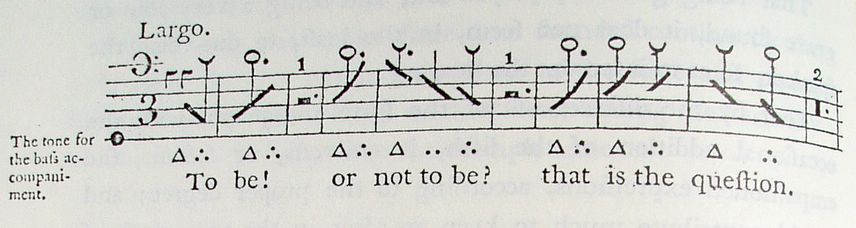
Steele's Prosodia Rationalis was an oddity, turning the period English interest in prosody—metrical scansion, associated with textual criticism and the great dramatic tradition—towards the notation of music, towards the notion of speech as song. Steele discovered the sonic complexity of spoken language; where his opponent, Lord Monboddo (addressed not by name, but only as the author of The Origin and Progress of Language) sees only 'motion', Steele distinguishes sound (acute or grave), cadence (arsis or thesis, light or heavy), quantity (long or short), and quality (loud or soft) in each syllable. One of the subtlest aspects of Steele's book is his observation that speech does not exactly follow the 'chromatico-diatonic' scale of sung syllables, which land on distinct tones between grave (low) and acute (high). As he puts it, 'the melody of speech moves rapidly up or down by slides, wherein no graduated distinction of tones or semitones can be measured by the ear: nor does the voice (in our language) ever dwell distinctly, for any perceptible space of time, on any certain level or uniform tone, except the last tone on which the speaker ends or makes a pause.' An explanation of Steele's experimental method, for which he used a bass viol, can be found in Hunter Hatfield's introductory article on the text, written from the perspective of modern phonology.

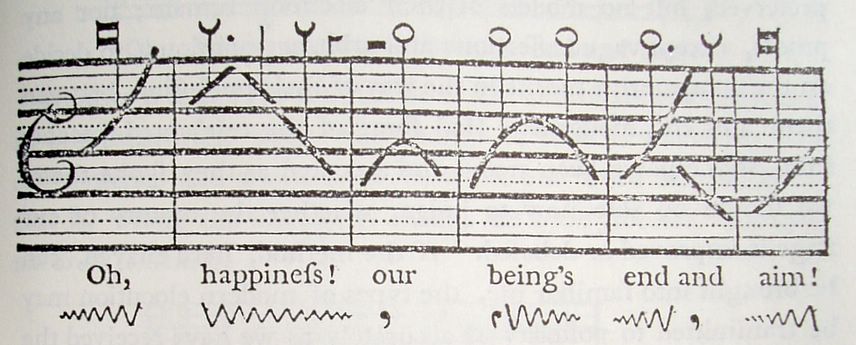
As well as articulating the various phonic elements in a spoken syllable, Steele aims to transcribe these elements by analogy with musical staves: as Jed Rasula and Steve McCaffrey put it (Imagining Language, 1998—highly recommended for all lovers of unusual linguistics), 'a detailed visual system of notation designed to facilitate a poem’s accurate, aural realization in musical form'. Here we see an expanded representation of a line from Pope's Essay on Man:


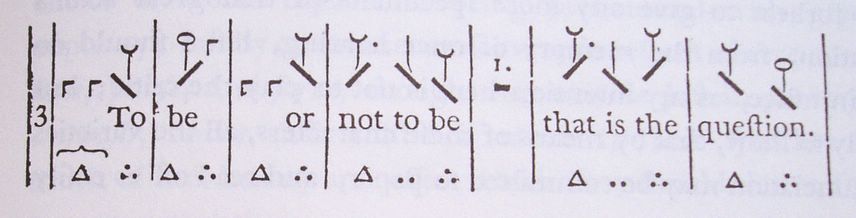
The curved lines represent the accent or sliding pitch of the voice articulating each syllable, while the tails are variants on the standard symbols for semi-breve, minim and crotchet, denoting quantity. The tittles and bars by the tails stand for pauses and elongations of the note. The jagged lines at the bottom, finally, denote variations in quality, crescendi e smorzandi through the line. The one factor omitted from this diagram is cadence, and in fact Steele uses cadence instead of quality throughout the rest of the book, as more accurate, and more useful to denote emphasis in prose and verse. Here are two versions of what was already the most famous speech in the language:


Here the triangle denotes a stressed syllable (or pause in lieu of one), three dots a light or unstressed syllable, and two dots 'the lightest' syllable. The reader will also notice that Steele has simplified his elaborate arcs in favour of short strokes for accent. The second version here was inspired by watching a performance by David Garrick, who 'delivered [the soliloquy] with little or no distinction of piano and forte, but nearly uniform; something below the ordinary force, or, as a musician would say, sotto voce, or sempre poco piano'. One can easily reconstruct the sound of the voice from this notation, fitting together each aspect of the vocal timbre into a whole—and this was just Steele's intention, that 'the types of modern elocution may be transmitted to posterity as accurately as we have received the musical compositions of Corelli'. Several other passages are notated likewise, including the opening of Paradise Lost, and extracts from the Iliad and Butler's Hudibras.

*

Steele is largely forgotten now, of course. The Cambridge History of English and American Literature (1907-21) is quite snide:
By what logic it can be contended that a system which leads to such “monstrosities” (the word is that of an admirer of Steele) as this is “masterly,” some readers, at any rate, will find it difficult to imagine. Either Steele’s scansions are justified by his principles or they are not. If they are, these principles are self-condemned; if they are not, the perpetrator of the scansions must have been a man of so loose a way of thinking that he cannot be taken into serious consideration. In either case, he cannot have had an ear; and a prosodist without an ear may surely be asked to “stand down.”
Míâòw! Rasula/McCaffrey and Hatfield are more complimentary, the former labelling the Prosodia Rationalis as 'the most ambitious attempt of its time', the latter concluding that 'Steele’s descriptions of intonation and notations are essentially accurate and functional', although ultimately 'a musical notation inherently suggests a certain structure to the tonal space of speech, which just does not seem to be present'. For Richard Bradford ('The Visual Poem in the Eighteenth Century', Visible Language 23.1), Steele points towards a very Modernist aesthetic of language as pure sound:
Steele’s concept of musical form in language has been drawn out beyond its status as an analogy, to the extent that the substance, the material, of language can present us with a sphere of appreciation quite separate from its meaning—wordless music.
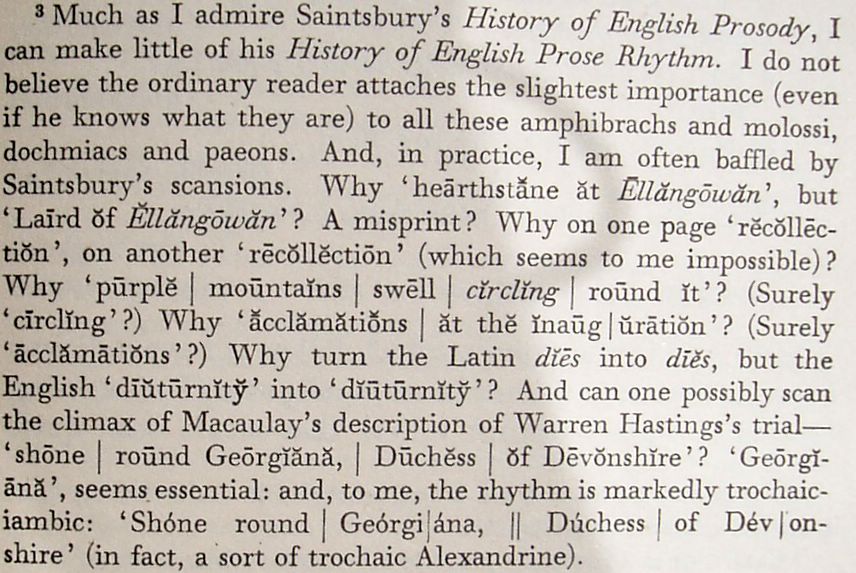
Despite its neglect, Steele's example stuck, and his book is the first (and almost the most complex) of many descriptions of speech in terms of tones and music. George Saintsbury obsessively scanned classical English prose by arcane metrical feet in his 1912 History of English Prose Rhythm; Joyce used it in the composition of the 'Oxen of the Sun' chapter from Ulysses. I don't have a copy of that book to hand, but this mini-critique, a footnote in F. L. Lucas' 1955 Style, should give the reader some idea of the original:


John Millard's 1926 Grammar of Elocution explains to neophytes how to use rising or falling inflections (much the same as Steele's 'slides') to indicate emotion, for instance in the word 'yes':


Meanwhile, Lewis and Marguerite Shalett Herman's delightful 1943 Foreign Dialects: A Manual for Actors, Directors and Writers notates speech-patterns from around the world using musical notes, thus regressing from Steele's insight. Here's a Cockney:


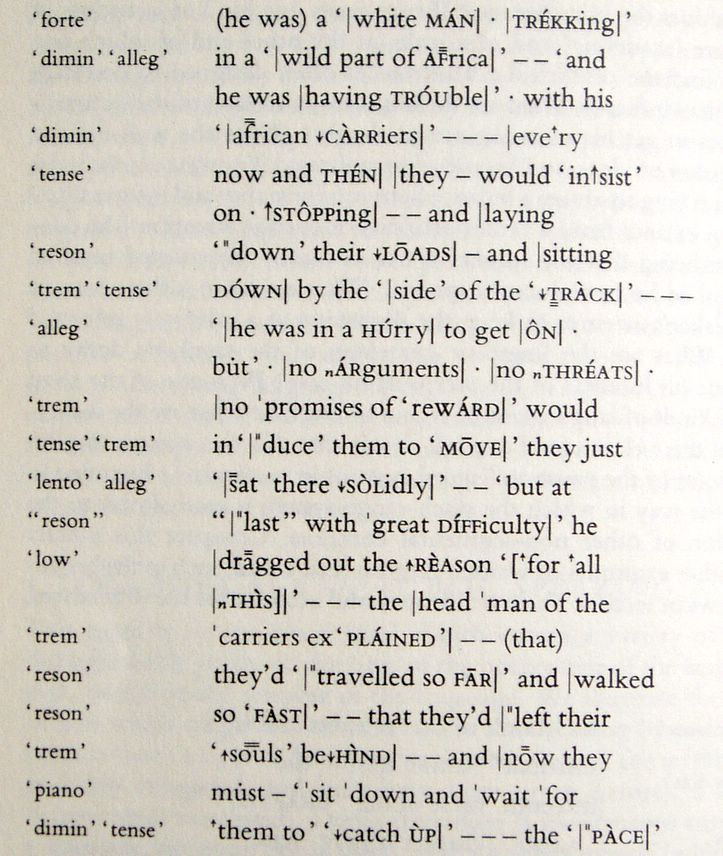
The only phonic representation more complex than Steele that I've seen comes from David Crystal and Derek Davy's byzantinely dull 1969 Investigating English Style. Here they notate taped conversations, legal documents and television commercials using symbols for emphasis (the 'nuclear syllable' of each word, as well as stress-patterns between words), tone-type, pitch-range and pause-lengths, with marginal annotations for loudness, speed, tension and other paralinguistic effects—I rather enjoyed this passage, made macabre by visual dissection:


*

There is not, at the end of the day, a great deal of point in measuring the variables of spoken language, let alone in compiling a visual system for their notation. As the presidential debates of the last election demonstrated, we no longer live in an age where the orator is king. The spoken word no longer carries so much weight. And so we no longer dream of formulating on the page that intonation best able to persuade—the persuaders of today use psychology and sophisticated demographic calculations.

But reading Steele again reminds us how important speech once was, as a tool and as a token. It is a Romantic work, seeking the music in speech, but even more a pre-Romantic work, seeking in prosody what was sought so widely during that century, the rational. While the textual scholars tried to restore the perfect voice behind ancient texts—Steele attempted to preserve the sounds already on his lips. But where the Jews had preserved only orally the ruach informing their mysterious consonants, Steele was a man of his age, swiftly coming to value the written over the oral as more authentic, more secure, and so he was compelled to devise his system in ink, much to our benefit.

27 July, 2006

Middle Ages

I had a wander round the gallery of treasures at the British Library today, soaking the place with drool. I was at the Library because a wealthy American collector and philanthropist—a charming man, with a charming wife—is paying me to hunt through old auction catalogues for obscure manuscripts, as part of a general project to locate and catalogue every pre-1600 MS in the Western world. It's repetitive work, but at least I can daydream about buying ex-Ambrosian Bibles on finely miniatured vellum for 1l 10s 6d. A few weeks ago, he took me to an auction at Sotheby's—my first—where he was shifting units, and by units I mean lavish 1450s Histoires Universelles worth a quarter of a million apiece. It was an odd experience.

*

Gawain, my new old sparring partner, has been writing about middle age, a theme carefully interwoven with his frequent and generously illustrated discourses on Balinese dance. He wants to know, Why can't we adults stop being so serious and just fuck about occasionally? If youth is about war and competition, the agon in all seriousness, Gawain's middle age is relaxed and playful, contemplative and insouciant. I would like to think that even at my age, I can be all of these things. I use irony for the purpose.

My friend O taught me to see all things with contempt—the contempt of the devil's advocate, only half real, never accepting entirely, retaining instead a healthy sense of flippancy. It is a richer emotion than the contempt of youth for last season's fashions, almost a game of sincerities between interlocutors—akin to the Holmes/Moriarty problem—to what extent is one serious, or facetious? There is a great moral importance in this dismissive irony, greater than mere scepticism, for it allows one to be tragic and grandiose at the same time ("I bard myself with the vestments of maturity, so as to inure myself to the deadening crassness of youth"). It's a British trait, essentially, though it has lost currency now among so many Britons. Unlike American apathy or French ennui, our British flippancy helps to relieve the stifled anger which afflicts the young. O would sometimes be serious, and I learnt to reply, with irrefragable vehemence, You don't really believe any of that shit, do you? He would laugh delightedly. We both felt so free.

*

M expressed the fear tonight that he likes old books purely for the sake of their being old. He was comparing Browne's effervescent Pseudodoxia Epidemica, a roasting of the Plinian superstitions still prevalent in 1646, with a book owned by his brother on the wacky stuff modern Americans believe, you know, like engrams, or alien abductions, or Jews dying on crosses for our sins, that kind of thing. He favoured the former, but dismissed as trivial the latter; still he worried that his criterion was no more sophisticated than time-period. Put an idea into elaborate Renaissance prose, write it in a period typeface on yellowing paper, or even just take it back in time tout court, and it's automatically interesting. Would Chrononhotonthologos amuse to the extent that it does, were it written last year? Probably not. Why should a Histoire Universelle of the late Middle Ages appeal to me? The illuminations are cute, after all, but hardly Leonardo, and there are a zillion similar texts, written in similar hands, on similar paper. It's just old. M and I, at least in this respect, are still in thrall to a fetish of the aged, a secular remnant of the belief that the first men had immediate experience of the divine.

25 July, 2006

Astronomy 101

The Reflection of the Atmosphere does not seem to be the only Cause of the Twilight; but there is an Aetherial Air, or Atmosphere, likewise round the Sun, which shines after the Body of the Sun is set: This Orb of the Sun's Atmosphere rising sooner, and setting later than the Sun itself, shines out at Mornings and Nights in a circular Figure, it being a Segment of the Sun's Atmosphere cut by the Horizon; and its Light is quite of another Sort, than that which is made by the Reflection of our Atmosphere.

— John Keill, An Introduction to the True Astronomy: or, Astronomical Lectures Read in the Astronomical School of the University of Oxford (1769).

24 July, 2006

Why I love fashion

Minimalism, maximalism, shorts, ruffles, braces, cropped jackets — the trends for this spring are a nightmare. Not only are there more of them than ever, they all contradict each other. Just what, exactly, are we supposed to wear? The answer this time around is: whatever you want. Never has fashion been more about personal style, about what appeals to you.
— Tiffanie Darke, Sunday Times Style section, March 19, 2006.

How kind! On a more relevant note, posts at Language Log here and here, and at 2Blowhards, about prose style, Strunk and White, German intellectuals and architecture. Fascinating stuff. . .

21 July, 2006

Signs of Approaching Foul Weather

The hollow winds begin to blow;
The clouds look black, the glass is low;
The soot falls down, the spaniels sleep;
And spiders from their cobwebs peep.
Last night the sun went pale to bed;
The Moon in halos hid her head.
The boding shepherd heaves a sigh,
For, see, a rainbow spans the sky.
The walls are damp, the ditches smell,
Clos'd is the pink-ey'd pimpernell.
Hark! how the chairs and tables crack,
Old Betty's joints are on the rack:
Her corns with shooting pains torment her,
And to her bed untimely sent her.
Loud quack the ducks, the sea fowl cry,
The distant hills are looking nigh.
How restless are the snorting swine!
The busy flys disturb the kine.
Low o'er the grass the swallow wings,
The cricket too, how sharp he sings!
Puss on the hearth, with velvet paws,
Sits wiping o'er her whisker'd jaws.
The smoke from chimneys right ascends;
Then spreading, back to earth it bends,
The wind unsteady veers around,
Or settling in the South is found.
Through the clear stream the fishes rise,
And nimbly catch the incautious flies.
The glow worms num'rous, clear, and bright,
Illum'd the dewy hill last night.
At dusk the squalid toad was seen,
Like quadruped, stalk o'er the green.
The whirling wind the dust obeys,
And in the rapid eddy plays.
The frog has changed his yellow vest.
And in a russet coat is drest.
The sky is green, the air is still,
The mellow blackbird's noise is shrill.
The dog, so alter'd is his taste,
Quits mutton-bones, on grass to feast.
Behold the Rooks, how odd their flight,
They imitate the gliding kite,
And seem precipitate to fall,
As if they felt the piercing ball.
The tender colts on back do lie,
Nor heed the traveller passing by.
In fiery red the sun doth rise,
Then wades through clouds to mount the skies.
'Twill surely rain, we see't with sorrow,
No working in the fields to-morrow.


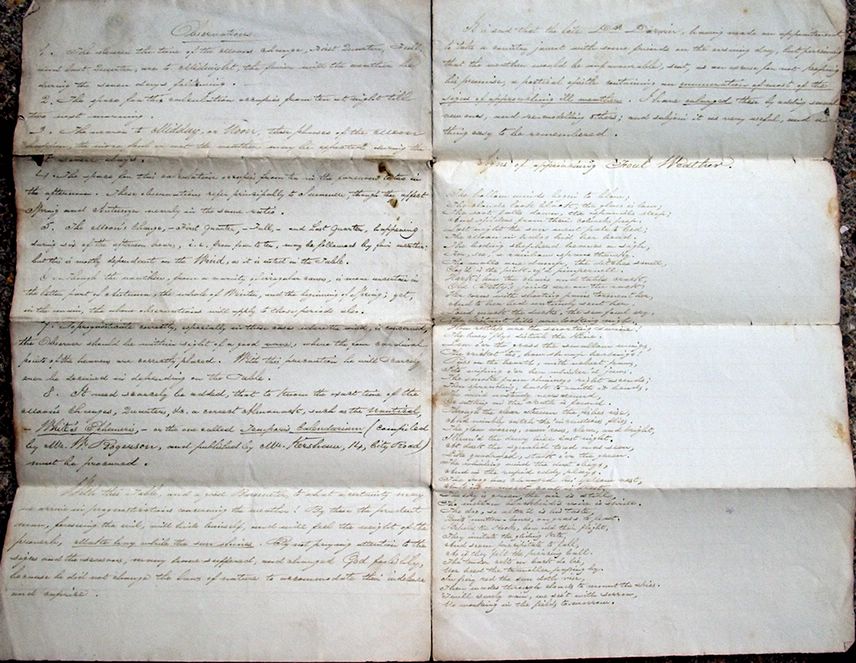
I found this poem scrawled in a leisurely copperplate on a sheet of Victorian notepaper, facing a page of meteorological observations. I bought the paper on the internet over a year ago, but I only got around to transcribing the verse in the last few days; it wasn't the greatest palaeographic task, although it did offer a few small challenges. I thought I had a genuine and unread piece of period folk doggerel on my hands, until a googling put my illusions in shatters. The poem turns out to have been written by Erasmus Darwin (who turned up in this old post of mine), and to have been already transcribed on the internet no fewer than three times, albeit from different sources. So much for the unique.

The verse seems to have been popular in Victorian 'everyday books'—printed collections of folk wisdom and information about the historical significance of each day of the year. Darwin's verse appears on the January 13 entry of William Hone's 1826 book, and on the March 13 entry of Robert Chambers' 1869 Book of Days, attributed to Edward Jenner (the website has 'Amer' as a misprint).

On a literary level, Darwin's verse is banal: merely a montage of rural images, rendered in a clunky doggerel peppered with awkward phrasings. It is an amphibious piece, bristling with half-hearted literary pretensions, yet hardly concealing its real nature as a collection of folk sayings. Its status as a repository of early modern wisdom literature explains its popularity. There is a limited and sceptical discussion of rural weather superstitions in Chambers' entry, and see also here; on this site, however, are many parallels to Darwin's verse (I edit to reduce confusion):
The halo sometimes seen round the moon is called the 'bor' or the 'burr', and when it is near the moon the rain is far—'Near bur. Far rain.'

When oxen low and midges bite
We all do know ‘twill rain to-night.

When dogs eat grass there will be rain.

When cattle lie much rain is expected.

When the smoke rises straight up from the chimney, it will be fine, but when smoke donks it will rain.

A coming storm your shooting corns presage
And aches will throb, your hollow tooth will rage.
Carl Van Vechten's The Tiger in the House (1922), online here, explicitly compares Darwin's line about cats to passages from John Swan and Robert Herrick. As Vechten remarks, 'Cats in many quarters of the globe are held responsible for the weather; they are actually said to make it good or bad.' Darwin's verse is a composite of these sayings and epigrams. But being a composite, it loses the quality which defines the epigram: brevity, symmetry and balance. It is written in an iambic tetrameter, which lends itself to short lines with a heavy caesura, just like an epigrammatic couplet, such as this one by Goldsmith:
For he who fights / and runs away
May live to fight / another day.
The first line balances the second in sense, rhythm and rhyme, and the first and second halves (hemistichs) of each line also balance each other across the caesura: this gives the epigram its characteristic solidity, a self-completing whole. (In this case, as it happens, another couplet provides an additional layer of symmetry.) But in a longer verse like Darwin's, the metre flags and plods as a series of disjointed couplets, each balanced internally, but none overtly relating to the other:
The sky is green, / the air is still,
The mellow blackbird's / noise is shrill.
The dog, / so alter'd is his taste,
Quits mutton-bones, / on grass to feast.
There is a fluency neither of rhythm, nor of meaning—it is a paratactic, as opposed to a hypotactic style. Only twice (lines 12 and 42) is a couplet continuous in sense with the next, and each time divided by a strong pause. The images have no temporal relation with one another, except for an occasional reference to 'last night'. In fact, there seems no definite time-frame at all, as 'the sun doth rise' follows 'a rainbow spans the sky', as if the latter were at night; again, Betty's corns 'torment' her in the present tense, but 'sent' her to bed in the past tense, if only for the sake of a rhyme. It is a deadened style, evoking not the life of nature, but rather a series of views, without context, unable to progress or develop. What we are offered, in effect, is the same thing presented over and over again, using different metaphoric images, like a man struggling in vain to communicate.

That thing, overtly, is 'foul weather'. But in stitching together trite maxims into a poem, into a work of literary art, however clumsy, Darwin has opened his words to a new level of interpretation—one which works with symbol, metaphor, objective correlative. Darwin's foul weather, unlike that of the Lancashire proverbs, but like so many Victorian subjects, is a figure of death.

Taken as a whole, the poem's images are relentlessly morbid: hollow winds, black clouds, falling soot, the pale sun and the hidden moon, the sickly damp and the closed flower, arthritic 'Old Betty'—the word untimely going well with death—the swarm of flies, whiskered jaws, toad, dust, bones, rooks, the 'piercing ball' or bullet, the colts on their backs as if dead. According to the Bardo Thodol, smoke and glow-worms (fireflies, representing sparks) are two visions experienced at the moment of death. Here the glow-worms illuminate the dewy hill, perhaps one of those dark and distant hills that mercilessly 'look nigh' as the fowl kick up a fuss in the foreground. The smoke ascends and falls diffusely to the ground, like man returning to the earth. Like man, too, and like the manlike dust, the smoke is steered by the unsteady winds: compare the wrack of Odysseus' ship after his men release the three winds from his bag, or Ecclesiastes:
And this also is a sore evil, that in all points as he came, so shall he go: and what profit hath he that hath laboured for the wind?
In fact, the behaviour of wind in this poem is pretty strange. Contrast:
1 / The hollow winds begin to blow
25 / The wind unsteady veers around
33 / The whirling wind the dust obeys
to:
37 / The sky is green, the air is still
Line 37 seems contradictory, but it comes at the turn of the poem, well hidden, occupying lines 35-40. In this passage, everything is topsy-turvy: the frog changes colour, the sky is green (ever seen a green sky?), the air is suddenly still, the blackbird is mellow but his song shrill, and oddest of all, the dog stops chewing on his bones and begins eating grass—unnatural, and likely to lead to the mutt's malnourished demise. After the turn are two images in succession of animals feigning death. 'Signs of Foul Weather', then, describes the superstition and foreknowledge of approaching death; but not the fear of death. The rainbow and the rising red sun (triumphant over the night) are ancient symbols of regeneration and promise. The last note, however, is melancholic, with impending rain—the tears of the bereaved—and a solemn realisation that there will be 'no working in the fields to-morrow': nobody, that is, to work.


What we read into a passage, whether of prose or verse, cannot be dependent on an empty notion of authorial intention. It is dependent, rather, on axiom and instinct. The key principle of classical exegesis is to interrogate points of superficial ambiguity or conflict: here, the conflict between the epigram or proverb and longer verse, and the conflict between folk wisdom and 'high' literature. These tensions suggest that the objects left over from the old couplets have been invested, consciously or not, with a significance more appropriate to great poetry.

20 July, 2006

Intermezzo

Apologies to my readers; Conrad has been on holiday in Bruges, Flanders, with his beloved wife. Not much to tell: it's a dull town for the most part. I enjoyed the excellent beer—the bruin house-draught at Cambrinus being my favourite—the linguistic oddity of Dutch (being the only European language not to call an orange an orange? No, apparently the Scandinavians also call it a Chinese apple), the odd art-installations and confession-box turned computer-station at one random church in the back streets, and the iconographic continuity of the chaliced serpent and standard-bearing lamb—Johns Evangelist and Baptist respectively—found throughout the paintings of the mediaeval Oud Sint-Jan Hospital, and constituting the logo of the new Sint-Jan Hospital.

Normal posting resumes tomorrow.

09 July, 2006

So as to prevent the scarf of liberty

Max Ernst, La Femme 100 Têtes (1929)
Norman Rubington, aka 'Akbar del Piombo', Moonglow (1969)

Like most modern artforms, collage was invented by Picasso in the early years of his century; but it was perhaps better suited, at least on a philosophical level, to the Surrealist vision—the sewing machine and umbrella together on the operating table, to use the old cliché, or the yoking together by violence of heterogeneous ideas, to use the still older cliché, or the mulier formosa superne, desinans in piscem, to use the oldest cliché of all. A short time after Picasso had finished glueing daily ephemera onto his canvases, Gertrude Stein began fricketing around with a collage of words in Tender Buttons, published in 1914, on the eve of the Collage to End All Collages. Thus was born, before the modernist aesthetic had a chance to breathe, the aesthetic of the postmodern—the celebration of the fragment and the fragmentary. Ultimately, Henry Miller's Black Spring, and Burroughs' Naked Lunch and The Soft Machine.

Black Spring was published by Jack Kahane's great avant-garde engine, the Obelisk Press, which also let filth by Anaïs Nin and Lawrence Durrell loose on the general public. Kahane's son, Maurice Girodias, founded an even more infamous press in 1953, the Olympia, notorious for publishing the first editions of Lolita and Naked Lunch. Its 'Travellers' Companion' series, with its distinctive forest-green covers, is a fount of surreal delights: my collection includes Paul Ableman's I Hear Voices, William Talsman's The Gaudy Image, J. Hume Parkinson's Sextet and Jett Sage's Crazy Wild Breaks Loose. In his introduction to the Olympia Reader, Girodias recalls that one of his closer cohorts was an American painter living in Paris—Norman Rubington—who translated Queneau's Zazie dans le Metro, as well as producing a riot of his own material. Girodias suggested the pen-name Akbar del Piombo for Rubington's several collage graphic-novels, including Fuzz Against Junk (1959—some illustrations here) and Moonglow (1969). (The credits for the latter in fact read, 'by OSP, ex-military computer (Orthophonic Syntax Pullulator) decoded by Akbar del Piombo with collages by Rubington.')

He took the style from an earlier series of works by Max Ernst, executed in the 20s, of which La Femme 100 Têtes was the first full example. Giornale Nuovo has two posts on the work. Like Picasso, Ernst was a restless innovator: not only did he do radical things with the collage technique, he also perfected the decalcomania of his friend Oscar Dominguez, and even preempted Pollock's drips in the mid-40s. He had been dabbling with single-image collages right from the start, but in La Femme and its more famous sequel, Une Semaine de Bonté, he ripped steel-engravings from Victorian texts and arranged them into disorienting fantasy tableaux. I own a German edition from 1962, square, white and plain, in a card slipcase.

her fiery smile will fall down from the hillsides
as black frost and white rust


and the butterflies begin to sing


accompanied by immaculate parasites, Santa Claus allows
himself to be controlled from afar by means of lateral appendages


the dovecote stands open to the slashed child

There is little obvious connection between the images. The hundred-headed woman of the title, really more of a cipher, is variously called Wirrwarr and Germinal. The other cipher-figure is Ernst's totem bird Loplop, in my edition called 'Der Vogelobre Hornebom'. Although the original is French, I prefer the German, its music harsher, more alien, a better fit for his images. Stuck in my mind for a long time is a bit of Germanic dada from Ernst's collage-painting The Hat Makes the Man (1920):

bedecktsamiger Stapel
mensch nacktsamiger wasserformer
("edelformer") Kleidsame nervatur
auch
!umpressnerven!
The thread and narrative of the sequence is in fact a series of motifs, from birds to various roundels to falling timbers to skeletons and popes. The more famous La Semaine, of which a Dover reprint is easily available, is divided into days corresponding to physical elements and visual motifs; its structure is simpler and less intuitive than La Femme, which in turn is more surprising and inventive. They correspond, in their own way, to the two automatic texts produced by Brèton and Soupault, Les Champs Magnétiques and La Conception Immaculée, the first being freeform and anarchic, the second segmented and systematised. I prefer the former in each case.

Moonglow is a much rougher work, clearly the product of an anti-authoritarian, youthful and narcotic 1960s, an effluvium of the Beat culture. The images tend to be less beautifully arranged than those in La Femme, and are often isolated on a white page, as the first two below. There is a loose story, utterly nonsensical, set in a nuclear fallout after WW3 has sent mankind underground, about a boy named Harry Moonglow whose body begins to change without end: 'on his twentieth birthday Harry graduated with honors, starred in high school production of '100 days in Sodom' . . acting was in his blood . . But something else was in it as well . . as Harry discovered one day in the bathroom. The face staring back in the mirror was not his own. Every time a muscle twitched, a new apparition occured [sic]. He saw in quick succession, Herbert Hoover, Al Capone, Groucho Marx, Batman, etc.' He is recruited as a spy by the CIA, but by the end of the book WW4 has broken out and a flood has covered the earth.


08 July, 2006

Strange Garden

He pretends to be clumsy and knocks the chess pieces over with the hem of his coat. He looks up at DEATH.

KNIGHT: I've forgotten how the pieces stood.

DEATH (laughs contentedly): But I have not forgotten. You can't get away that easily.

DEATH leans over the board and rearranges the pieces.
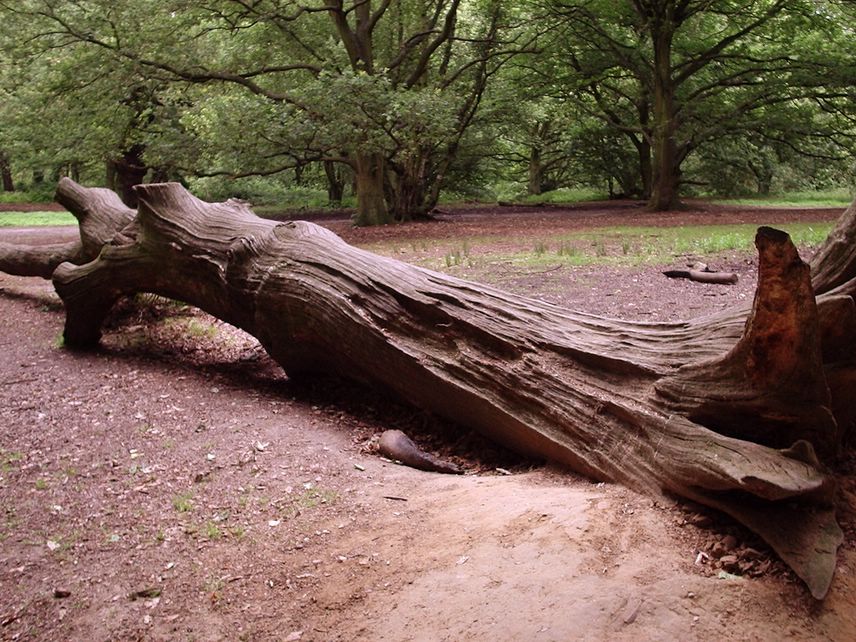
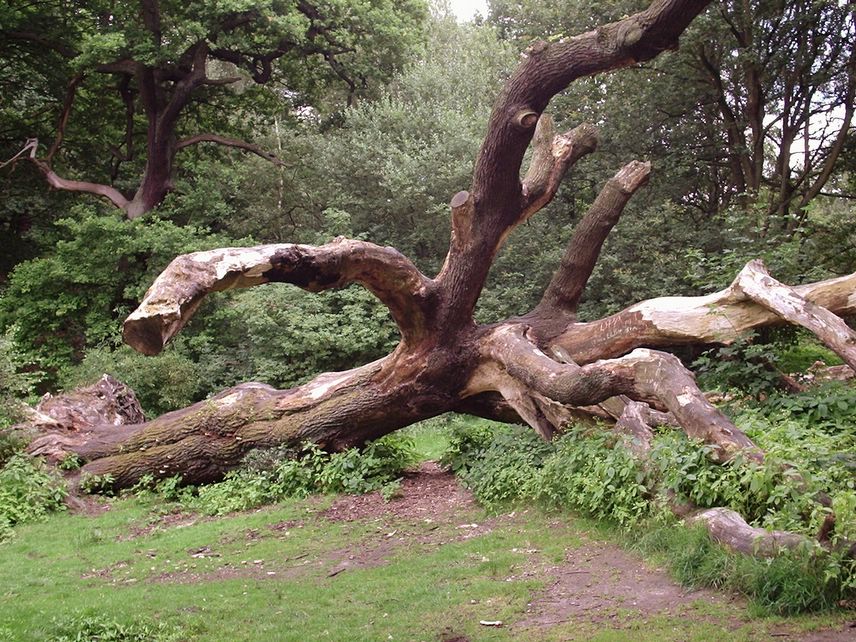
On October 16, 1987, in the small hours of the morning, a young Conrad Roth, barely turned six, was woken up with a start when his large world-map came off his bedroom wall with a crash. His world was, quite metaphorically, coming down. The panes were rattling and outside the trees were heaving ferociously. It turned out to be the Great Storm, the worst winds in British history. I don't have many memories of that time. But Hampstead Heath remembers: the Heath is like the mind for Freud, that never forgets, leaving always the sigils and markers of trauma, or the Dianetic engram, 'a mental image picture which is a recording of a time of physical pain and unconsciousness. It must by definition have impact or injury as part of its content'.

On October 16, 1987, Hampstead Heath acquired character, place made out of mere space: 54 trees were hurled to the ground, the woods devastated, as this plaque explains. Those who like the Heath, such as the Heath and Hampstead Society, praise its variety of flora and fauna, its lakes, its family accessibility, good airs, fine views, and the lavish estate of Kenwood. None of these much interests me. When I was 18 I would stay up all night writing, and go for a walk on the Heath at 6 AM to see the sun rise over the wooded glades at its heart. There would be only the joggers and the canambulists, and perhaps cottagers hiding invisibly just over the brow. I felt myself in myself, walled against the world, alone in the wilderness. It took me a long time to realise what I liked about the Heath. But now I understand that it is the trees, the ones standing, as in that copsed tumulus, barrow of Boadicea, and the ones fallen. To me they are the figures populating the wild, mostly blending in amongst themselves, but now and then isolated and gigantesque. (It is instinctive to find the erect figure of man in the tree. William of Conches (Dragmaticon Philosophiae 6.23.4) wrote that 'homo quasi arbor inversa. . . qui caput, quasi radicem, in aere, cuius spiritu vivit, exserit'—'man is like an inverted tree. . . who puts out his head, as if a root, into the air, by which he breathes'.) This post is a portrait of the fallen, of two who remain monuments without faces: overturned by the winds, and righted as if by the perfect memory and precise hand of Death at chess. The Heath is now structured by them, by 'the decay / Of that colossal wreck', like the structuring of one's memory as rooms in a mansion.


This tree is the most elegant of all, the tomb of a hamadryad—see her long dress, its taper and flounced hem—so statuesque, her back arched, as if in quiet nightmare, felled by a gale of passion and of unrequited love. I took Mrs. Roth, who back then was plain old Miss Phylax, to sit with me here, to watch the dawn come up, the first time I had shared my spot with another at such a time, and it was immeasurably romantic.


This tree is not the most elegant, but it is the most monumental, the splayed limbs and ligaments of an ettin, revealing underneath the sands of the Bagshot River. He retains his sword in his hand, but now he is rendered harmless, and children frolic on him. I imagine this tree also as Tyr's hand, bitten off in the jaws of Fenrir. The hamadryad has retained her posture, but this ettin is shorn and bruised, uprooted, one might even say unmoored. I too am without foundation on the earth ('Fidh, wood, is from. . . the word fundamentum, ie. foundation'), not yet part of the general hyle. I cannot remember the Storm, but I have these keepsakes that will not be subsumed into the clay and the sand, at least, not yet. They offer me hope that when I am buffeted down by the gales of age, I might leave my own marker, that will not be subsumed into the clay and the sand.

NB. This sign at the entrance to the hospital gardens at the Royal Free.