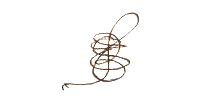
This post takes as its genesis an epigram falsely attributed to Vergil through the Middle Ages and Renaissance. Our earliest source for the poem is an eleventh-century manuscript, although the version I quote is taken from a modern edition of the
Anthologia Latina:
Littera Pythagorae, discrimine secta bicorni,
Humanae vitae speciem praeferre videtur.
Nam via virtutis dextrum petit ardua callem
Difficilemque aditum primo spectantibus offert,
Sed requiem praebet fessis in vertice summo.
Molle ostentat iter via laeva, sed ultima meta
Praecipitat captos volvitque per aspera saxa.
Quisquis enim duros casus virtutis amore
Vicerit, ille sibi laudemque decusque parabit.
At qui desidiam luxumque sequetur inertem,
Dum fugit oppositos incauta mente labores,
Turpis inopsque simul miserabile transiget aevum.
A prose translation of a prosaic verse: The Pythagorean letter, divided into two horns, seems to present an image of human life. For the steep way of virtue, to the right, offers the viewer a difficult approach up a mountainside, but at the top it provides the weary with rest. The left way shows a pleasant journey, but at the end it hurls down the trapped traveller among rough rocks. For whoever has conquered hardship from his love of virtue will be rewarded with praise and honour. But he who follows a life of idle decadence, thoughtlessly skiving, will spend eternity [or, 'a lifetime'] poor, ugly and miserable.
This piece is about that very
littera Pythagorae, the 'Pythagorean letter'.
*
Classical ethics has as its foundation the concept of free will,
liber arbitrium; the quintessence of free will is an individual's choice between right and wrong. One of the key tasks of a moral teacher was to persuade his student that virtue, though difficult, was in the student's best interest in the long term. One finds this in Plato, for instance, all the time. Thus the path of virtue was portrayed as harsh or steep, and the primrose path of vice as easy and gentle.
The dualism of this choice, between vice and virtue, was traditionally symbolised by the left and right hands. The right hand, with which one fought and wrote, has always been positive in connotation; its counterpart the left, weak hand. If one surveys the words for 'left' and 'right' in European languages, one finds that the latter are groups of cognates—
dexios,
dexter,
destra and
diritto,
dereche,
direita,
droit,
rechte,
right,
deis—and the former mostly unrelated—
laios,
sinister,
lasciato,
izquierdo,
linke,
gauche,
left,
clé. This is because words for 'left', with their negative connotations, have undergone taboo-substitution from foreign sources;
izquierdo, for instance, is Basque. To call someone
gauche or
sinister is to insult him—whereas to call him
adroit or
dextrous is high praise. It is no coincidence that
right should have its two primary meanings, nor that
left should come from a root meaning 'lame'. The moral dualism of the hands is not left linguistically implicit among the Greeks, but explicitly formulated; a passage in Aristotle (
Metaphysics, I.5.985) describes a Pythagorean table of opposites (the formatting is mine)—
A different party in this same school says that the first principles are ten, named according to the following table:
finite and infinite,
even and odd,
one and many,
right and left,
male and female,
rest and motion,
straight and crooked,
light and darkness,
good and bad,
square and oblong.
At some point in Greek history, it was noticed that the capital upsilon—Y—looked like a path branching left and right. The comparison, like so much traditional material, was ascribed to the Pythagoreans, in accordance with the dualism just mentioned; our earliest source for it, however, is as late as the Roman poet Persius (
Satires, 3.56). It is perhaps not surprising that the image would have more resonance among the Romans than among the Greeks. Symbols and sigla, and even entire texts, have a greater magic as they grow opaque—hence the preservation of a Greek mass among Latin-speakers, and a Latin mass among vernacular-speakers, hence even the deliberate archaism of the English Bible. The Y, imported into the Roman alphabet in the first century, was always an alien letter, used only to render Greek names. The Y is still called the 'Greek I' in the Romance languages, retaining its alterity in the modern alphabet, a symbol of something earlier, almost occult. Thus its efficacy as a moral totem: the less it is a letter, the more it is a symbol. (Compare the defamiliarisation of Roman letters to yield opaque modern symbols—&, £, ∫.)
Throughout late antiquity, the Y was an accepted symbol of pagan ethics, of the choice between the hard path of virtue (right) and the easy path of vice (left). Lactantius, for instance, criticises the Y, cited as standard idiom, for its implication that the rewards or punishments for a man's actions occur during his lifetime, and not after his death.
*
Two paths diverged in a yellow wood.
Servius' commentary on the
Aeneid, written around 400 AD, finds the Y in the Golden Bough (a favourite motif of mine, see
here and
here):
novimus Pythagoram Samium vitam humanam divisisse in modum Y litterae, scilicet quod prima aetas incerta sit, quippe quae adhuc se nec vitiis nec virtutibus dedit; bivium autem Y litterae a iuventute incipere, quo tempore homines aut vitia, id est partem sinistram, aut virtutes, id est dexteram partem sequuntur.
We know that Pythagoras of Samos divided human life according to the letter Y, that is, because the first age is uncertain, as it is not yet given over either to vices or to virtues; however, the fork of the letter Y signifies the beginning of manhood, at which time men follow either vice (the left path) or virtue (the right path).
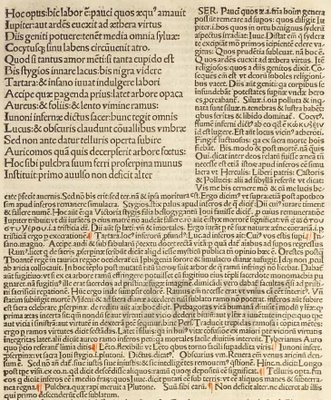
Servius' commentary on Aeneid 6.129-143, in a 1492 edition
This seems a rather far-fetched conflation—what on earth has the Bough to do with the
littera Pythagorae? Perhaps it is not as outlandish as it first appears. Throughout the sixth book of the
Aeneid, which contains the Bough, the theme of the Y is implicitly present. At lines 540-543, Aeneas finds his paths diverging in the underworld, left towards Dis and right towards Elysium, and it is at the entrance to the latter (line 636) that Aeneas plants the Bough. The goddess Hecate is present in the Bough's grove, in her Roman incarnation as Trivia—literally, 'she of three roads'—three roads that form an intersection looking much like the Y. But the Y as bough? We turn to Alfred Kallir's 1961 classic,
Sign and Design: The Psychogenetic Source of the Alphabet. Kallir interprets the Y as a grander, more antique form of the V, a symbol of the outstretched arms and open vagina. (Incidentally, Pynchon's first novel,
V., derives most of its symbolic content from Kallir.) The Y, furthermore, is a tree-symbol related to the Christian cross and the letter T:
Tree designs are subjected to gradual simplification. The roots, invisible in nature, disappear also in script; and to achieve greater expediency in writing, more and more lines which secured realistic representation vanish; eventually Y remains, on first sight, much more acceptable as replica of the arboreal prototype than the symmetrized cruciform Semitic character of our own letter T.
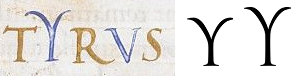
Meanwhile, Xensen and Curtis have observed (see comments) that the classical Roman Y has a curved form, much closer to the schematic tree. Below left is a calligraphic Y from a Quattrocento manuscript (by
Bartolomeo Sanvito, according to Curtis), and, right, a modern typographical imitation of the monumental Roman Y, courtesy of Xensen:
Finally, the tree as a metaphor for division is a common enough trope, from the
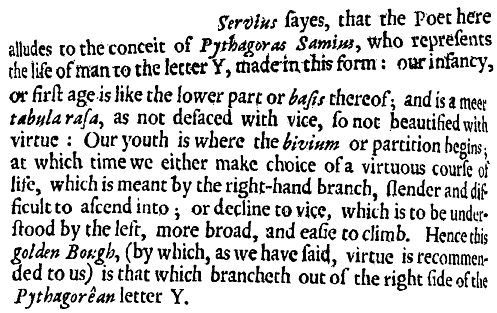
Tree of Porphyry to the tree-diagrams of modern linguistics. So in purely formal terms, Servius' reading of Vergil is not so bizarre after all. It was, furthermore, enormously influential: the reading would be repeated by Bernard Silvestris (c. 1150), Cristoforo Landino (1473), Josse Bade (1500), Jacobus Pontanus (1599) and John Boys (1660). Boys, a Royalist propagandist from York who composed the first English
Aeneid commentary, expressed the Servian reading in these terms:
Boys was also the first
Aeneid commentator to cite the pseudo-Vergilian epigram I quoted earlier—as he puts it, Vergil 'is the best expositor of his own sense'. He therefore quotes the first seven lines (his text is slightly different), and provides a doggerel translation:
Pythagoras his forked letter does
Of humane life a scheme to us propose;
For virtues path on the right hand doth lye,
An hard ascent presenting to the eye;
But on the top with rest the wearied are
Refresh'd : the broad way easier doth appear;
But from its summit the deluded fall
And (dash'd 'mongst rocks) finde there a funerall.
*
A. Are there any graphic representations of the
littera?
M. There are. It was in the Renaissance that the cultural capital of the ancient world was fully revivified, both in text and in image. Raminagrobis tells me that a (reversed) woodcut of the Y crops up in Josse Bade's
Sylvae Morales, and he's provided a photograph of a sketch of Bade's Y
here. (Plato would have been none too happy about relying on an image of an image of an image of an image of an image of an image of an image of an image—but what the hell.) This, curiously, as well as having the branches reversed, is a lowercase letter (see comments, below). The next image I can locate is from Geoffroy Tory's 1529
Champ Fleury, a treatise on divine proportion and typography, on classical mythography and the mystical arts of language. It is a most arresting work, full of unexpected wealths: Rabelais would find in the work his
escholier Limousin, l'escorcheur de Latin. A bibliophile's edition was produced in 1927 by the Grolier Club, designed by the legendary
Bruce Rogers. You'll pay
hundreds of dollars for a copy. In my possession is a Dover facsimile of it, though even that is rare. Tory treats each of the letters in turn, and the
Y grec is penultimate. It is to be constructed thus: 'as broad at the head as it is high, & the foot is of the exact breadth of the foot of the said I [ie. its trunk]'. The letter was invented by Pythagoras, to represent the broad path of Pleasure, and the narrow path of Virtue. 'Vergil's' epigram is quoted. Then he offers an image of the Y, suggesting that the reader meditate upon it, as a buckler against evil:

From the left branch of the Y hang scimitar, scourge, rods, gibbet and fire—instruments of torture—from the right hang laurel wreath, palms, sceptre and crown. The moral paths are reproduced in typographic form, the left branch broad, the right branch narrow. Thus, with allegory, Tory generates the shape of the classic Roman serifed Y. Compare modern renderings, all of which have a narrow right branch:

Times New Roman, Palatino Linotype, Georgia
One might expect the Y to be a common image in the emblem-books so beloved of the age. A cursory perusal of the most important of these, Alciati's
Emblemata, turned up many trees but no Y. Nonetheless, I would be surprised if there were no material here, and perhaps Mr. H. of
Giornale Nuovo will come to our aid. In the meantime, this rather skewed and rococo version from the Giornale, by
Theodor de Bry (1595):

The armaments of the left branch seem to symbolise military valour more than vice, while the meanings of parrot, fish and lobster remain obscure to me.
Update: my further conclusions on this image
here.
*
We find in the Pythagorean Y two things: an aesthetic delight in binaries or complementaries, and an ethical attempt to associate virtue with hardship—and it is only by making virtue difficult that the professional moralist asserts his central value in society. If it were acceptable to follow the road of delights and pleasure, what need would a man have for authority?
Modern structuralism, with its rage for order, embraces the dualisms embodied in the Y; post-structuralism, with its love of playful

chaos, seeks to expose or invent the instability implicit in such images. Thus the structuralist focuses on aesthetic delight, the post-structuralist on the manipulation of authority. These systems of thought, like the Y itself, diverge irrevocably; but which among us are headed for vice, and which for virtue? Myself, I am left-handed. Our age has quieted its superstition on the matter. Riddled with half-digested Eastern tropes and characters, we are inclined to speak of truth as a harmony of opposites: of left and right, odd and even, finite and infinite, light and darkness. We talk of thesis, antithesis, synthesis. Has the three conquered the two? Or is the three truly the one, duality resolved in unity? Have we come to understand the Y as turned on its head—wisdom and virtue not as
discernment, as the sorting of wheat from chaff, but as a holism, a confluence of diverse paths?
[
Update 15/02/09: For those who read Turkish—not me, I'm afraid—C. Cengiz Çevik has a
post on the Pythagorean Y on his own blog.]


 laughter, but only of smiling? I propose surrisible (sub-ridere, 'to smile', whence the nonce-words subride and subrident—but surrisible is more natural English, following surrogate (sub-rogare), surreptitious (sub-repticius), etc.). We can all think of examples of surrisible things. If I absentmindedly confused shaving-foam for deodorant in a blearyeyed morning, Mrs. Roth would think it risible, but to you, it would probably be only surrisible. Likewise, we find surrisible a freshman paper marked by my wife, casually claiming that the man behind the bar in Manet's Folies-Bergère (right) is in fact Jack the Ripper. We had no idea what would lead someone to such a conclusion: the date's almost right (painting—1882, Jack's spree–1888), but the country is off and in any event it's completely nonsensical. We now know, it turns out,
  the perils of not properly reading what you find online. Idly browsing the Wikipedia


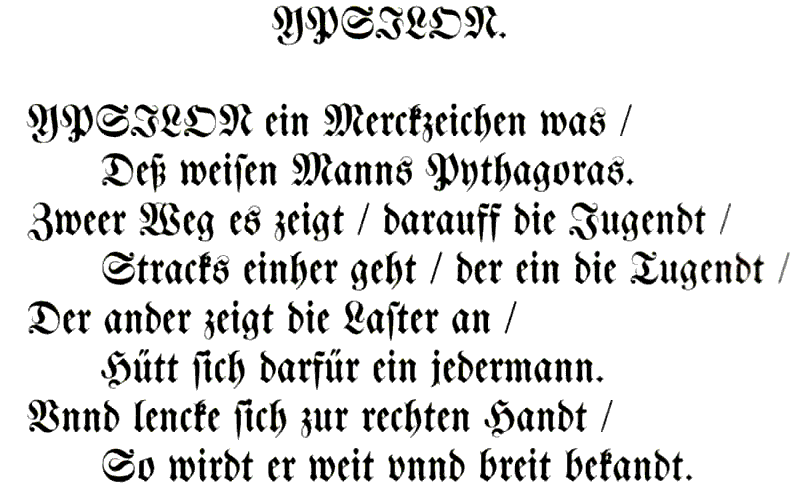
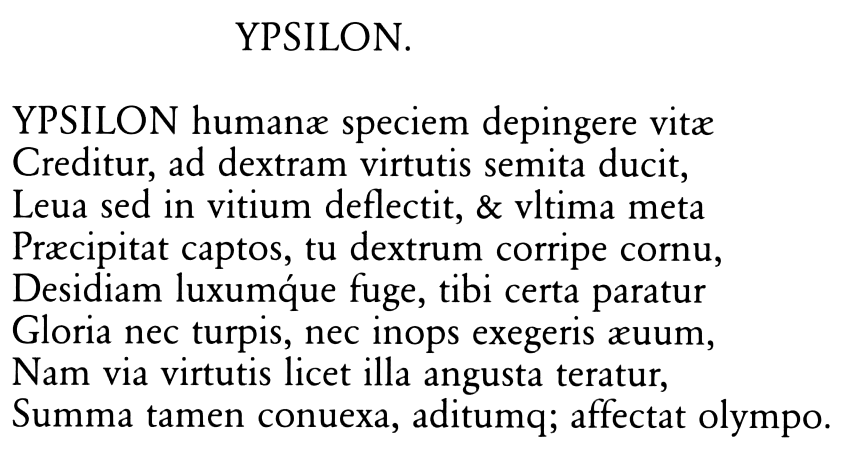


 chaos, seeks to expose or invent the instability implicit in such images. Thus the structuralist focuses on aesthetic delight, the post-structuralist on the manipulation of authority. These systems of thought, like the Y itself, diverge irrevocably; but which among us are headed for vice, and which for virtue? Myself, I am left-handed. Our age has quieted its superstition on the matter. Riddled with half-digested Eastern tropes and characters, we are inclined to speak of truth as a harmony of opposites: of left and right, odd and even, finite and infinite, light and darkness. We talk of thesis, antithesis, synthesis. Has the three conquered the two? Or is the three truly the one, duality resolved in unity? Have we come to understand the Y as turned on its head—wisdom and virtue not as discernment, as the sorting of wheat from chaff, but as a holism, a confluence of diverse paths?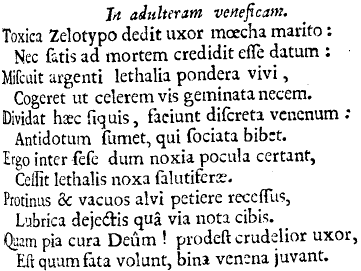
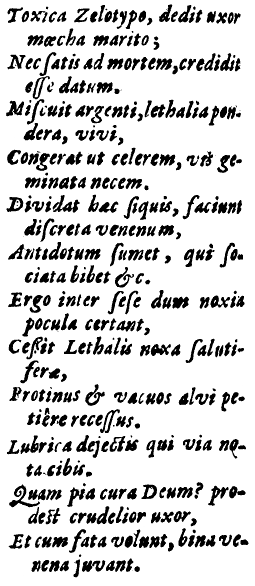 Thus, he concludes, 'one poison expels and prevailes against another'. Peacham's text, we note, is slightly different. Leaving aside the ligatured cessit, and the rewired punctuation (especially in the penultimate line), he 1. substitutes congerat for cogeret—the two words mean much the same—2. et for est, and 3. cum for quam. The